

Understanding Skincare Ingredient Compatibility: What to Mix
Retinoids and exfoliating acids are often better used at different times. Stabilized formulas can pair vitamin C with niacinamide, while hyaluronic acid can complement many active ingredients.
Understanding skincare ingredient compatibility means considering the ingredients, their formulas, and how your skin responds before deciding what to combine or use separately.
Key Takeaways
- Assess the formula and each active’s preferences, not just ingredient names, before layering products.
- Separating certain actives between morning and evening can help support a more comfortable, balanced routine.
- Hyaluronic acid can complement active ingredients, while the product’s formula and how you apply it shape the experience.
- Use ingredient-pair checks to spot combinations that may need different timing or a gradual introduction.
- Learn how molecular weight and moisture-binding ingredients influence the way a hyaluronic acid serum hydrates.
What Skincare Ingredient Combinations can you mix and what must be avoided?
Vitamin C, niacinamide, and hyaluronic acid commonly work well together, but retinoids and exfoliating acids can be harder to layer. Redness, itching, burning, or swelling after applying a product may signal irritation or an allergic reaction.
Vitamin C, Retinoid, and Acid Compatibility
Compatibility describes how ingredients interact within a formula or skincare routine, including whether they remain effective and feel comfortable on skin. It matters because combining active ingredients can affect how a routine feels and works.
Retinoids such as retinol and exfoliating acids such as glycolic or salicylic acid may increase irritation, dryness, or skin-barrier disruption when used together. Alternating them between routines, or reducing the concentration of one or both, may make the combination gentler. Vitamin C and AHAs or BHAs are also often better used separately, as pH differences may affect stability or performance. A morning-and-evening split is one practical option.
L-ascorbic acid, a form of vitamin C, needs a pH of 3.5-4 to remain stable and penetrate skin. Niacinamide is stable across pH 4-7, so a single formula must balance differing preferences. A combined vitamin C and niacinamide formula may use pH 3.8-4. Separate products can also be layered, with 10-15 minutes between them sometimes recommended when their pH ranges differ.
Niacinamide and Glycolic Acid Concentrations
A functional concentration is an amount of an ingredient used to serve a particular role in a skincare formula. Understanding concentration helps you compare products instead of relying only on an ingredient’s name on the label.
Niacinamide is generally functional at concentrations of 2% or higher, while glycolic acid is described as effective at 5% or higher. These figures don’t mean a higher concentration is automatically a better match for your routine. Glycolic acid is an exfoliating AHA, so pairing it with retinol can add to the routine’s overall exfoliating effect. Consider the other active ingredients in your products before layering them.
Niacinamide Pairings with Other Actives
Niacinamide works with many skincare ingredients, making it a flexible choice for routines that include other actives. It can pair with hyaluronic acid, which helps attract and retain moisture, while niacinamide supports sebum regulation.
Niacinamide and vitamin C are generally compatible in modern stabilized skincare formats. Their different pH preferences may matter in one formula, but they can still appear together in a thoughtfully balanced product. Niacinamide also pairs well with retinol, and it may help reduce retinol-related irritation. For salicylic acid followed by niacinamide, one suggested approach is to wait 20-30 minutes between applications, allowing time before adding the next layer.
Signs of Irritation or Allergic Reaction
Irritation is an uncomfortable skin response, while an allergic reaction may involve an itchy rash or swelling. Noticing changes after applying an active can help you decide whether a product combination feels comfortable.
For example, persistent burning, redness, or unusual dryness after layering retinol with glycolic acid may mean the routine is too intense. Itching, raised bumps, or swelling after applying a product may indicate a different kind of reaction. Note which products you used and when symptoms appeared. Introducing one new active at a time makes it easier to identify which product may be associated with a change, rather than guessing among several new layers.
What are the most important active ingredients to look for in a serum?
Choose serum actives by their role, formula, and place in your routine, not popularity alone. How products layer can affect comfort and performance.
Wait about 30-60 seconds between serum layers; that’s generally enough for most products. Skin type and sensitivity affect how a combined routine feels, while formula texture and delivery also shape compatibility. Moisturizer can follow serums, and sunscreen belongs at the end of your morning routine.
PH Effects on Active Ingredients
pH compatibility describes whether a formula’s acidity suits the active ingredients it contains. This matters because actives can perform differently across pH environments. Retinoids are more stable at pH 5-6, while AHAs such as glycolic and lactic acid work best at pH 3-4. Those ranges can help you decide which products belong in separate routines.
For example, you might use an exfoliating acid in one routine and a retinoid in another. This keeps each active in a routine suited to its function, without stacking several potent steps together.
Formulation and Active Delivery
Formulation is the way ingredients are combined and delivered in a finished product. It matters because ingredients with different solubility profiles may separate or perform poorly without a suitable emulsifier or delivery system. Emulsifiers help keep oil and water blended in lotions and creams.
A serum’s full ingredient blend, texture, and pH all affect how it layers. A formula containing several actives may behave differently from those ingredients in separate products. Check the product’s intended use and directions before adding it to your existing routine.
Not every pair needs to be separated. Of 49 documented skincare active-ingredient pairs in the SYNC table, 31 are listed as usable in the same routine. Six call for a slow start, and 12 are usually applied at different times. These comparisons show why you should assess each pair rather than assume all actives either mix or conflict.
Moisturizer and sunscreen also determine the order of a morning routine. Apply serum first, moisturizer next, and sunscreen as the final layer. Antioxidant serums such as vitamin C can go beneath sunscreen, but they don’t replace sun protection. When using AHAs, daily morning sunscreen is advised because exfoliation can increase sun sensitivity.
Build gradually: add one new active, keep the rest of your routine familiar, and note how your skin feels. This gives you a clearer way to assess a formula’s place in your regimen. For serum options, explore microneedling serums.
How does ingredient compatibility affect what you should use together?
Compatibility affects more than whether two ingredients can share a routine. It also shapes how you introduce products, arrange layers, and interpret changes in your skin’s comfort.
Retinol Pairing with Hyaluronic Acid
When planning a routine with retinol and a hyaluronic acid product, consider each product’s texture and directions. This can help you fit both into your existing steps without treating them as interchangeable.
For example, a lightweight serum can go before a richer moisturizer, while a cream may already contain hydrating ingredients. Check the label to see whether your moisturizer contains hyaluronic acid, so you can avoid unnecessary layers. Keep your routine simple as you introduce retinol, and note how your skin feels after each application.
Retinol use is usually increased gradually rather than started nightly. The suggested introduction is 2 nights per week for the first 2-3 weeks, then a gradual increase toward nightly use over 8-12 weeks. These intervals give you a clear way to pace the routine and observe how your skin responds before changing frequency.
Retinol Conflicts with Benzoyl Peroxide and Acids
Benzoyl peroxide can degrade retinoids through oxidation, potentially reducing retinol’s potency. This is a compatibility issue at the ingredient level, not simply a question of whether your skin can tolerate multiple active layers.
Use benzoyl peroxide and retinol in separate routines rather than applying them together. For instance, use one in the morning and the other at night, following each product’s directions. Separating them helps avoid combining ingredients that may affect one another in a formula or on skin.
Choose a schedule you can follow consistently. Write down which product you apply and when, especially while introducing retinol. If you change how often you apply a product, avoid adding another new active at the same time. This makes it easier to tell which adjustment changed how your routine feels.
Moisturizer and sunscreen each have a distinct place in a routine. Use moisturizer as a supportive layer and apply sunscreen during the day. Retinol is commonly used at night, with sunscreen the next morning. Keep these steps consistent as you adjust retinol use, rather than changing several products and timings at once.
Hyaluronic acid molecular weights and hydration
Hyaluronic acid is a humectant, meaning it helps draw in moisture and bind it to the skin. A serum with multiple molecular weights may hydrate across a broader range of skin depths than one with a single weight. This helps explain why two hyaluronic acid products can feel different, even when both focus on hydration.
Hyaluronic acid can hold up to 1000 times its weight in water, and the listed optimal humectant concentration range is 0.5-2%. More is not automatically better: the full formula and surrounding routine also shape how a serum performs. Apply a hydrating serum as directed, then follow with moisturizer to support a comfortable routine.
Environment matters, too. When humidity falls below 40%, humectants alone may increase transepidermal water loss rather than supply enough moisture. Pairing a humectant with an emollient can help balance the routine. For example, glycerin attracts moisture, while squalane softens and smooths skin. Together, they offer complementary hydration and emollient functions.
For barrier support, consider more than humectants. Ceramides can help buffer retinol-related dryness when used in the same routine, while emollients soften and smooth skin. People with dry skin may find emollients useful for this reason. Antioxidants serve a different role: they help neutralize free radicals that can damage skin. A moisturizer containing ceramides and emollients can complement a serum without asking one ingredient to do every job.
Glycolic and lactic acid are alpha-hydroxy acids that exfoliate, rather than hydrate. They work best at pH 3-4, so a separate hyaluronic acid serum can add moisture to an acid-focused routine. If glycolic acid leaves your skin feeling dry or tight, avoid stacking several exfoliating products. Let hydration and exfoliation play distinct roles, and use sunscreen in the morning after an acid routine.
Texture can help you choose how to layer products. A watery hyaluronic acid serum generally goes before a richer cream, while an emollient moisturizer helps soften the finish. Plant oils above 3% may feel greasy, so the overall formula matters if you prefer a lighter feel. Check product directions and keep the sequence consistent across your routine.
Try one adjustment at a time: use a humectant serum, add moisturizer, then observe how your skin feels. If you use retinol, a ceramide-containing moisturizer can help buffer dryness. If you use glycolic or lactic acid, choose a hydrating layer that complements exfoliation without adding another acid. This approach helps you assess comfort and texture without changing several products at once.
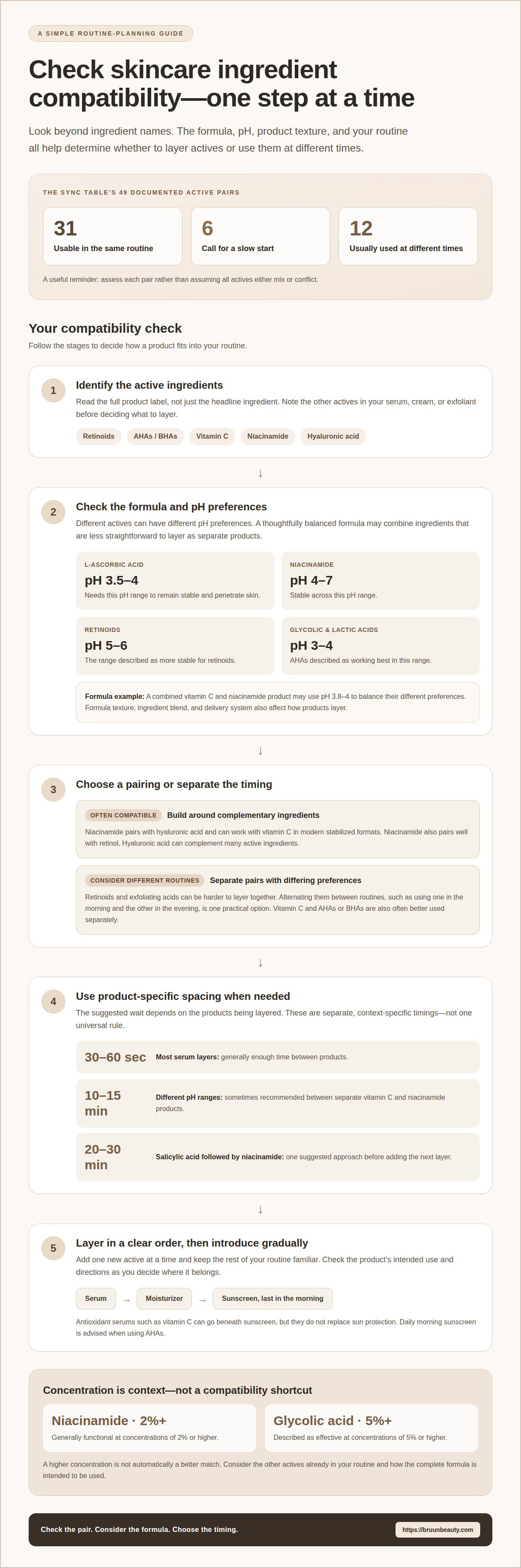
Ingredient-pair compatibility checks
A useful compatibility check looks beyond ingredient names: consider the formula, how products layer, and whether the actives suit the same routine. For example, copper peptides and low-pH acids have different formulation needs, while antioxidants can go beneath sunscreen without replacing it.
Start by comparing the active ingredients in each product, then consider their purpose and preferred conditions. Copper peptides are sensitive to low-pH environments and reactive compounds, so acids or ascorbic acid may destabilize them or reduce their effectiveness. Use those products at different times rather than layering them together. Ingredients interact as part of a complete formula, not as isolated terms on a label.
Some pairings can be useful when the formula and application make sense. Vitamin C can be paired with SPF to support antioxidant defenses alongside sun protection. Hyaluronic acid can be layered with vitamin C, and glycerin with squalane combines a humectant with an emollient. AHAs and BHAs can exfoliate the skin’s surface, but combining them at pH 3-4 increases irritation potential. A starting AHA concentration of 10% is within the stated 10% to 15% range for beginning use.
Consider how products are applied, too. Antioxidants can go under sunscreen, but they don’t replace it. Don’t mix sunscreen into foundation, primer, or other makeup, as dilution may reduce its effectiveness. Keep sunscreen as its own final morning layer rather than changing its formula. This simple distinction helps preserve its intended role in your routine.
Before adding another product, use these points to assess whether the pairing makes sense:
- Compare actives: Separate copper peptides from low-pH acids or ascorbic acid.
- Check the formula: Clay ingredients such as bentonite and kaolin may bind actives and reduce their availability.
- Consider timing: Of 49 documented active pairs, 12 are usually used at different times, while 6 call for a slow start.
- Watch the product: Separation, unexpected color or odor changes, sediment, or vitamin C browning can signal instability.
Formulators assess compatibility by monitoring stability under different temperature and humidity conditions, tracking pH over time, conducting patch tests, and checking packaging compatibility. These checks matter because an active can behave differently in a finished formula than it does on its own. In a home routine, introduce one new pairing at a time and note the products and layers used. This makes changes in comfort or appearance easier to connect with a specific combination.
For serum options that fit into a considered skincare routine, explore microneedling serums.
Bruun Beauty: Advanced Microneedling Serum SD - Control Salmon DNA Ampoule Serum
Advanced Microneedling Serum SD - Control Salmon DNA Ampoule Serum is one option to consider for a microneedling-focused skincare routine. Ingredient compatibility still matters: consider how it fits alongside the other products you use, and follow each product’s directions.
To explore the serum’s product details, visit the Salmon DNA skincare serum page. Jelly Mask Kits and BB Glow Treatment Supplies are other options for building a skincare and beauty setup around your preferences. Choose products based on the role you want each one to play, rather than layering actives simply because they’re popular.
Explore the serum and other skincare products at Bruun Beauty.
Make Your Next Skincare Choice with Confidence
Understanding skincare ingredient compatibility can help you build a routine around your priorities instead of adding products simply because they’re popular. Choose one goal, review the products you already use, and decide which ingredient role is missing. Then introduce a new product thoughtfully and pay attention to how your routine feels.
If microneedling is part of your skincare routine, Bruun Beauty offers Advanced Microneedling Serum SD - Control Salmon DNA Ampoule Serum and professional-grade microneedling tools. Jelly Mask Kits are another option for adding a mask step. Keep your choices focused on the products and experience you want, rather than trying to layer every active at once.
A considered routine can make product choices feel simpler and more personal. Keep learning, make thoughtful adjustments, and enjoy building a skincare routine that feels right for you.
Frequently Asked Questions
Skincare Ingredient Checker: Can You Mix These Together?
Compare the specific ingredients and product instructions before deciding whether to layer them. For example, hyaluronic acid and vitamin C can fit into one routine, while copper peptides and low-pH acids are better used separately. Check whether each product is intended for the same routine, calls for gradual introduction, or works best at another time. A checker that considers only ingredient names can’t account for every finished formula.
How can you tell if an active is present at a functional dose?
Look for a stated concentration, but interpret it in context. Niacinamide is generally functional at 2% or higher, and glycolic acid is described as effective at 5% or higher. Ingredient lists usually place ingredients above 1% in descending concentration; those at or below 1% can appear in any order. So, list position alone can’t reveal an exact dose.
How do you identify ingredients that support barrier function?
Look for ingredients with moisturizing or skin-softening roles, such as ceramides, glycerin, and emollients. Glycerin is a humectant, while emollients soften and smooth skin. In a leave-on product, surfactant levels at or below 1% are recommended to help preserve the skin barrier. Consider the complete formula, since ingredient names alone don’t show how a product will feel on your skin.
What Is Active Compatibility?
Active compatibility describes whether two active ingredients can work in the same routine without undermining each other’s performance or making the routine harder to tolerate. For example, niacinamide and hyaluronic acid can complement each other, while retinol and exfoliating acids may feel more comfortable at different times. Compatibility describes the pairing, not a guarantee that every combination suits every person.
What Is Formulation Compatibility and Why Does It Matter?
Formulation compatibility describes how ingredients behave together in a finished product. For instance, oil- and water-based ingredients may need an emulsifier to stay evenly combined, while clay can bind some actives and reduce their availability. A product that changes unexpectedly in color, texture, or odor may have become unstable. These clues relate to the formula itself, not simply whether two ingredient names sound compatible.
What does skincare ingredient compatibility mean?
A clear understanding of skincare ingredient compatibility means considering how ingredients interact in a formula and within your routine. Two products may work well together, but their pH, texture, and intended use still affect how you layer them. For example, a serum and moisturizer can have complementary roles, while two exfoliating products may create a more intense routine than you want.
Which skincare ingredients should not be used together?
Some combinations are better used separately than layered. Retinol with glycolic or salicylic acid may increase irritation, and benzoyl peroxide can degrade retinoids through oxidation. Copper peptides are also sensitive to acids and ascorbic acid. Use these ingredients in different routines or at different times rather than treating every pairing as an absolute prohibition. The complete product formula matters, too.
Can retinol be used with vitamin C, AHAs, or BHAs?
Retinol can fit into a routine that also includes vitamin C or exfoliating acids, but separating products by time can make layering simpler. Retinol is commonly used at night, while vitamin C can be part of a morning routine. AHAs and BHAs, such as glycolic and salicylic acid, may add irritation when layered with retinol. Keep sunscreen in your morning routine when using exfoliating acids.
Preventative Anti-Aging Skincare for Daily Skin Support
Preventative Anti-Aging Skincare for Daily Skin Support
Related Posts

PDRN Benefits for Skin: Regeneration, Results and Safety

How to Dispose of Used Microneedle Cartridges Safely

Self-care rituals for better skin through mindful daily habits

How to Explain Microneedling Benefits for Skin and Scars

How to use a Korean 10-step skincare routine for hydration

Microneedling for atrophic scars: clinic or at-home results

V-Line Lifting Masks and Their Claimed Face-Shaping Effects
