


Can You Use Peptides and Vitamin C Together? How to Layer Them
Yes, you can use peptides and vitamin C in the same skincare routine. This guide explains how to layer them, when to use each, and how to introduce active ingredients gradually.
Key Takeaways
- Layer vitamin C serum before your peptide moisturizer so each step fits smoothly into your morning routine.
- Finish your daytime skincare with sunscreen, and keep the routine simple while your skin adjusts.
- Introduce new active ingredients gradually, giving each addition time to settle before adding another.
- Peptides and vitamin C can complement each other; you don’t need to separate them solely because they’re used together.
- Learn how to adjust your routine and explore skincare options that fit your goals.
Layering Vitamin C With a Peptide Moisturizer
You can use a vitamin C serum and peptide moisturizer in one routine. The key is to layer them in a practical order and follow each product’s directions.
Peptide and Vitamin C Compatibility
Compatibility means using separate peptide and vitamin C products in one routine without assuming they cancel each other out. Keep each formula in its original packaging and apply it as a separate step. For example, use a vitamin C serum followed by a peptide moisturizer rather than blending them. Separate layers also make it easier to tell which product affects how your skin feels.
Concentration and pH Considerations
There is no universal vitamin C concentration or pH that guarantees compatibility with every peptide formula. Products differ in their ingredients and formulations, so a percentage alone cannot tell you how two specific products will layer. Follow both labels. When choosing formulas, consider their instructions and how your skin responds rather than relying on a single concentration or pH.
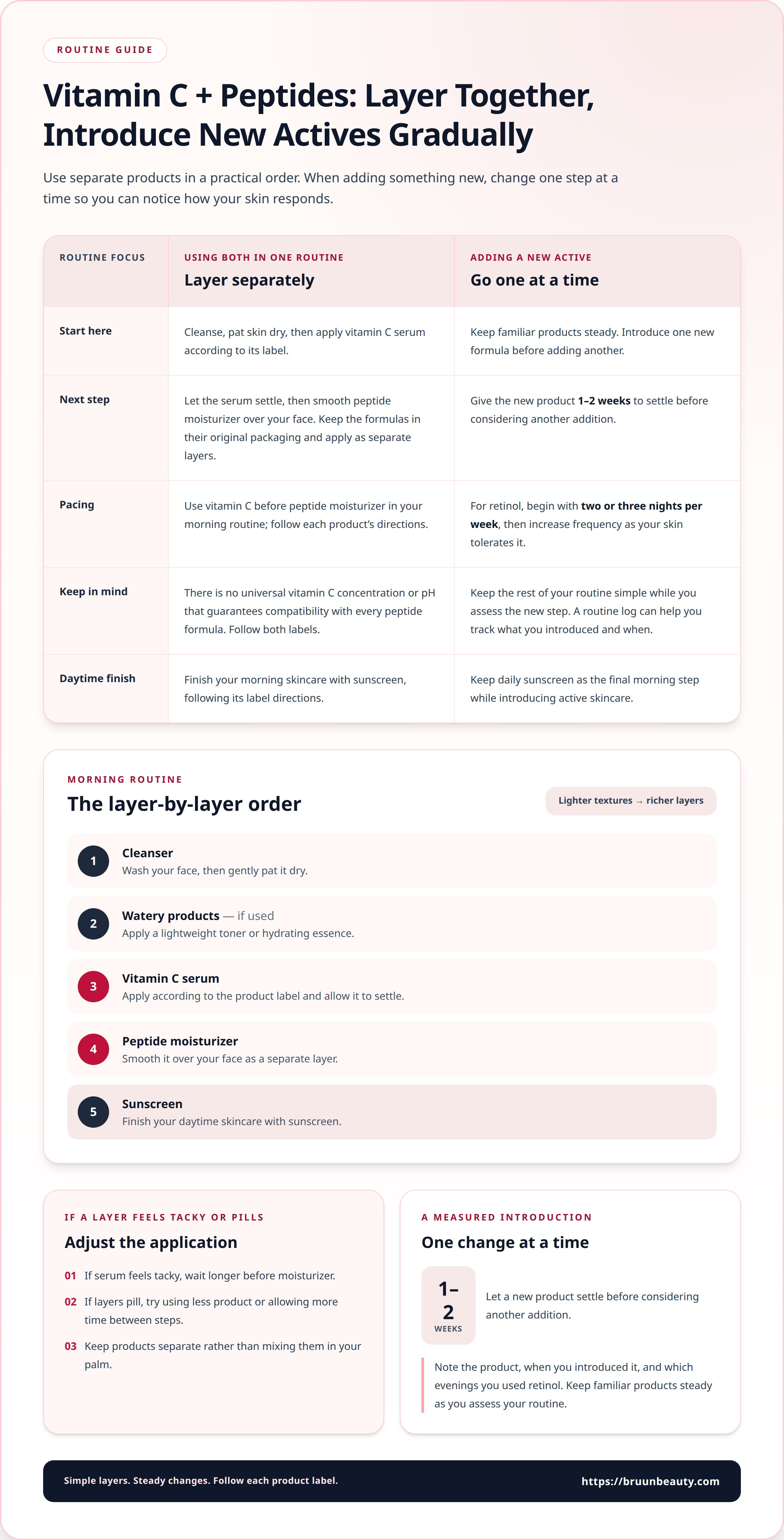
For a simple morning routine, use these steps:
- Cleanse your face and pat it dry.
- Apply vitamin C serum according to its label.
- Allow the serum to settle before applying another layer.
- Smooth peptide moisturizer over your face.
- Apply sunscreen as the final daytime skincare step.
If the serum feels tacky, wait longer before applying moisturizer. If the layers pill, try using less product or allowing more time between steps. Keep the formulas separate instead of mixing them in your palm. These adjustments help you apply each product as directed and keep your routine comfortable.
Topical skincare and oral supplements are different uses of ingredients. Using a vitamin C serum with a peptide moisturizer does not establish whether vitamin C and peptide supplements are suitable together. Follow each supplement’s directions, and ask a qualified health professional about combining supplements in your circumstances. Do not use skincare layering advice to decide how to take oral products.
If retinol is also part of your routine, treat it as another separate product rather than mixing it into vitamin C serum or peptide moisturizer. The Treatment recommends starting with retinol at 0.03% and moving to 0.05% after the skin acclimates. This recommendation concerns retinol use; it does not establish a required order for retinol, vitamin C, and peptides, or guarantee how your skin will respond. Keep the vitamin C serum and peptide moisturizer steps as described, and follow the directions for the retinol product as well.
If your routine includes retinol, pay attention to how it feels rather than assuming another active ingredient requires changing your vitamin C or moisturizer. Keep products in their original packaging and apply each as a separate step. If the layers feel uncomfortable or do not sit well, review the product directions and adjust cautiously without blending formulas. A retinol recommendation may give a starting concentration and a later concentration after acclimation, but it does not replace the directions for your specific products. For individual guidance on using these products together, ask a qualified health professional.
Introducing Active Ingredients Gradually
Introducing active ingredients one at a time makes it easier to assess your routine. If vitamin C, peptides, and retinol are all new to you, avoid starting them together. Keep familiar products steady while you introduce one formula, so you can tell which change affects your skin’s comfort.
Allow a new skincare product to settle in for 1-2 weeks before adding another. For example, introduce vitamin C first and keep your cleanser and moisturizer unchanged. After that adjustment period, add a peptide product if your routine still feels comfortable. This measured approach helps you avoid guessing which new step caused a change.
Introduce retinol gradually, too. Start with two or three nights per week, then increase frequency as your skin tolerates it. Keep the other evenings simple rather than adding exfoliating acids or harsh scrubs. Changing one variable at a time makes your routine easier to evaluate.
Use this progression as a practical guide:
- First: Keep your established routine consistent.
- Next: Add one active product and observe how your skin feels.
- After 1-2 weeks: Consider introducing another product if the first fits comfortably.
- For retinol: Begin with two or three nights per week and adjust gradually.
Daily sunscreen belongs in the morning routine when you use active skincare. Finish with SPF 40+ sunscreen, following its label directions. A morning routine might include familiar cleanser, vitamin C, moisturizer, and sunscreen. Keeping sunscreen consistent gives your routine a clear final step, even as you introduce products at a slower pace.
If your skin feels uncomfortable after adding a formula, pause that newest step and return to familiar products. Do not respond by adding more active ingredients or scrubbing. Once your skin feels settled, reconsider whether and how to reintroduce the product. If you also use retinol, avoid exfoliating acids and harsh scrubs on the same day as vitamin C and retinol.
A simple routine log can help you track changes. Note the product, when you introduced it, and which evenings you used retinol. If you notice discomfort, these details can help you connect it to a specific step instead of restarting your entire routine. Add products deliberately, and let your skin’s comfort guide the pace.
Product Application Order
For daytime, apply products from lighter textures to richer ones. This places a watery vitamin C serum under a peptide moisturizer and sunscreen.
- Cleanser: Wash your face, then gently pat it dry.
- Watery products: Apply a lightweight toner or hydrating essence if you use one.
- Vitamin C serum: Smooth on the serum according to its label directions.
- Peptide moisturizer: Apply it after the serum, covering your face evenly.
- Sunscreen: Finish your morning routine with sunscreen as the final skincare layer.
Keep the order simple when using two treatment products. After cleansing, apply vitamin C, follow with your peptide moisturizer, then use sunscreen. There is no need to mix the serum and cream. Applying each as a separate layer makes it easier to use the directed amount and notice how your skin responds.
Let each layer settle before applying the next, especially if your products feel tacky. If you wear makeup, allow the moisturizer and sunscreen to form an even surface first. When layers pill, try using less product or giving each step more time to settle. Avoid repeated rubbing, which can disturb the layers beneath.
At night, the order depends on the products in your routine. Keep your nighttime routine simple, applying treatment products before moisturizer. Follow each product’s directions and introduce products gradually so you can notice how your skin responds.
For example, a simple evening routine could be cleanser followed by peptide moisturizer. If you prefer vitamin C in the morning, leave it out of this nighttime sequence. Follow each formula’s directions, since texture and instructions can affect layering. A thin serum generally goes before a cream, while sunscreen is the final step in daytime skincare.
Think of your routine as a consistent order, not a race to apply every product. Cleanse first, apply treatment products before moisturizer, and finish daytime skincare with sunscreen. This gives vitamin C and peptides distinct places in your routine without adding unnecessary layers.
Do Peptides and Vitamin C Cancel Each Other Out or Reduce Effectiveness?
No, peptides and vitamin C do not inherently cancel each other out in the same skincare routine. You can apply a vitamin C serum, then follow it with a peptide moisturizer, keeping each product in a separate layer. This lets both ingredients have a place in your routine without mixing formulas.
Vitamin C is commonly used during the day as an antioxidant associated with brightness and collagen. Peptides can fit into a morning routine through a moisturizer that supports hydration and the skin barrier. For example, apply vitamin C before a peptide cream, then finish with sunscreen.
Compatibility concerns often come from comparing ingredient lists or hearing that active ingredients should never be combined. But having both ingredients in one routine does not automatically mean one makes the other ineffective. Formulas vary, so follow each label’s directions and pay attention to how the complete routine feels on your skin.
- Keep formulas separate: Apply each product as its own layer instead of blending them together.
- Follow product directions: Use the amount and method listed on each label.
- Use a simple sequence: Apply vitamin C serum, peptide moisturizer, then daytime sunscreen.
You do not need to move peptides to nighttime just because you use vitamin C in the morning. One practical option is vitamin C followed by peptides during the day. Alternatively, use a peptide moisturizer at night and reserve vitamin C for morning. Choose a schedule that is easy to maintain.
What matters most is how the full routine works for you, not simply whether two ingredient names appear together. If a new combination feels uncomfortable, simplify your steps and introduce products individually. This makes it easier to identify which product or layering choice may be contributing. Avoid starting several unfamiliar actives at once, since that makes your skin’s response harder to interpret.
Should You Use Vitamin C and Peptides at Different Times of Day?
You do not need to separate vitamin C and peptides by time of day. Vitamin C fits naturally into a daytime routine, and a peptide moisturizer can follow it or be used at night. Choose a schedule that keeps your skincare consistent and comfortable.
In the morning, vitamin C serves as a daytime antioxidant that supports brightness and collagen. Peptides can also fit into morning skincare as part of your routine. For example, apply vitamin C after cleansing, layer on peptide moisturizer, then finish with SPF 40+ sunscreen.
This gives both products a clear place without adding steps. For a shorter routine, use vitamin C and sunscreen in the morning, then apply your peptide moisturizer at night. Separating them may simplify your routine, but it is not necessary just because the ingredients are paired.
Use these examples to choose a schedule that suits your preferences:
- Both in the morning: Cleanse, apply vitamin C, use peptide moisturizer, then apply SPF 40+ sunscreen.
- Split between morning and night: Use vitamin C before daytime sunscreen, then apply peptide moisturizer during your evening routine.
- Peptides twice daily: Use a peptide moisturizer morning and night, with vitamin C in the morning if it suits your routine.
If retinol is also part of your routine, keep it for nighttime. You can include a peptide moisturizer in the same evening routine, either before or after retinol, based on your preferred order. Vitamin C can remain in your morning routine, paired with sunscreen.
Timing can also help you identify which step feels uncomfortable. When introducing a new vitamin C serum, keep your peptide moisturizer familiar rather than changing both products at once. Once the serum is established in your routine, decide whether you prefer layering both in the morning or using peptides at night.
The best schedule is the one you can follow consistently. Keep vitamin C in the daytime if you want its antioxidant role there, use peptides in the morning or evening, and make SPF 40+ sunscreen your final morning skincare step. If your routine includes retinol, place it at night and adjust its frequency gradually.
Bruun Beauty
Bruun Beauty offers skincare products and treatment supplies for people building thoughtful routines at home or in professional settings. Once you understand how to layer vitamin C and peptides, choose products that suit your broader skincare goals and follow each formula’s directions.
The Advanced Microneedling Serum SD - Control Salmon DNA Ampoule Serum is one product in Bruun Beauty’s skincare range. It is a distinct product, not a substitute for a vitamin C serum or peptide moisturizer. Keep ingredient roles clear, and do not assume a product contains vitamin C or peptides unless its label says so.
Bruun Beauty also offers Jelly Mask Kits and BB Glow Treatment Supplies. These products are suited to different skincare and treatment routines, so choose based on what you want to add. If you are focused on daily ingredient layering, keep your vitamin C and peptide steps separate from other treatment supplies.
For licensed estheticians and spa or clinic owners, product selection starts with the intended routine and each formula’s directions. The same principle applies at home: identify what each product is designed for, then avoid adding several unfamiliar products at once. This keeps your routine easier to understand and adjust.
As you compare options, consider practical questions such as:
- What role does the product have? Separate daily skincare from treatment supplies.
- How will it fit? Keep your vitamin C serum and peptide moisturizer in their established routine order.
- What do the directions say? Follow the product’s own instructions rather than assuming every formula layers alike.
Bruun Beauty’s products let you explore skincare and treatment supplies beyond the two ingredients in this guide. They do not replace a well-ordered daily routine, and each product should be used as directed. This distinction helps you choose confidently without treating every skincare item as interchangeable.
Contact Bruun Beauty to discuss which skincare products and treatment supplies suit your routine.
Frequently Asked Questions
Can you use peptide skincare and vitamin C in the same routine?
Yes, you can use peptide skincare and vitamin C in the same routine. For example, pair a vitamin C serum with a peptide product, then finish your daytime routine with sunscreen. Keep the formulas in separate layers rather than mixing them. If either product is new to you, introduce it on its own first so you can tell how it suits your routine.
What order should you apply vitamin C and peptide serum?
When both products have similarly light textures, apply vitamin C serum before peptide serum. Then use moisturizer, followed by sunscreen in the morning. If your peptide product is a cream and vitamin C is a watery serum, serum first is a straightforward order. Follow any specific layering instructions, since product texture and label directions matter more than ingredient names alone.
Can you layer copper peptides with vitamin C?
Whether copper peptides suit a particular vitamin C formula depends on the products’ formulations and directions. Do not combine them in your hand or container. If you want to use both, apply them in separate steps or use one in the morning and the other in the evening. Introducing them separately makes it easier to see how your skin responds.
What are the risks or irritation signs when combining vitamin C and peptides?
Pay attention to persistent stinging, redness, tightness, or dryness after adding a product. These signs do not prove the ingredients are incompatible, but they may indicate that your routine needs simplifying. Pause the newest addition and return to familiar products. Avoid exfoliating acids or harsh scrubs on the same day as vitamin C and retinol, since too many active steps may overwhelm your routine.
How should sensitive skin introduce vitamin C and peptides together?
Introduce one product at a time, leaving your other skincare unchanged. Start with the product you’re most interested in, then allow 1-2 weeks before adding the second. For example, try a peptide moisturizer first, then add vitamin C serum later. Keep the rest of your routine gentle and familiar, and use sunscreen each morning while you assess the new steps.
What do dermatologists recommend about combining peptides and vitamin C?
There is no single routine that suits every formula or skin type. Follow each product’s directions, apply separate formulas in layers, and introduce new products gradually. For example, use vitamin C in the morning and peptides in the evening. If you have ongoing skin concerns or persistent irritation, seek advice from a qualified skincare professional.
Related Posts

Microneedling for Beard Growth: Choosing Needles and Frequency

RF vs microneedling for skin tightening: Which suits your skin

Do Chin Sculpting Masks Work for a More Defined Jawline?

Can You Microneedle Your Lips, and How Long Do Results Last?

How Often Can You Use a Hydrojelly Mask? Set a Routine

Skin Purging After Microneedling: How Long Does It Last
