


Microneedling for Beard Growth: Choosing Needles and Frequency
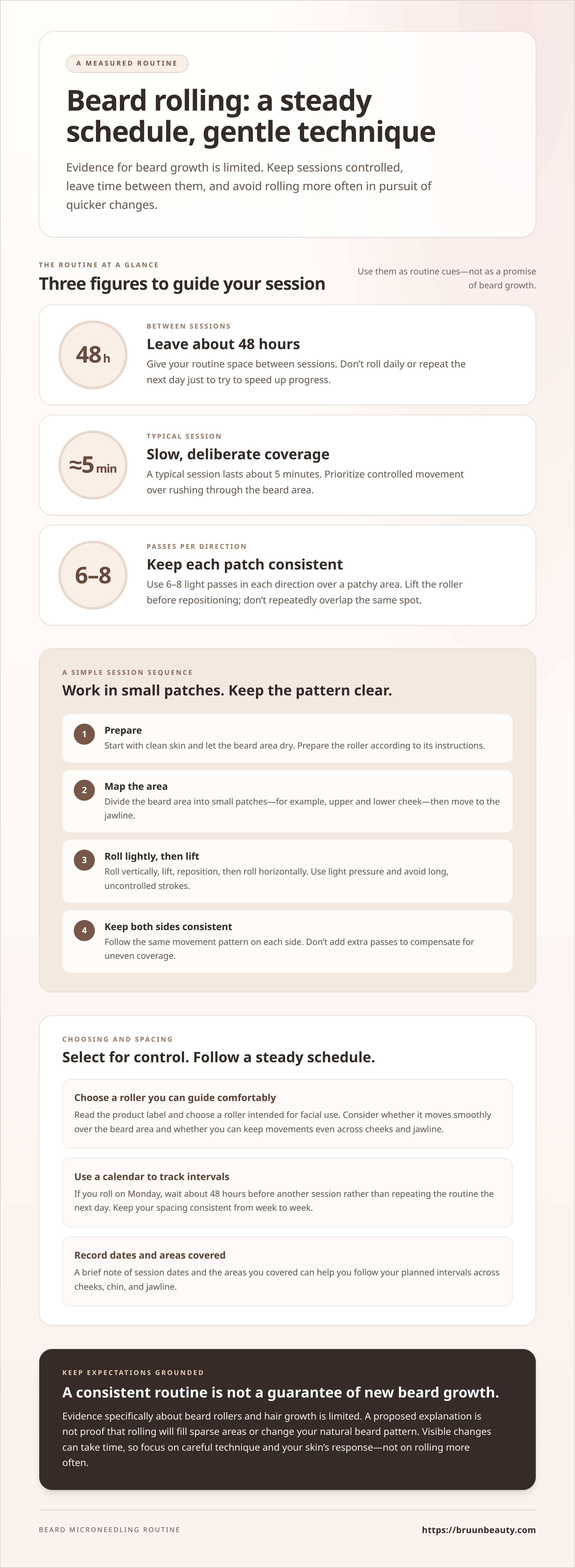
More rolling doesn’t necessarily mean more beard growth. Evidence for microneedling for beard growth is limited, so a careful approach matters: use a conservative needle size and leave about 48 hours between sessions rather than rolling daily.
It’s understandable to want a simple routine when beard coverage looks uneven. This guide explains what is known about microneedling for beard growth, how needle size and session spacing factor into a routine, and how to use light, even rolling movements without repeatedly working the same patch.
You’ll also learn how to keep your microneedling routine focused on cosmetic skincare and why visible changes can take time. The aim is a practical routine guided by your skin’s response, not pressure to roll more often.
Key Takeaways
- Prepare clean skin and use light, even rolling motions rather than pressing hard or repeatedly covering the same patch.
- Build your schedule around recovery time between sessions; rolling more often can irritate skin.
- Choose a roller that suits your experience and routine, and keep your technique consistent across patchy areas.
- Evidence for beard growth is limited, so treat changes as gradual and avoid expecting a quick transformation.
- Explore microneedling skincare options, including BRÜUN’s Advanced Microneedling Serum SD - Control Salmon DNA Ampoule Serum.
Skin Preparation and Rolling Technique for Beard Microneedling
Careful preparation and light, consistent movements help keep a beard-rolling routine controlled. Focus on clean skin, a clean roller, and even coverage rather than pressing harder or repeatedly covering one patch.
Preparing Skin and Using the Roller
Before a session, clear the beard area and prepare the roller according to its instructions. This gives you a consistent surface to work over and helps keep your routine organized.
Start with clean skin, then let the beard area dry before rolling. Clean the roller after each use, and replace it every few months. Before use, soak it in rubbing alcohol for at least 10 minutes; 70% isopropyl alcohol is one recommended option for cleaning.
Work in small patches so you can keep track of coverage. For example, divide a cheek into upper and lower areas, then move to the jawline. Keep the roller aligned with each patch instead of dragging it across the beard area in long, uncontrolled strokes.
Rolling Technique
Rolling technique refers to the pattern and pressure you use on each patch. A steady pattern helps prevent concentrating your effort in one spot.
Use light pressure, letting the roller move across the skin without forceful pushing. Make 6-8 passes in each direction over each patchy area, then lift the roller before repositioning it. Avoid repeatedly overlapping the same area during one session. A typical session lasts about 5 minutes, so slow, deliberate coverage is more useful than rushing.
Keep each stroke distinct: roll vertically, lift, reposition, then roll horizontally. If you start with the left cheek, follow the same pattern on the right. This sequence helps distribute passes evenly across the cheeks, jawline, and sideburns.
For a closer look at tools and supplies for this routine, browse the microneedling collection. Keep the session focused on the beard area you intend to cover, and avoid extending each pass across neighboring skin without a reason.
Sensitivity can vary across the face, so use light pressure and notice how each area feels during the session. If one patch feels more sensitive, don’t press harder to match the sensation. Keep movements gentle and consistent, and avoid extra passes to compensate for uneven coverage.
Derma Roller Needle Selection and Frequency
Choose a roller based on its intended use, construction, and fit with your routine. For beard microneedling, spacing matters as much as the tool: give skin time between sessions instead of rolling daily.
Derma Roller Needle Sizes
Needle size is the length stated for a roller, so read the product label before choosing. The label helps you compare tools, but it isn’t an instruction to press to a particular depth. At-home rollers generally have shorter, blunter needles than those used by dermatologists.
Check that the roller is intended for facial use and that its head moves smoothly over the beard area. A commonly described roller design has 192 needles arranged in eight rows. The needle count alone doesn’t establish the best choice; consider the tool’s stated use and whether you can control it comfortably across cheeks and jawline.
Choose a tool you can guide with steady, even movements over the areas you plan to cover. A roller that catches on coarse beard hair, for example, may be harder to control than one that moves smoothly over skin. Keep beard hair trimmed enough for consistent skin contact, and follow the device’s instructions. For broader tips on managing hair texture and daily grooming, guides from Wavy Beard Maven can help you learn how to train and maintain your facial hair.
Derma Roller Treatment Frequency
Treatment frequency means how much time you leave between rolling sessions. Spacing gives your skin time between treatments and helps you avoid an overly frequent routine.
Choose a schedule that gives your skin time to recover between beard microneedling sessions. Don’t use a roller daily or add sessions simply because you want quicker progress. If you choose a roller with shorter needles, those tools can be used more often than larger-needle rollers, but more frequent use still needs thoughtful spacing.
Use a calendar to make the schedule clear. For example, if you roll on Monday, wait about 48 hours before another session, rather than repeating the routine the next day. Keep the same spacing from week to week, and adjust your routine if your skin hasn’t had enough time to recover.
Consistency means following a steady schedule, not increasing frequency whenever you notice patchy areas. Keep a brief record of session dates and areas covered. This makes it easier to follow your planned intervals, especially when coverage differs across the cheeks, chin, and jawline.
How Microneedling May Affect Beard Growth
Microneedling may be worth exploring, but evidence specifically about beard rollers and hair growth is limited. Interest in microneedling for beard growth often stems from the idea that controlled skin stimulation could affect processes near hair follicles. That proposed mechanism does not prove that rolling fills sparse cheeks or changes your natural beard pattern.
Facial hair can vary across the cheeks, jawline, and chin. A roller can’t guarantee even coverage, and a cosmetic routine shouldn’t be treated as a promise of new hairs. With microneedling for beard growth, distinguish a possible explanation from a demonstrated outcome.
In the United States, the cost of professional microneedling depends on location, treatment area, session format, and included services. These factors affect the price of a beard appointment, so compare what each session covers rather than assuming all professional treatments have the same scope or cost.
Research on scalp hair also needs careful interpretation. A scalp trial examined a topical hair-growth approach alone and alongside weekly microneedling, then measured new hair growth after 12 weeks. That result concerns scalp hair; it doesn’t establish that the same combination produces similar changes on the beard area.
Keep research findings separate from what you observe in your own routine. A photo can look fuller because of longer hair, different lighting, or a changed camera angle. Compare the same cheek under similar grooming and lighting conditions, rather than comparing a close-up with a full-face image.
Track each area individually. Note the cheeks separately from the chin and jawline, since coverage can differ across the face. A specific observation, such as “the right cheek looks denser,” is more useful than a general impression that your whole beard has changed.
Keep your routine consistent while observing changes. If you change your roller, schedule, grooming habits, and other products all at once, it becomes difficult to tell what came before a visible difference. Recording session dates and routine changes can make later comparisons clearer.
Overall, evidence specific to beards remains limited, and a roller can’t promise fuller facial hair. Treat microneedling as a cosmetic practice with uncertain beard-growth outcomes. Focus on careful use and observation rather than assuming that findings about scalp hair or a short-term change predict your results.
How Long Does Microneedling Take to Show Beard Growth Results?
Beard changes take time to assess, and early observations are not a reliable forecast. Case reports described thicker cheek coverage after 8-12 weeks of rolling twice weekly alongside topical products. That timeframe is a reference from those reports, not a promise that every person will notice the same change.
The timeline for microneedling for beard growth is hard to assess because “a change” might mean a few visible hairs or a difference in overall coverage. Some accounts describe possible changes within a few weeks, while improvements may take several weeks to months to become noticeable. These observations don’t establish a predictable schedule.
Consistent photos make comparisons more useful. Take a baseline image, then repeat it every few weeks with similar lighting, camera distance, and angle. Compare the same cheek in both photos, for example, rather than a close-up with a full-face image. Keep grooming length similar, since longer hairs can make an area look denser.
Separate changes in appearance from changes in your routine. Trimming, growing your beard longer, or changing the light can affect how much coverage you see. If you take a photo after trimming, use a similar beard length in later comparisons. Otherwise, it may be difficult to tell whether you’re seeing a real difference or simply longer hair.
Record session dates alongside each comparison. A calendar can show whether your routine stayed consistent during the 8-12-week period described in early case reports. It can also help explain why two photos may look different if sessions were irregular or grooming changed between them.
Make notes by facial area rather than judging your beard as a whole. Describe the left cheek, right cheek, and chin separately, for example. “More visible hairs near the jawline” gives you a clearer comparison point than a general impression that your beard looks fuller.
When tracking microneedling for beard growth, look for patterns across repeated comparisons instead of drawing conclusions from one photo. Changes may take several weeks to months to become noticeable, and grooming and lighting can alter appearance. Keep your records consistent so you can assess what you actually see over time.
Microneedling may show positive results in beard growth within a few weeks, but treat this possibility as an early observation, not a deadline. A first visual difference doesn’t show how much coverage may change or whether the appearance will last. Repeatedly comparing the same facial areas can help prevent one noticeable patch from dominating your overall impression.
Interpret each comparison in context: matching light, angle, distance, and beard length helps limit changes caused by photography or grooming. If a difference appears early, note where it is and use the same approach for later photos instead of treating that comparison as a final result. If no clear difference appears after a few weeks, that alone doesn’t rule out later change. Look for a pattern across consistent observations, while remembering that timing can vary.
Bruun Beauty
Bruun Beauty offers skincare products that can complement a considered microneedling routine. A serum or mask can have a place in facial skincare, but it can’t promise fuller beard coverage or replace consistent technique. Choose products for their skincare purpose, and assess beard appearance separately.
The Advanced Microneedling Serum SD - Control Salmon DNA Ampoule Serum is a topical cosmetic serum. “For external use only” means it is applied to the outside of the body, not injected. These ampoules are made to be used with microneedling pens and derma rollers. They are NOT injectable. This product is intended for cosmetic skincare use only. It is not intended to replace qualified medical diagnosis or treatment and is not intended to diagnose, treat, cure, or prevent any disease.
Jelly Mask Kits offer another option for facial skincare. They aren’t a beard-growth method, so choose them for skincare rather than as a way to change beard density. This distinction helps you select products that suit your routine without confusing facial care with a hair-growth outcome.
BB Glow Treatment Supplies are another complexion-focused option, not a beard-growth solution. Choosing products for their intended purpose helps you focus on your priorities, whether you’re selecting facial skincare or observing beard coverage over time.
For licensed estheticians and spa owners, product selection can complement an existing skincare approach. At home, a straightforward routine may be easier to follow consistently. In either setting, keep expectations clear: skincare products support skincare routines, while beard-growth results remain uncertain.
Before choosing a product, identify the role you want it to play. You might choose a serum for a skincare step or a jelly mask for facial care. Matching products to their intended purpose helps avoid treating every microneedling-related item as a beard-growth aid.
Bruun Beauty offers these options for readers exploring skincare alongside a beard-care routine. Follow each product’s directions, and track beard appearance separately from skincare choices. This lets you assess your routine without assuming that a particular product caused every visible change.
If you have questions about the skincare products mentioned here, contact Bruun Beauty.
Frequently Asked Questions
Do Derma Rollers Work for Beard Growth?
Derma rollers aren’t proven to fill sparse beard areas. Evidence specific to beards is limited, so treat rolling as a cosmetic routine rather than a reliable way to change coverage. For a useful comparison, photograph the same cheek with similar lighting and grooming length. This helps distinguish a visible change from differences in hair length or camera angle.
Does microneedling stimulate beard growth, and what does the evidence show?
Current evidence doesn’t establish that microneedling stimulates beard growth. Some research examines scalp hair, but those findings don’t prove the same effect on facial hair. Distinguish a proposed explanation from a demonstrated result. If you track changes, note each beard area separately instead of judging your whole face from one impression.
How does microneedling work for facial hair growth?
Microneedling uses a roller or pen across the skin’s surface. One proposed explanation is that this stimulation may affect processes near hair follicles, but its effect on beard growth remains uncertain. Facial hair can vary across the cheeks, chin, and jaw, so the method can’t promise even coverage or a change in your natural pattern.
What microneedle depth and device are used for beard growth?
There isn’t one established needle depth for beard growth. Choose a device for its stated use and follow its instructions rather than assuming a deeper setting works better. At-home rollers and powered pens are different tools, so select one you can guide steadily over the areas you plan to cover.
How often should you microneedle your beard area?
A commonly suggested schedule is twice a week, with about 48 hours between sessions. Avoid daily rolling or adding extra sessions to chase faster changes. For example, choose planned days and leave the intervening time free. Keeping a simple calendar can help you maintain consistent spacing without letting enthusiasm increase your frequency.
What are the step-by-step instructions for microneedling the beard at home?
Start with clean, dry skin and prepare the roller according to its instructions. Work across small beard-area patches with light pressure, lifting the roller before changing direction. Aim for even coverage rather than repeatedly rolling one spot. Follow the device’s care instructions afterward, and record the session date to keep your routine organized.
How can you care for facial skin after microneedling?
Keep post-session care simple and follow the device’s directions. Avoid introducing several new skincare products at once, since that makes it harder to assess how your routine feels. For example, stick with familiar, gentle skincare rather than trying several active products immediately after a session. Resume your usual routine gradually as your skin settles.
Does combining microneedling with a topical hair-growth product improve beard growth, and is it suitable?
A scalp trial compared a topical hair-growth product alone with the product plus weekly microneedling, measuring new hair growth after 12 weeks. That result doesn’t establish a beard-growth benefit or show that combining the methods is suitable for facial skin. Scalp findings can’t reliably predict how a beard area will respond.
Related Posts

RF vs microneedling for skin tightening: Which suits your skin

Do Chin Sculpting Masks Work for a More Defined Jawline?

Can You Microneedle Your Lips, and How Long Do Results Last?

How Often Can You Use a Hydrojelly Mask? Set a Routine

Skin Purging After Microneedling: How Long Does It Last

Microneedling for Smoker's Lines: Is It Right for You
