

Rubber Masks or Sheet Masks: Which Suits Your Skin
The simpler sheet mask can be the better choice when you want a quick moisture boost, while a rubber mask may suit you when you want a close-fitting layer that helps hold skincare against your skin. Whether rubber masks are better than sheet masks depends on your skin’s needs, the ingredients, and how you plan to use the mask. Sheet masks are typically worn for 15 to 20 minutes, and both types offer temporary benefits rather than a lasting change to your skin.
It makes sense to expect a mask that feels richer or stays on longer to work better, but comfort and ingredient fit matter just as much. You’ll learn how sheet and rubber masks work, what their temporary hydrating and calming effects can feel like, and how to choose by skin type and ingredients. Then you can match the mask to what your skin needs today, whether it feels dry, dull, oily, or easily unsettled.
Key Takeaways
- Choose a mask by what your skin needs now, not by texture alone.
- Check the ingredient list to match your mask to dryness, oiliness, dullness, or sensitivity.
- Follow the mask’s wear-time directions; letting a sheet mask dry can leave skin feeling less comfortable.
- Learn how a close-fitting modeling mask helps hold skincare against your skin.
- Use masks for a temporary boost in hydration and comfort, then build the rest of your routine around your skin’s needs.
1. Do sheet masks work?
A sheet mask can temporarily hydrate your skin and leave it feeling softer and more comfortable. The result depends on the formula, fit, and wear time. A hydrating formula may suit skin that feels tight, while a calming formula may feel more comfortable when your skin seems stressed.
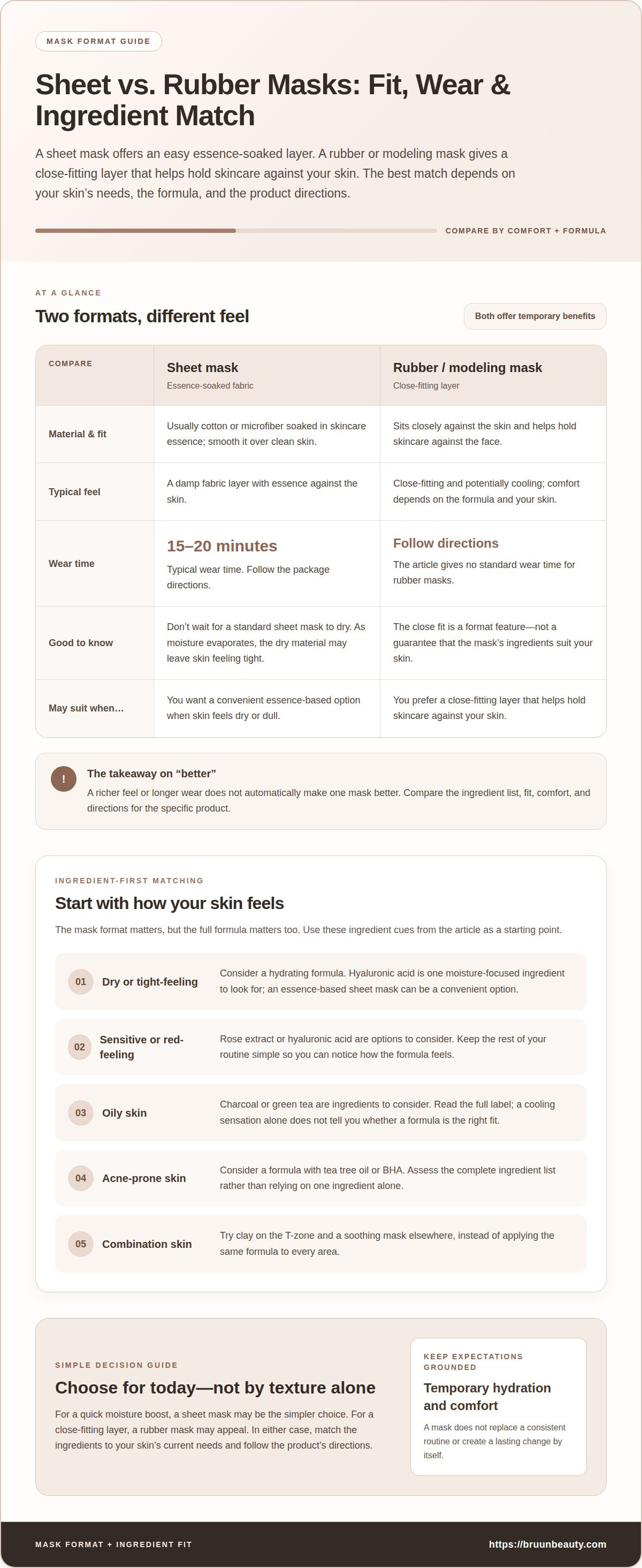
Most sheet masks use cotton or microfiber soaked in skincare essence. Apply one to clean skin, smooth it over your face, and follow the package directions. A typical wear time is 15 to 20 minutes. Don’t leave a standard sheet mask on until it dries: as moisture evaporates, the dry material may pull moisture from your skin and leave it feeling tight. That’s not a better way to boost hydration or support your skin barrier.
Hydrogel masks use a gel material that sits closely against the skin. Some gel masks can be worn for 1 to 3 hours or overnight, depending on their directions. The longer wear time doesn’t make every gel mask a better choice; the mask’s ingredients and your skin’s comfort still matter. Remove it at the time directed rather than waiting for it to dry out.
The Medicube PDRN Pink Collagen Gel Mask is one example of a product named for PDRN and collagen. Those claims indicate how the product is positioned, but don’t guarantee how it will feel on your skin. Check the full ingredient list and directions. If temporary hydration is your priority, consider whether the formula and gel format suit that goal.
For most people, using a sheet mask once or twice a week is generally enough. Gel masks may fit into a routine a few times a week, but follow the product directions and adjust based on how your skin feels. Masking more often isn’t automatically more effective; choose a comfortable routine that suits your skin.
Mask prices in the United States vary by product, ingredients, and whether it’s sold individually or in a kit. Compare the format and ingredient list rather than assuming a higher price means a better match for your skin.
Choose by your current skin need: a sheet mask can be convenient when your face feels dull or dry, while a gel mask offers a closer-fitting format for longer wear. For combination skin, you might use a clay mask on the T-zone and a soothing mask elsewhere. If sensitivity is a concern, look for gentle, hydrating ingredients such as hyaluronic acid, then follow the product directions and notice how your skin responds.
2. Choosing masks by skin type and ingredients
Start with how your skin feels, then choose a formula to match. A rubber mask’s close fit can feel cooling and hold skincare against your face, but the format alone doesn’t determine whether it suits you. Check the ingredients first: a gel mask with a suitable formula may be a better fit than a rubber mask that doesn’t meet your needs.
For acne-prone skin, consider a mask with tea tree oil or BHA. Focus on the complete formula rather than assuming every mask with these ingredients works the same way. If your skin also feels dry or easily unsettled, consider whether the rest of the ingredient list supports comfort and moisture.
Sensitive or visibly red skin may feel more comfortable with a mask containing rose extract or hyaluronic acid. Hyaluronic acid is a moisture-focused ingredient, while rose extract is another option to consider. Keep the rest of your routine simple instead of layering several new products at once. This makes it easier to notice whether the formula feels comfortable.
For oily skin, charcoal or green tea are ingredients to consider. Green tea is described as gently detoxifying and energizing, supporting the protective barrier and helping fight free radicals. A cooling mask can feel refreshing, but that sensation alone doesn’t tell you whether the ingredients suit your skin. Read the label and choose based on your main concern.
Combination skin often benefits from different approaches across the face. Try clay on the T-zone and a soothing mask elsewhere. This targets oiliness in the center of your face without applying the same formula to drier areas. For dullness, dryness, or a stressed feeling, an essence-based sheet mask can be a convenient option.
Brightening formulas also call for an ingredient-first approach. AHAs appear in sheet masks, modeling masks, and sleep masks. They exfoliate by dissolving dead cells on the skin’s surface and encouraging renewal. Since the format doesn’t change what an AHA does, choose based on the formula and your skin’s comfort.
Are rubber masks better for acne-prone or sensitive skin? Not automatically. For acne-prone skin, consider tea tree oil or BHA. For sensitive or red-feeling skin, look for rose extract or hyaluronic acid in a formula your skin tolerates.
If you’re considering a jelly format, jelly masks offer another mask option to compare by ingredients and fit with your routine.
3. Temporary hydration and calming benefits
A mask can provide a temporary hydration boost and leave your skin feeling cooler and more comfortable. Hydrogel’s close contact helps hold in moisture, while its cooling effect can make a warm, tired face feel refreshed. These effects are temporary. A mask may improve how your skin feels after use, but it doesn’t replace a consistent routine or change your skin’s needs long-term.
A hydrogel mask, for example, may feel soothing before an event when you want your skin to look fresh. The cooling sensation may also feel welcome when your face feels warm after sun exposure. Choose a formula that suits your skin and follow its directions. If your skin is sensitive, stick to gentle, familiar ingredients rather than trying several new products at once.
Sheet masks offer another route to temporary hydration. Their essence sits against your face during wear, giving skin time to feel softer and less dry. A 20-minute session can fit into a quiet evening or a pre-event routine. Remove the mask at the directed time, then gently press any remaining essence over your face rather than waiting for the material to dry.
Texture can help you decide. A sheet mask feels like a damp fabric layer, while a hydrogel mask feels cool and gel-like, conforming closely to your face. If fabric shifts or feels uncomfortable, gel may feel more secure. If you prefer a simple, shorter masking step, a sheet mask may fit more easily into your routine.
For comfortable masking, start with clean skin and apply the mask evenly. Keep it away from your eyes and mouth, and smooth out folds that interrupt contact. Follow the package directions for wear time. After removing it, notice whether your skin feels hydrated, sticky, tight, or comfortable. That response can guide your next choice.
Hydrogel masks can be worn longer without drying and may hold moisture more effectively than sheet masks. Some people use them before an event, after sun exposure, or for a spa-like reset. A longer session isn’t automatically better, so let the product directions and your skin’s comfort determine the timing.
Think of the effect as a temporary reset, not a permanent fix. Choose a sheet mask for a quick, essence-based boost, or a hydrogel mask if you prefer cooling and close contact. Either format can be useful when its ingredients, texture, and wear time suit your skin’s needs that day.
4. What sheet masks are and how they work
Sheet masks are typically sheets made from materials such as cotton or microfiber and soaked in skincare essence. They create a damp layer across your face, keeping the formula in contact with your skin during use. The material itself isn’t the main skincare ingredient; the essence carries the ingredients, such as hyaluronic acid for added moisture. A sheet mask’s feel and results therefore depend on both its fabric and its formula.
What are rubber masks and sheet masks, and how do they work? A sheet mask is a pre-cut, essence-soaked sheet; a rubber or modeling mask starts as a thick gel that sets into a close-fitting layer. Both hold skincare against the face, but their materials, application, and feel differ.
For a sheet mask, begin with cleansing so the essence meets clean skin rather than a layer of makeup or daily buildup. Unfold the sheet, align its openings with your eyes, nose, and mouth, then smooth it over your cheeks and forehead. This step-by-step placement reduces folds and helps the mask sit evenly. Wear it according to the package directions; sheet masks are commonly worn for 15 to 25 minutes.
While you wear it, a damp sheet temporarily covers the essence. Close contact gives ingredients time on the skin, and the sheet helps limit quick evaporation. This doesn’t mean every ingredient moves into skin in the same way or that a longer session creates a stronger effect. Remove the mask at the directed time, especially before the fabric dries.
Hyaluronic acid is a familiar example of a moisture-focused ingredient in an essence. A hydrating formula may be useful when your face feels dry, while other essences may focus on calming or brightening. Read the ingredient list before choosing: “sheet mask” describes the format, not the formula’s purpose. Judge a collagen mask by its full ingredient list and directions.
A modeling mask has a different preparation step: its thick gel sets into a layer that conforms to the face and covers the skincare underneath. This heavier layer holds treatment against the skin and helps limit evaporation. Preparing it takes more effort than applying a ready-made sheet, which offers a quick, convenient step in a beauty routine.
Think of each format as a different way to apply skincare, not a replacement for cleansing or your regular routine. Choose a sheet mask for a ready-to-use, pre-soaked essence; consider a modeling mask if you prefer a gel that sets closely over the face. In either case, follow the directions and match the ingredients to your skin’s needs.
5. How modeling masks deliver and retain skincare actives
A modeling mask, also called a rubber mask, starts as a thick gel and sets into a layer that conforms to your face. Its weight helps hold skincare against the skin and limit evaporation while you wear it. The mask doesn’t replace the skincare underneath; it creates a close-fitting cover. Mix and apply it according to the product directions.
Are rubber masks better than sheet masks for hydration? Not in every case. A modeling mask can help hold moisture against the skin, but the formula and your skin’s needs matter more than the format alone. If hydration is your goal, consider what you apply beneath the mask and whether the full routine feels comfortable.
Can rubber masks or sheet masks deliver skincare ingredients better? Neither format guarantees better absorption of every ingredient. A modeling mask creates a heavier covering layer, while a sheet mask holds its essence against your face. Choose based on the formula, directions, and how you want the product to feel during use.
You can layer a rubber mask over serum or other skincare if the directions allow it. Apply products in their instructed order, then spread the mask evenly. Don’t assume every serum is meant to be used under a mask. For example, the Advanced Microneedling Serum SD - Control Salmon DNA Ampoule Serum has specific use directions that should guide how it fits your routine.
Are at-home rubber masks as effective as professional alginate masks? Their shared modeling format doesn’t make their results interchangeable. The formula, preparation, application, and wider treatment routine all shape the experience. At home, follow the mask’s own instructions rather than assuming professional application methods apply to every product.
For an even application, prepare the mask as directed and spread it promptly. Aim for consistent coverage without thin, uncovered gaps. Keep it away from areas excluded by the product directions. When it’s time to remove the mask, follow the stated method; a set layer may lift away differently from a fabric sheet.
Choose based on the experience you want. A modeling mask suits a routine built around a close-fitting cover, while a sheet mask offers a pre-soaked format. In either case, let the formula, application directions, and comfort on your skin guide your decision.
A modeling mask’s heavy layer holds treatment against the skin and helps limit evaporation. Silver Mirror says molding rubber and bio-cellulose masks adhere closely to the skin and enhance absorption. The company also says these masks have higher absorbency than fiber sheet masks, so daily application is unnecessary.
Bruun Beauty: Jelly Mask Kits
Bruun Beauty’s Jelly Mask Kits are an option to consider if you want to add a jelly mask to your skincare routine. Compare the kit with the formats discussed above, and follow the product directions for use.
Bruun Beauty’s products are intended for cosmetic skincare use only; not intended to diagnose, treat, cure, or prevent any disease. Explore the Jelly Mask Kits if you’re considering this format for your routine.
Contact Bruun Beauty with questions about its products.
Build a Masking Routine That Fits Your Skin
Make masking intentional instead of choosing by trend. Notice how your skin feels before applying a mask, then decide whether you want a simple essence step or a closer-fitting gel texture. This small habit can help you choose products with more confidence.
So, are rubber masks better than sheet masks? The better fit is the one whose ingredients, texture, and directions work for your skin and routine. You don’t need to commit to just one format; different days may call for different approaches.
Keep your routine thoughtful, comfortable, and focused on what your skin needs. Consistency can make each skincare step feel more purposeful.
Frequently Asked Questions
Do sheet masks work?
Yes, sheet masks can temporarily make skin feel more hydrated and comfortable. For example, an essence with humectant ingredients may leave dry-feeling skin softer after use. Results depend on the formula and how it suits your routine. Treat a sheet mask as a supportive skincare step, not a substitute for cleansing, moisturizer, or other products you use consistently.
What is a sheet mask?
A sheet mask is a face-shaped piece of material saturated with skincare essence. Openings around the eyes, nose, and mouth help it sit over your face. Cotton and microfiber are common materials. Formulas vary, so compare the ingredient list with your goal, such as adding moisture or choosing a calming step.
Which mask format is right for your skin type?
Choose based on your current skin concern and the formula’s ingredients. A hydrating sheet mask, for example, may suit a dry-feeling day, while a modeling mask offers a close-fitting layer. Combination skin may benefit from different formulas on different areas, such as clay on an oily T-zone and a soothing mask elsewhere.
Which skin types benefit most from rubber masks versus sheet masks?
Neither format is reserved for one skin type. For oily skin, consider charcoal or green tea; for sensitive or red-feeling skin, look more closely at rose extract or hyaluronic acid. Dry or dull-feeling skin may benefit from an essence-based sheet mask. Let the formula, rather than the mask’s name, guide your choice.
What are the risks or side effects of rubber masks and sheet masks?
Some formulas may feel uncomfortable or cause visible irritation, especially if an ingredient doesn’t suit your skin. Follow the product directions and remove the mask if it feels unpleasant. Don’t leave a sheet mask on until it dries, as dry material can leave skin feeling tight. Introduce new formulas separately from other new products so you can observe how your skin responds.
How long should you leave a rubber mask or sheet mask on?
Follow the package directions for the exact mask you’re using. Sheet masks are commonly worn for 15 to 25 minutes, and you should remove one before it dries. Gel masks may have longer wear times, while modeling masks vary by product. Don’t assume rubber masks share one timing rule; check the label before application.
Microneedling for Rosacea: Is At-Home Treatment Safe
Microneedling for Rosacea: Is At-Home Treatment Safe
Related Posts

PDRN Benefits for Skin: Regeneration, Results and Safety

How to Dispose of Used Microneedle Cartridges Safely

Self-care rituals for better skin through mindful daily habits

How to Explain Microneedling Benefits for Skin and Scars

How to use a Korean 10-step skincare routine for hydration

Microneedling for atrophic scars: clinic or at-home results

V-Line Lifting Masks and Their Claimed Face-Shaping Effects
