

Wholesale Spa Supplies for Salon and Spa Professionals
Buying wholesale spa supplies for professionals means selecting professional-use skincare, treatment products, and room essentials that suit your salon or spa. The right mix depends on your services, storage space, and restocking needs.
This guide explains how to assess supplies, compare wholesale offers, and choose products for your setup. It also covers facial-room essentials and where Bruun Beauty’s professional-grade products can fit.
Key Takeaways
- Match professional-size skincare and treatment supplies to the services you actually provide, rather than buying bulk simply for a lower unit cost.
- Compare wholesale offers by pack size, product fit, and how reliably each item moves through your day-to-day workflow.
- Build a facial room around the essentials: a facial bed, facial steamer, and magnifying lamp.
- Choose brands by the product category and treatment routine you need to support, then keep your supply choices consistent.
- For a skincare-focused addition, explore Bruun Beauty’s Advanced Microneedling Serum SD - Control Salmon DNA Ampoule Serum.
Professional salon and spa supplies
A professional supply selection can include treatment products, room essentials, and equipment. Choose each item based on your services, daily workflow, and storage needs.
Wholesale Product Categories
Wholesale spa supplies for professionals can include backbar skincare, masks, treatment accessories, and salon equipment. A facial room might use cleansers, moisturizers, masks, linens, a magnifying lamp, and a facial steamer. Equipment may also include massage oil warmers, towel warmers, and facial beds. Match your selection to the services your salon provides.
Before ordering, list the products used for each service and identify the items you replenish most often. Compare a mask’s format and application steps with your facial routine, for example. Check package size, storage requirements, and dispensing method. This helps you judge a wholesale offer by practical fit, not bulk alone.
Vendors Serving Licensed Professionals
In the U.S., licensed estheticians and spas can buy through professional beauty wholesalers, esthetics-focused distributors, and brands with wholesale programs. Some vendors focus on backbar skincare; others carry equipment, linens, or treatment accessories. Build a shortlist around the categories your business needs, such as facial products and room tools, rather than choosing by supplier name alone.
Compare vendors using the same checklist: product range, package sizes, ordering terms, and product information. A salon buying skincare and equipment may value a broad selection, while a solo esthetician may prefer a focused range. Review directions for use and care, and keep product names and reorder details on file to maintain a consistent supply process.
Product and Equipment Quality and Safety
Evaluate skincare by its ingredient information, directions, packaging condition, and intended use. For equipment, review operating and cleaning instructions, and consider whether the item suits your room and workflow. When choosing a facial steamer, for instance, consider where it will go and how it fits into your routine. Read product details before adding an item to your setup.
For disinfectants, the U.S. Environmental Protection Agency says product labels should clearly show an EPA Registration Number. Read the full label and follow its directions for the intended use. Store disinfectants separately from skincare and keep labels accessible to staff. These steps make products easier to identify and handle consistently.
In the United States, first identify whether an item is skincare, equipment, or a disinfectant, then review the requirements and labeling for that category. One checklist cannot replace product-specific instructions. A facial steamer and a skincare mask, for example, have different functions, so review their use and care information separately.
A facial steamer may offer features suited to particular services, so review its product details and instructions before use.
When assessing a steamer, consider whether aromatherapy fits your services and whether the unit suits your room and routine. Read the operating and cleaning guidance before adding it to your setup, and make sure staff know how to use it as directed.
Wholesale pricing and professional deals
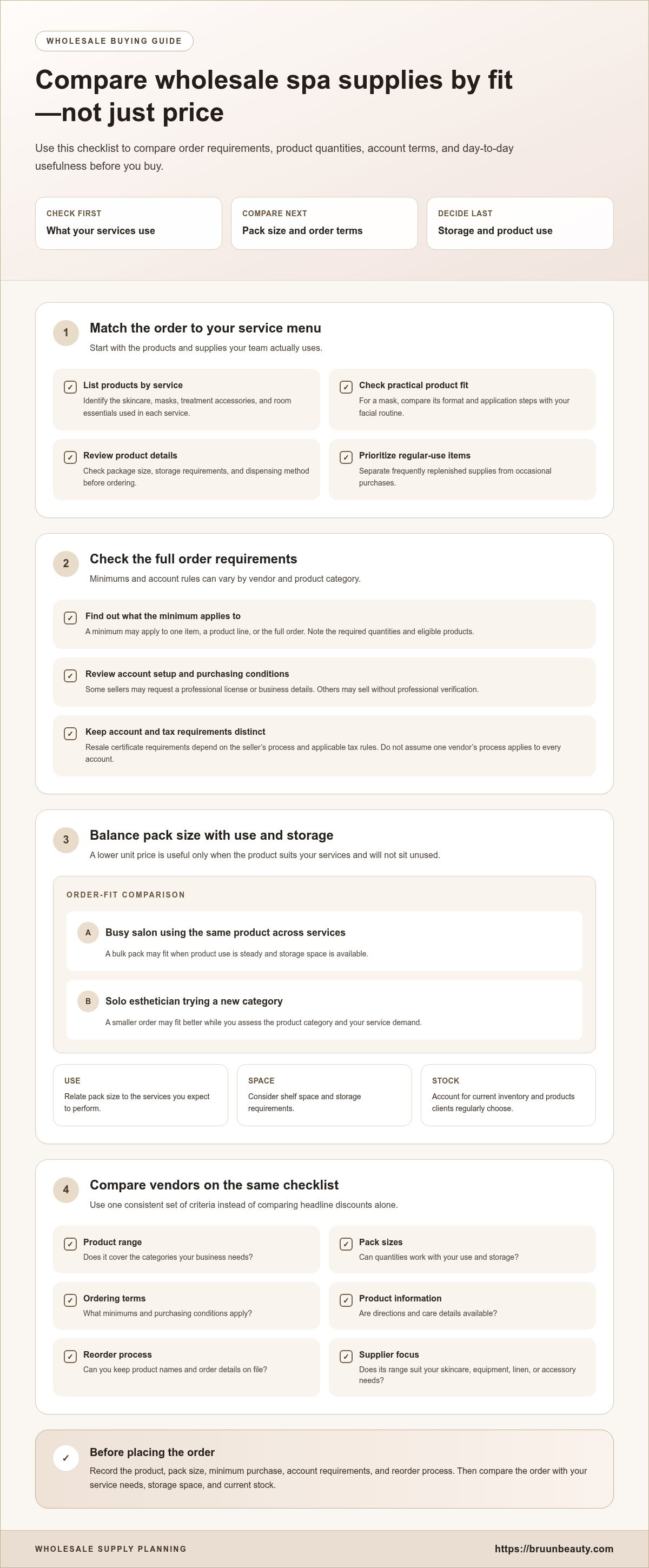
Compare wholesale offers by order requirements, pack size, and how quickly you use each item. A lower unit price is useful only when the product suits your services and will not sit unused.
Order Minimums and Account Requirements
Minimum order quantities and account rules vary by vendor and product category. A supplier may set a minimum for one item, a product line, or the full order. Before comparing offers, note required quantities, eligible products, and account setup steps. If you are stocking masks, for example, compare the required pack size with actual service demand.
Separate regularly replenished items from occasional purchases. This makes it easier to judge whether a larger order fits your storage space and product rotation.
Professional Purchase Credentials
Some wholesale sellers may ask for a professional license or business details to open an account; others may sell without professional verification. Resale certificate requirements also depend on the seller’s process and applicable tax rules. Review each source’s account terms, and distinguish professional access requirements from documents used for tax handling.
Keep relevant business records ready if a vendor requests them. Do not assume one supplier’s process applies to every wholesale account.
Use the same comparison method for every source. Record the product, pack size, minimum purchase, account requirements, and reorder process. This gives you a clearer picture than comparing headline discounts alone. For example, compare the amount of cleanser or mask material in a pack with the number of services you expect to perform.
Consider storage and product use before choosing a deal. A bulk pack may suit a busy salon using the same product across services, while a smaller order may better suit a solo esthetician trying a new category. Match quantities to shelf space, current inventory, and products your clients regularly choose.
- Compare the full order: Review item quantities and any minimums together.
- Check account terms: Note credential requests and purchasing conditions.
- Estimate product use: Relate pack size to your service menu and stock levels.
- Plan reorders: Keep product names and order details in one record.
Deals can also depend on which categories you buy together, so compare the offer against your actual service menu. If microneedling supplies are part of your planned inventory, browse the microneedling product selection as one category in your purchasing plan. Choose quantities based on your workflow, not a discount alone.
For a useful final check, compare two possible orders using the same list: products needed, required quantity, storage fit, and account steps. This simple review helps you choose an arrangement that supports daily services without overstocking items your team rarely uses.
Wholesale skin care and spa supplies
Choose skincare and spa supplies based on your service menu, storage, and replenishment routine. A facial-focused salon may prioritize cleansers, masks, moisturizers, and treatment accessories, while another business may need supplies for different services.
Shipping costs, delivery times, and return policies vary by supplier, destination, order size, and shipping method. Compare those terms alongside product selection, since delivery timing affects when supplies can be added to your service schedule.
Buying from an unauthorized or low-cost wholesaler can make it harder to establish product provenance, compare consistent product details, or resolve order questions. Review seller information, labels, item descriptions, and return terms before purchasing.
Start with your service menu. List the products each service uses, then identify items used across multiple treatments. If a mask suits several facial routines, for example, its role in your regular stock may differ from a product reserved for one specialized service.
Next, compare product information. Look for clear ingredient details, directions, package size, and intended use. Keep product labels and descriptions accessible to staff, especially if your team works with several skincare lines. Consistent records help staff identify the right item during busy appointments.
For equipment and treatment accessories, focus on the task each item supports. A facial steamer, for example, serves a different purpose from a magnifying lamp or a treatment mask. Read operating and care instructions, then consider placement, storage, and cleaning within your room setup.
Product selection also affects inventory planning. Track how quickly your team uses cleansers, masks, and other backbar products. Then align order size with shelf space and replenishment needs. This practical record helps prevent purchases that do not match your regular services.
When reviewing a supplier, compare the full purchasing experience rather than one advertised deal. Consider product descriptions, available categories, shipping terms, delivery expectations, and the stated returns process. A broad selection may simplify ordering several types of supplies, while a focused catalog may suit a narrower service menu.
Establish a consistent receiving routine for every order. Match delivered items against the order record, inspect packaging, and store products according to their labels. Record the source and product name so your team can reorder the same item and maintain a consistent setup.
Finally, revisit your list when services change. A new facial option may call for different masks or accessories, while removing a service can leave slow-moving stock. Keep your supply list current so every purchase serves a real purpose in your salon.
Essential spa room supplies
Choose room supplies around your team’s tasks and available space. A towel warmer, massage oil warmer, and organized storage can support a smoother service flow. Decide where each item belongs before ordering, so staff can reach supplies without crowding the work area.
A towel warmer can keep towels close at hand during services. Compare its capacity and placement with your room’s layout, then consider how staff will load and retrieve towels. Some models include a UV sterilizer function that turns off automatically after 10 to 15 minutes. The UV light also switches off when the cabinet door opens to prevent eye damage.
Follow the towel warmer’s operating instructions, including guidance for its UV function. Assign storage locations for towels and other supplies. This can make restocking easier and reduce unnecessary movement during a service. Keep equipment instructions accessible to staff who use or maintain the warmer.
Massage oil warmers suit services that use warmed oil. They are designed to operate continuously throughout the day and stop heating when they reach the set temperature. Consider where the warmer will sit, how staff will access it, and whether its placement fits the service sequence. Keep the product instructions nearby for consistent operation.
Equipment choice also depends on whether you are furnishing a professional salon or a smaller home spa. At-home esthetic equipment is generally smaller and has fewer functions than professional salon equipment. Compare the unit’s intended setting with your available space and the tasks it needs to support. A compact design may suit a limited room, while a busy salon may prioritize equipment built around its daily workflow.
Use a short room-planning checklist before placing an order:
- Map the work area: Assign each warmer and storage spot a practical location.
- Match equipment to services: Choose an oil warmer only if your menu uses massage oil.
- Review instructions: Keep operating and care guidance accessible to staff.
- Plan restocking: Decide where replacement towels and supplies will be stored.
Plan the service sequence, too. If a treatment uses warmed oil and towels, place those supplies where staff can reach them at the right steps. Position cords and equipment to keep the path through the room clear. These layout choices help supplies support the work rather than interrupt it.
Before buying, compare equipment dimensions, functions, and placement requirements with your room plan. Choose items that meet a real workflow need, while leaving staff room to move comfortably and retrieve supplies efficiently.
Complete the room plan by accounting for the core facial setup, warming, and storage. A basic facial room setup includes a facial bed, facial steamer, and magnifying lamp. Consider how these items fit the available space and service sequence, while keeping supplies organized and accessible.
Review the full arrangement before ordering. Consider the facial bed, facial steamer, and magnifying lamp alongside planned warmers and storage, so the room supports its intended tasks without crowding the work area.
Professional brands
A professional brand should fit your service menu, product standards, and ordering routine. Compare brands by category, not reputation alone. A skincare line, facial equipment maker, and treatment accessory supplier each serve different needs. A brand known for masks, for example, may not offer the tools your facial room uses.
Start by listing your services and the products each requires. Then compare brand offerings against that list. If your salon performs regular facials, review cleanser, mask, and moisturizer options together. A coordinated selection can help staff follow consistent service steps and keep stock records organized.
Product information matters. Review each item’s label, ingredients, directions, package size, and intended use. Compare brands using the same checklist. For equipment, read the operating and care instructions, then assess whether the product suits your room setup. Clear information helps staff understand what they are using and how it fits the workflow.
Consider how each brand sells to your business. Some sell directly, while others work through a distributor or professional wholesaler. The purchasing source affects how you browse products, manage reorders, and find product details. Record the supplier and exact product name in your inventory so staff can identify the right item when stock runs low.
Consistency is another useful comparison point. If your salon uses a mask across several facial services, check whether its directions and format suit those routines. If you use several brands, create a simple reference sheet with product names, intended service, and storage notes. This helps prevent confusion when similar products have different instructions.
Before adding a new brand, evaluate one category at a time. Compare the product’s purpose, ingredients or materials, directions, and fit with your service menu. Then consider storage and replenishment. This measured approach gives you a clearer basis for choosing than a brand name or promotion alone.
Use this checklist when comparing brands:
- Service fit: Match each product to a treatment you actually provide.
- Product details: Review labeling, directions, and intended use.
- Ordering source: Record the brand, distributor, and product name.
- Staff workflow: Make instructions easy to find during services.
A brand earns a place in your professional selection when its products support a real service need and staff can use them consistently. For a microneedling-focused product category, explore professional microneedling supplies.
Bruun Beauty: Advanced Microneedling Serum SD - Control Salmon DNA Ampoule Serum
Advanced Microneedling Serum SD - Control Salmon DNA Ampoule Serum gives estheticians a focused option when selecting microneedling supplies for their treatment menu. Review its product details and intended use as part of your routine planning, then pair it with the tools and steps your service requires.
Bruun Beauty also offers Jelly Mask Kits and BB Glow Treatment Supplies for professionals building out facial service options. Choose products based on the treatments you provide and the supplies your team needs.
Explore the Advanced Microneedling Serum SD - Control Salmon DNA Ampoule Serum to review its product information. Visit bruunbeauty.com to explore Bruun Beauty’s professional skincare and treatment supplies.
Build a Supply Plan That Grows With Your Services
Make your next purchase serve a specific service you want to deliver consistently. Use your menu to identify which categories need replenishing first, then choose products that fit your team’s workflow and storage. A focused plan makes it easier to adapt as your salon adds or changes services.
For microneedling routines, Bruun Beauty offers Advanced Microneedling Serum SD - Control Salmon DNA Ampoule Serum and professional microneedling equipment. Jelly Mask Kits can support facial services that include masks. Explore each option based on how it fits your professional setup and product selection.
Thoughtful wholesale spa supplies for professionals start with clear priorities, not simply a larger cart. Let your service menu guide your next purchase, and build your supply selection one useful category at a time.
Choose the next addition that best supports your work and your clients’ skincare experience.
Frequently Asked Questions
Do you offer professional-sized products for spas and estheticians?
Yes. Bruun Beauty offers professional-grade skincare and spa supplies, including Advanced Microneedling Serum SD - Control Salmon DNA Ampoule Serum, Jelly Mask Kits, DR. PEN Microneedling Devices, and BB Glow Treatment Supplies. Review each item’s product details and format to determine how it fits your salon’s services and professional purchasing needs.
What do I need for a facial room?
For a facial room, plan the client pathway and work zones before choosing additional supplies. Decide where clean products, used linens, and tools will go during a service, and keep frequently used items close to the treatment area. This room map helps you identify storage or workflow needs before ordering.
What supplies must I have for a spa room?
Your must-have supplies depend on the services you offer, so build your room list around actual treatment steps. Include the products and tools each step requires, along with practical storage and replenishment items. A service that uses masks, for example, needs application tools and an organized place to keep those products between appointments.
How do wholesale prices compare for spa supplies across major vendors?
Wholesale prices vary by item, pack size, order minimums, and vendor terms, so compare like with like. Check the quantity, product details, delivery conditions, and return policy alongside the listed price. A lower unit cost may not suit your business if the pack size or purchasing terms are a poor fit.
What professional spa supplies are essential for opening or restocking a spa?
Before opening, confirm that every planned appointment can be completed from start to finish with the supplies in place. When restocking, note any substitutes staff used and decide whether to approve them for future use. This record helps keep purchasing decisions consistent across shifts.
Whiteheads After Microneedling: How to Adjust Your Skincare
Whiteheads After Microneedling: How to Adjust Your Skincare
Related Posts

PDRN Benefits for Skin: Regeneration, Results and Safety

How to Dispose of Used Microneedle Cartridges Safely

Self-care rituals for better skin through mindful daily habits

How to Explain Microneedling Benefits for Skin and Scars

How to use a Korean 10-step skincare routine for hydration

Microneedling for atrophic scars: clinic or at-home results

V-Line Lifting Masks and Their Claimed Face-Shaping Effects
