

How to Dispose of Used Microneedle Cartridges Safely
To properly dispose of used microneedle cartridges, place each one directly into a sharps container after treatment, then follow local guidance for disposing of the sealed container. Don’t reuse a cartridge, even if it looks intact.
Discarding a cartridge after one session may feel wasteful, but it keeps your treatment routine consistent. Cleaning or disinfecting it doesn’t make it suitable for reuse.
This guide explains immediate disposal, safe container handling, and how to find an accepted local drop-off or collection option for your home or practice.
Key Takeaways
- Discard each cartridge after its session. Cleaning or disinfecting it doesn’t make it suitable for reuse.
- Place used cartridges directly into a sharps container, then store the closed container where children and pets can’t reach it.
- Follow local community guidance for disposing of sealed sharps containers, since accepted options vary by location.
- Avoid recapping, bending, or breaking used needles, and replace the container when it’s about three-quarters full.
- Explore local drop-off, household waste programs, or medical waste collection to find an appropriate disposal route.
Keeping sharps containers away from children and pets
Choose a stable, out-of-reach storage spot before treatment. Keep used cartridges contained and away from children, pets, and routine sanitation supplies.
-
Place Used Sharps Inside
Put each used cartridge straight into a sharps container designed to contain needles safely. Keep the container stable and guide the cartridge inside without touching the needle. Don’t leave it on a treatment tray, counter, or other surface while you look for a container. Keeping the container beside your work area makes this step easier after every session.
- Choose a container that stays upright and closes securely. Use a purpose-made sharps container when available, and follow its printed directions. Don’t assume an ordinary thin bag or household bin can safely contain a needle. Cartridge types and packaging can vary; the needle cartridge collection identifies the category this disposal routine covers.
-
Seal and Label the Container
Close the sharps container when it reaches its fill line or when its instructions say to seal it. Don’t press the contents down to make more room. After sealing, label the container “SHARPS - DO NOT OPEN.” Keep the label visible so anyone handling household or studio waste can identify the contents without opening it.
- Store the closed container on a high, stable shelf or in a locked cabinet that children and pets can’t access. Avoid placing it beside food, clean linens, or sanitation products, where someone might move it during routine cleanup. In a shared treatment room, designate a storage location and return the container there after each use.
- If you don’t have a sharps container, don’t leave a used needle loose in household trash. Use a rigid container designed to contain sharps if one is available. Research also describes securely wrapping used sharps before household disposal, but local community rules determine which disposal methods are accepted. Keep any temporary containment inaccessible to children and pets while you arrange the appropriate disposal route.
- Keep the closure and label intact during storage and handling. Don’t reopen a sealed container to add another cartridge or retrieve an item. If children or pets can reach your usual disposal station, move it before the next treatment and choose a location they cannot access. A designated location also helps other household members know where the closed container belongs.
Local sharps and hazardous household waste disposal
Place used cartridges in a sharps container, then use a disposal route accepted by your community. Local rules determine whether sealed containers go to a drop-off, collection, or another program.
-
Check Local Sharps Disposal Guidelines
Find your city or county’s instructions for sealed sharps containers before choosing a disposal route. Search for terms such as “sharps disposal” and “household hazardous waste.” Programs differ in the container types they accept and whether they offer drop-off or pickup. Don’t assume a hazardous waste site accepts sharps just because it handles other household materials.
Identify the disposal route before your next treatment. Then you’ll know where to take the closed container when it’s ready.
-
Understand Sharps Categories
Treat a microneedling cartridge as a sharp because it contains needles. PMU studios should use sharps containers for used needle cartridges and follow local disposal requirements. A cartridge that contacts skin, serum, tissue fluid, or blood is no longer sterile, so don’t treat it as unused.
Reusing, recapping, or discarding a cartridge loose can compromise safe handling. Keep the process simple by moving each used cartridge into its designated container.
-
Dispose of Sharps After Treatment
Place used needles and other sharps in a sharps container immediately after use. In a workplace, follow facility procedures as well as local waste rules. These directions cover how staff handle the container and where it goes after sealing. Community requirements vary, so a sealed container may have a different destination in another city or county.
For home treatments, keep the closed container until an accepted local drop-off or collection option is available. Don’t put loose cartridges in household trash.
-
Keep Handling Consistent
Use the same disposal routine after every treatment, whether you work in a PMU studio or at home. Don’t reuse a cartridge, put its cap back on, or discard it loose. Each shortcut adds handling steps instead of keeping the used item contained. Follow the sharps-container instructions and your local program’s directions through final disposal.
For a microneedling setup, keep disposal planning separate from product selection. Choose supplies that fit your routine, and follow the same clear disposal process after every session.
Following local disposal guidelines helps you choose an appropriate route for sealed sharps containers. Keep the written instructions with your studio procedures or home treatment supplies so the right option is easy to identify.
Disposal practices to avoid
Keep used cartridges contained and avoid shortcuts that change how they’re handled. Household trash is appropriate only when local guidelines allow it and the sharp is securely contained as directed.
- Don’t throw a loose cartridge into household trash. Put it in a sharps container first. If local rules permit household disposal, contain the cartridge as those rules direct. If they don’t allow that method, keep it secured for an accepted local disposal option.
- Don’t try to reuse a cartridge after cleaning or disinfection. Soaking a microneedle cartridge in 75% isopropyl alcohol for 30 minutes doesn’t make it suitable for reuse. Cleaning can’t restore sterility or guarantee needle performance. After a session, replace the cartridge rather than relying on appearance or sanitation as a measure of suitability.
- Avoid recapping a used needle, and don’t bend or break its needles before disposal. Put the cartridge into its disposal container without altering it. This keeps the process simple and avoids extra handling around your device.
- Don’t press cartridges down or add more once a sharps container reaches its fill line. Dispose of the container when it’s about three-quarters full, rather than waiting until the lid becomes difficult to close. Follow the container’s instructions for sealing it, then use an accepted local disposal route.
- Don’t reopen or reuse a sealed, single-use sharps container. After sealing, follow the manufacturer’s instructions and local disposal rules. Keep the closure intact during storage and transport. A sealed container is not a place to sort items or retrieve a cartridge. Follow the container’s instructions for disposal.
- Don’t handle a cartridge more than necessary or soak or recap it. Use the disposal container as intended and follow the same routine after every session. For microneedling devices, follow the cartridge and handling instructions supplied for that device; disposal shortcuts don’t replace them.
Handle a used PMU needle only as needed to place it in its disposal container. Don’t recap or reshape the needle. Leave it intact and follow the established disposal routine rather than adding steps that involve handling or altering it.
Medical waste collection and drop-off options
Pharmacies, clinics, and household hazardous waste programs accept used cartridges only when their local programs allow it. For nearby options, start with your city or county waste-disposal information.
- Search your city or county’s waste pages for “sharps disposal,” “household hazardous waste,” or “medical waste.” These terms can point you to local drop-off sites, residential pickup, and accepted container types. Check the instructions for sealed containers, including whether a site requires a specific sharps container. A household hazardous waste listing doesn’t automatically mean the site accepts sharps.
For nearby locations, use your municipality’s service information and look for the exact disposal category. A pharmacy or clinic may offer drop-off only if it participates in an accepted program.
- Compare the disposal routes listed by your community. Sharps drop-off services may be free or charge a nominal fee. Mail-back programs are usually fee-based, with charges varying by container size. Residential special-waste pickup is typically fee-based and may set requirements for the containers it collects.
There isn’t one nationwide price for every route. The program, container size, and collection method determine the cost, so follow the provider’s current instructions before arranging a shipment or pickup.
- Consider medical waste collection if it’s accessible, especially for a studio that generates cartridges through regular appointments. A medical waste service provides a designated route for used treatment supplies. Keep cartridges in an appropriate sharps container while arranging collection, and follow the service’s instructions for sealing and handover.
For home use, a community drop-off or mail-back program may be a better fit if local rules accept it. Don’t assume an ordinary pharmacy counter or clinic reception can take a sealed container without participating in a program.
- Prepare the container for the route you choose. Mail-back programs may require particular labels, while pickup services may accept only certain container types. Follow the container manufacturer’s sealing instructions and the disposal program’s directions. Don’t reopen a sealed container to change its contents or labeling.
A closed container keeps used cartridges contained, but it doesn’t make them sterile or change their waste category. Secure it until the listed drop-off, shipment, or collection step, and don’t put it in a different waste stream unless local instructions allow it.
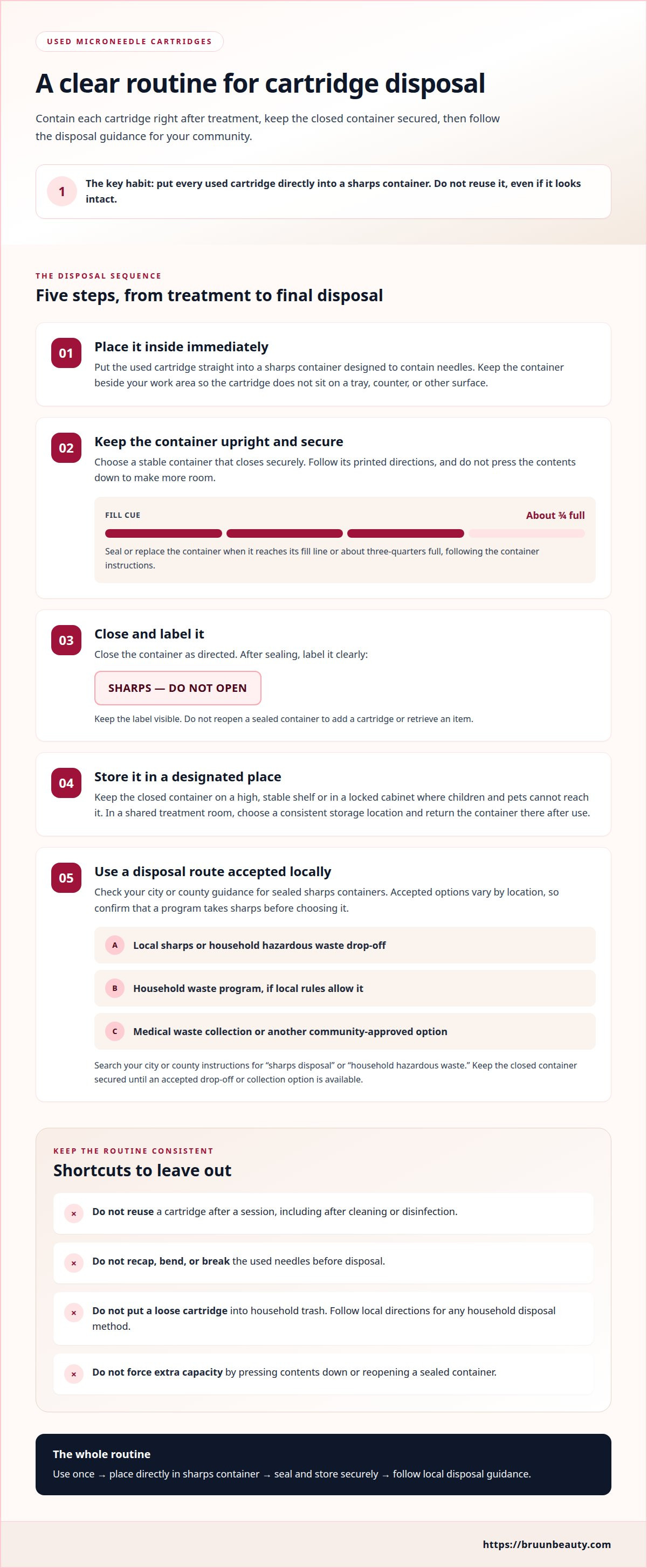
Immediate cartridge disposal after treatment
Make disposal the final step of every treatment, not a task for later cleanup. A clear routine for how to properly dispose of used microneedle cartridges starts before treatment, with the sharps container within reach.
- Position the sharps container beside your treatment station before using the device. Choose a stable spot so you don’t have to carry an exposed cartridge across the room. At home, keep the container away from household traffic, children, and pets. In a studio, place it where the practitioner can reach it without crossing the client’s space.
- After treatment, stop the device and follow the manufacturer’s instructions for removing the cartridge. If the instructions call for the supplied protective cap, use it as directed. Don’t touch the needle directly or set the cartridge on a tray while preparing the device for its next step.
- Move the cartridge directly into the sharps container as soon as you remove it. Don’t pass it between people or leave it beside the device for later cleanup. Follow a simple sequence: finish the treatment, stop the device, remove the cartridge as instructed, then dispose of it before organizing other supplies.
- Keep the disposal step consistent whether the cartridge contacted skin, serum, tissue fluid, or blood. Contact means it’s no longer sterile, and the cartridge shouldn’t go back into the device. Don’t reuse it for another area or client. Use a new cartridge when another session requires one.
- In a multi-client studio, make cartridge disposal part of the station reset between appointments. Put the used cartridge in the sharps container before wiping down the work surface or restocking supplies. This ties disposal to the treatment that generated the cartridge instead of mixing it into general sanitation tasks.
- At home, don’t wait until the end of the day to gather used cartridges from different rooms. Dispose of each one at the treatment station, then keep the container closed between sessions. Knowing how to properly dispose of used microneedle cartridges means planning this step before treatment begins, not improvising afterward.
- At the end of an appointment, check that the cartridge is inside the container and the opening is clear. Don’t push contents down or reopen the container to correct a missed step. Follow the container’s fill line and sealing instructions, then use the appropriate local disposal option for that sealed container.
Bruun Beauty
Bruun Beauty offers professional skincare and beauty supplies for home or studio use. Once you’ve established a safe, consistent cartridge-disposal process, you can focus on choosing products suited to the rest of your treatment setup.
For example, the range includes Advanced Microneedling Serum SD - Control Salmon DNA Ampoule Serum, Jelly Mask Kits, and BB Glow Treatment Supplies. These products serve different parts of a skincare routine, so choose according to your planned treatment. None replaces proper sharps disposal.
If you have questions about Bruun Beauty’s skincare and beauty offerings, contact Bruun Beauty.
Build a Routine You Can Keep
A dependable disposal habit starts with a clear decision before treatment: know which local option fits your household or studio, and follow that plan consistently. Knowing how to properly dispose of used microneedle cartridges is part of an organized microneedling routine, not an afterthought once your supplies are packed away.
Make your process easier to maintain by keeping the local disposal route and container instructions with your treatment setup. That way, the next session follows the same straightforward routine. If you manage a studio, share the process with everyone who handles treatment cleanup.
Bruun Beauty offers microneedling products for professionals and at-home skincare enthusiasts, including high-quality microneedling devices. Explore products that support your setup, while following local requirements and the container manufacturer’s instructions for disposal.
A thoughtful routine helps you care for your treatment space with confidence and stay focused on the skincare experience.
Frequently Asked Questions
Can I reuse a microneedle cartridge?
No. Treat each cartridge as single-use and discard it after its treatment session. A cartridge may move across treatment areas during one continuous appointment only if it remains secure, works as intended, and the device manufacturer’s instructions allow it. That’s different from saving it for another appointment. If you’re unsure whether it stayed secure or worked properly, replace it.
Can I disinfect a used cartridge and use it again?
No. Cleaning or disinfecting a used cartridge can’t restore its sterility or guarantee that its needles will perform as intended. A 75% isopropyl alcohol soak, even for 30 minutes, doesn’t make it reusable. Don’t rely on appearance or a sanitation step to decide whether a used cartridge can go back onto a device.
Do I really need to go through all these steps?
Yes. A consistent routine makes cartridge disposal easier at home or in a studio. Keep the container near your treatment setup, follow its fill and closure instructions, and identify an accepted disposal route in advance. For example, include cartridge disposal in the station reset before preparing supplies for the next appointment.
What if I don’t have a sharps container?
Don’t leave a used cartridge loose in household trash. Use a sturdy, rigid container that can temporarily contain needles, and keep it secured away from children and pets while arranging disposal. Household disposal rules vary, so use that option only when local guidance allows it. Don’t handle or alter the needle to make it fit.
Why Are Cartridges Strictly Single-Use?
After a cartridge contacts skin, serum, tissue fluid, or blood, it’s no longer sterile. It may also not perform as intended in a later session. Cleaning doesn’t reverse these changes or guarantee needle performance. Treating cartridges as single-use gives you a clear replacement point: finish the session, remove the cartridge according to device instructions, and discard it.
How should used microneedle cartridges be handled immediately after use?
Stop the device and remove the cartridge according to the manufacturer’s instructions. If those instructions call for its protective cap, use it as directed. Put the cartridge straight into the sharps container rather than setting it on a tray or carrying it across the room. This simple sequence links disposal to the session that generated the cartridge.
What type of sharps container is appropriate for microneedling cartridges?
Choose a sharps container designed to resist needle penetration, with a secure closure and clear fill instructions. Follow the manufacturer’s directions, since containers can differ in their openings and sealing methods. Don’t substitute a thin bag or a container that can’t safely contain needles. The disposal program may also specify which container types it accepts.
How should a sharps container be sealed and stored safely?
Seal the container according to its printed instructions when it reaches its fill line, and don’t push contents down to create extra room. Label a closed used-cartridge container “SHARPS - DO NOT OPEN.” Store it upright in a stable place children and pets can’t reach, such as a secured cabinet. Keep the label visible during storage and transport.
PDRN Benefits for Skin: Regeneration, Results and Safety
PDRN Benefits for Skin: Regeneration, Results and Safety
Related Posts

PDRN Benefits for Skin: Regeneration, Results and Safety

Self-care rituals for better skin through mindful daily habits

How to Explain Microneedling Benefits for Skin and Scars

How to use a Korean 10-step skincare routine for hydration

Microneedling for atrophic scars: clinic or at-home results

V-Line Lifting Masks and Their Claimed Face-Shaping Effects
