

How to use a Korean 10-step skincare routine for hydration
The best Korean skincare routine may be the one that skips several steps. A Korean 10-step skincare routine, explained simply, is a flexible sequence of cleansing, hydrating, and moisturizing steps, not a requirement to use ten products every day. It can suit different skin types when you choose steps that fit your skin and leave out those you don’t need.
If the full routine feels like a lot, that’s understandable. More layers don’t automatically mean more hydration, and your skin’s needs can change with the season, your products, and how your skin feels.
This guide explains how to adapt the routine for hydration. You’ll see how cleansing, essence, sheet masks, and moisturizer fit together, which steps are optional, and where to focus for your skin. Think of the ten steps as a menu: choose what supports your routine instead of following every step just because it’s on the list.
Key Takeaways
- Layer products from lighter to richer textures, and use essence after cleansing to add hydration before moisturizer.
- Double cleansing pairs an oil-based cleanser for makeup and sunscreen with a water-based cleanser for remaining sweat and dirt.
- Use a sheet mask as an occasional hydration step, then follow with moisturizer to help hold onto moisture.
- Keep morning care focused on hydration and sun protection, with sunscreen as the final step.
- Adjust the routine to your skin’s needs instead of treating all ten steps as daily requirements.
Essence for hydration and skin replenishment
Start by exfoliating once a week, then increase use gradually only if your skin tolerates it. Essences support hydration after cleansing, while exfoliation addresses dead skin on the surface. They serve different purposes in a Korean skincare routine.
- Use toner as your first leave-on step. After cleansing, apply toner with your hands or a soft cotton pad. Toners can refresh skin and add a light layer of hydration. Their formulas vary, so look at the ingredients and choose one that fits your skin’s needs. A hydrating toner, for example, can prepare your skin for the next layer.
- Press essence onto clean skin. Essence usually has a lightweight, fluid texture that helps hydrate and prepare skin for products applied afterward. Dispense a small amount into your palms, then gently press it over your face. This approach keeps application gentle and helps you avoid unnecessary rubbing.
- Choose ingredients for the hydration you want. For example, an essence with glycerin or hyaluronic acid can add hydration. Let the layer settle before applying another product. If your skin feels comfortable, follow with a serum or ampoule; an ampoule is typically positioned as a more concentrated treatment step, not a replacement for every hydrating layer.
- Keep essence and skin cell turnover in perspective. Essence is generally used as a hydrating layer, while exfoliating products serve a different role in a routine. Exfoliating products address surface buildup and can help skin feel smoother. Start with exfoliation once a week, then increase gradually only if your skin tolerates it. Avoid stacking several exfoliating products in one routine.
- Layer from light to rich. Apply toner, then essence, followed by any treatment serum or ampoule and moisturizer. If your skin feels coated or uncomfortable, simplify by skipping a layer rather than adding more. This step-by-step approach makes it easier to tell which products support comfortable, hydrated skin.
For example, cleanse in the evening, apply a hydrating toner and essence, then finish with moisturizer. Add exfoliation on a separate evening, starting once a week. This keeps hydration and surface exfoliation as distinct parts of your routine.
Water-based second cleanse
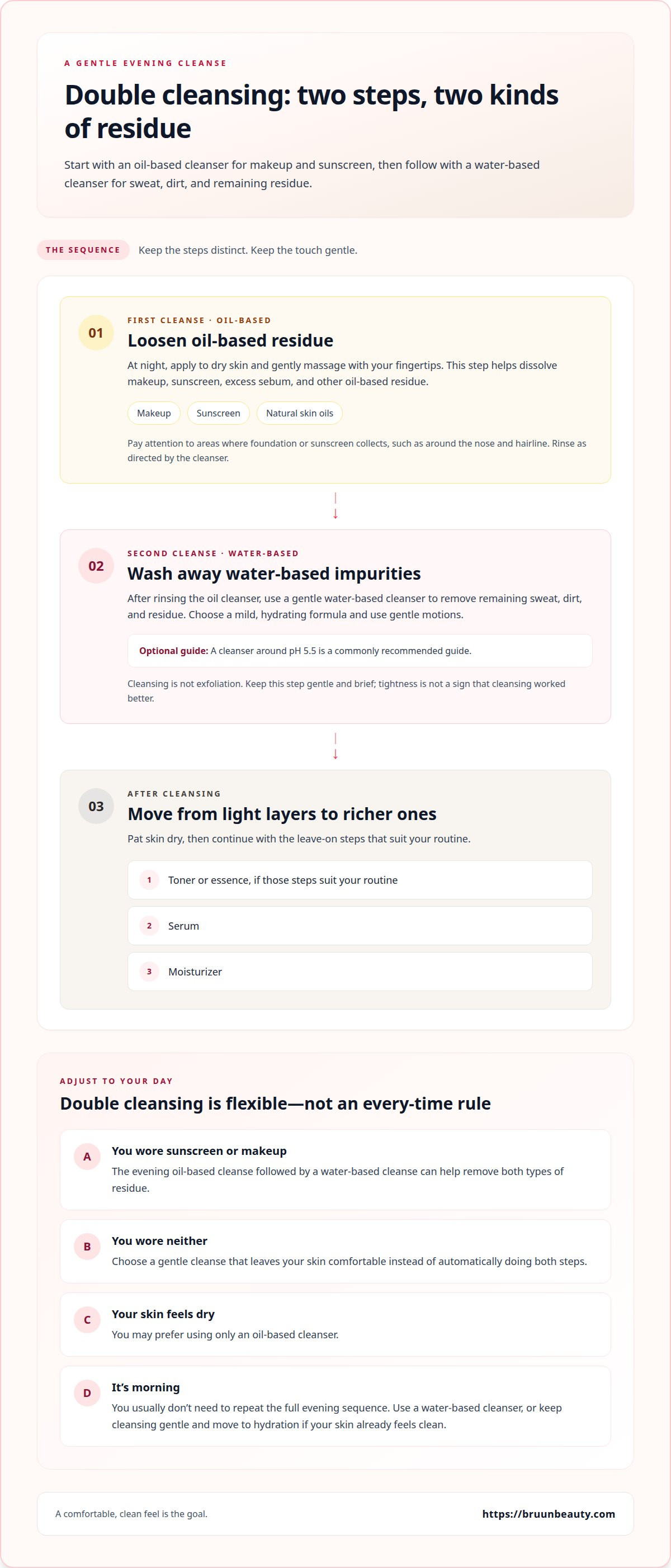
Double cleansing starts with an oil-based cleanser, followed by a water-based cleanser. The first step loosens oil-based residue; the second washes away water-based impurities such as sweat and dirt.
- Start with an oil-based cleanser at night. Use it on dry skin to dissolve makeup, sunscreen, excess sebum, and other oil-based residue. Gently massage with your fingertips, paying attention to areas where foundation or sunscreen collects, such as around the nose and hairline. Rinse as directed by the cleanser.
- Follow with a gentle water-based cleanser. After rinsing the oil cleanser, use a water-based formula to remove remaining sweat, dirt, and residue. A mild, hydrating cleanser helps complete the double cleanse without making the routine feel like a scrub. Look for a cleanser around pH 5.5 if you want to follow that commonly recommended guide.
- Keep the two steps distinct. The oil cleanser targets makeup, sunscreen, and natural skin oils; the second cleanser handles water-based impurities. If you wore long-wear makeup and sunscreen, this pairing can help remove both types of residue before you apply leave-on products. Use gentle motions, and don’t treat cleansing as exfoliation.
- Adjust the routine to what you wore. Double cleansing is most useful in the evening when sunscreen or makeup needs removing. If you didn’t wear either, choose a gentle cleanse that leaves your skin comfortable. Dry skin may prefer using only an oil-based cleanser, while oily skin can still use oil cleansing as the first part of a double cleanse.
- Make morning cleansing simpler. You usually don’t need to repeat the full evening sequence after waking. A water-based cleanser can refresh skin, or you can keep the morning routine gentle and move to hydration if your skin already feels clean. Choose based on how your skin feels, not on a rule to use both cleansers twice daily.
- Continue with leave-on skincare. Pat skin dry, then apply toner or essence if those steps suit your routine. Follow with serum and moisturizer, using lighter textures before richer ones. A comfortable, clean feel is the goal; tightness isn’t a sign that cleansing worked better. Keep the second cleanse gentle and brief.
Moisturizers and preventing moisture loss
After watery layers and serums, apply moisturizer to help reduce moisture loss. In the morning, finish with sunscreen. Apply eye cream gently around the eye area.
-
Seal in Hydration With Moisturizer
Apply moisturizer after your essence and serums, while your skin still feels comfortable. It helps slow transepidermal water loss, the movement of water from skin into the air. Choose a texture that suits your skin: a lighter lotion may feel comfortable during the day, while a richer cream may suit your evening routine.
- Keep moisturizer in its role. It supports hydration but doesn’t remove dead skin cells, so it isn’t a substitute for exfoliation. If you use a concentrated serum, apply it before moisturizer. A simple order is water-based cleanser, toner or essence, serum, then moisturizer.
Let your skin’s feel guide how much you apply. If a thick layer feels heavy, use less or choose a lighter formula. Aim for a comfortable finish, not a coated feeling.
-
Include Eye Cream With Moisturizer
Apply eye cream gently around the eye area, using light taps instead of pulling the skin. Use it in your morning and evening routines if it suits you. Follow with facial moisturizer, taking care not to rub the eye area as you spread it.
- Finish your morning routine with sunscreen over moisturizer. Apply two to three fingers’ worth to your face and neck, then reapply every two hours throughout the day. Sunscreen is the final skincare layer, so apply it after eye cream and moisturizer, before makeup.
At night, leave out sunscreen and finish with moisturizer. Your evening routine can be shorter: cleanse with an oil- or water-based cleanser as needed, apply your hydration layers, then moisturize. This keeps daytime sun protection separate from nighttime moisture care.
Moisturizer’s role is to help prevent moisture from leaving the skin, a process called transepidermal water loss. Keep eye cream in both daily routines, morning and night, and gently tap it around the eye area. For morning sun protection, Soko Glam recommends 2-3 fingers’ worth of sunscreen on the face and neck as the final step. Skip night cream in the morning and go straight to a BB cream or a product with SPF.
Sheet masks
A Korean routine can include an oil cleanser, water-based cleanser, exfoliant, toner, essence, serum, sheet mask, eye cream, moisturizer, and morning sunscreen. You don’t need every product daily. Use a sheet mask as an occasional hydration step after essence and before moisturizer.
- Choose a mask that fits the routine. A sheet mask holds a serum-like essence against your skin for a short, focused hydration step. A wash-off mask is applied and rinsed away, while a sleeping mask stays on overnight as the final layer. Choose based on the texture and finish you want, not on the assumption that all masks do the same job.
- Apply your sheet mask after cleansing and essence. Smooth it over clean skin, aligning the eye, nose, and mouth openings without pulling. Leave it on for 15-20 minutes, then remove it and gently press leftover essence into your skin. Follow the product’s directions, and don’t leave the mask on until it dries.
- Use masks as an occasional care step. A sheet mask can fit once or twice a week, rather than replacing your daily moisturizer. If you exfoliate, keep that as a separate step in your routine and avoid treating a mask as a way to remove dead skin. The purpose here is hydration, not exfoliation or massage.
- Layer moisturizer and facial oil thoughtfully. After removing the mask, apply moisturizer to help hold onto the added moisture. If facial oil is part of your routine, apply it after moisturizer as a final nourishing layer. Add eye cream gently around the eye area, rather than placing a sheet mask over the delicate skin unless its design allows it.
- Keep sunscreen for daytime. Use a sheet mask in the evening or before your morning skincare layers, but always finish a morning routine with sunscreen. Don’t treat a mask as sun protection. For an alternative mask format, jelly mask options offer another way to add a mask step to your care routine.
Sheet masks are designed for a set wear time, while sleeping masks stay on overnight and wash-off masks are rinsed away. Choose one mask format for your routine rather than layering several masks. A simple sequence is cleanse, essence, sheet mask, moisturizer, then sunscreen the next morning.
Korean skincare as a flexible, personalized routine
The Korean 10-step skincare routine works best as a flexible menu, not a fixed checklist. Keep the products that feel comfortable and serve a clear purpose for your skin.
-
Tailor the Routine to Your Skin
Choose cleanser, toner, essence, serum, and moisturizer based on texture and how your skin feels. If your skin feels dry after cleansing, try a gentler formula; if rich creams feel heavy, opt for a lighter texture. Apply products gently and introduce one new formula at a time so you can tell whether it suits your routine.
The steps generally move from cleansing to hydration and targeted products, then moisturizer. Optional treatments can be left out. To start simply, focus on cleansing, hydration, and moisturizer, then adjust based on what your skin needs.
-
Limit Product Overuse and Active Combinations
Keep your routine focused instead of layering several products with similar purposes. For example, choose one exfoliating product rather than combining multiple exfoliating formulas in the same session. Add new products one at a time and follow their directions, so you can identify which textures and ingredients work comfortably together.
If your skin feels tight or looks less smooth after a change, pause the newest product and return to familiar basics. This makes it easier to see whether the addition suits you, without rebuilding your routine or adding more products to compensate.
-
Consider Routine Cost
There’s no single cost for a Korean skincare routine in the United States. Your total depends on the products you choose, their sizes, and how often you replace them. Start with products that fill everyday roles rather than buying every category at once.
Before adding an essence, serum, or mask, consider its purpose and whether you’ll use it regularly. This helps you prioritize products that fit your preferences and routine. The number of steps alone doesn’t determine what you need to spend.
Make changes gradually and keep the products that feel useful. A routine you can follow consistently is more practical than one built around completing every step.
Bruun Beauty
Bruun Beauty offers skincare products and treatment supplies for different parts of your routine. If you’re refining a Korean-inspired regimen, choose products according to the step you want to support, whether that’s an occasional mask, a microneedling routine, or professional BB Glow supplies.
For readers whose skincare practice already includes microneedling, the Advanced Microneedling Serum SD - Control Salmon DNA Ampoule Serum is a relevant product to explore. Its name identifies it as a microneedling serum; it isn’t a toner or a replacement for your daily essence and moisturizer. Keep your everyday hydration routine distinct, and follow the product’s directions for its intended use.
Jelly Mask Kits may suit an occasional mask step when you want an alternative to a sheet mask. Treat them as one optional part of your routine, not a substitute for cleansing, moisturizer, or morning sunscreen. Choose a mask because it fits your routine, rather than adding products simply to reach ten steps.
BB Glow Treatment Supplies are for professionals working with BB Glow treatments, not a required part of a basic home hydration routine. This distinction helps you match supplies to the task: everyday skincare products support your regular routine, while treatment supplies are for the treatment context.
For estheticians and spa or clinic owners, these categories help organize product choices around different skincare needs. Advanced at-home enthusiasts can keep their routine focused on the basics, then consider an optional mask or a microneedling product only when it fits their existing practice. The ten-step approach remains flexible: no single product turns it into a fixed checklist.
Explore Bruun Beauty’s offerings based on the step or treatment context you’re building around. If you have questions about a product, contact Bruun Beauty.
Build a Routine You’ll Keep Using
Let your skincare routine evolve with your habits, preferences, and the way your skin feels. Treat a Korean 10-step skincare routine explained as a flexible framework, not a scorecard. You can start with a manageable selection, then make thoughtful changes instead of adding several new products at once.
Give each adjustment time to become part of your routine. Notice whether the textures feel comfortable and whether the steps fit your morning or evening schedule. If a product doesn’t suit your preferences, simplifying is a useful choice, not a setback.
For your next step, explore products for professional microneedling and choose what fits your skincare practice. Keep your everyday routine focused on products you enjoy using consistently, and let optional treatments remain optional.
With a routine shaped around your needs, you can move forward with confidence and enjoy caring for your skin.
Frequently Asked Questions
Does Korean skincare work for everyone?
Korean skincare can suit a wide range of preferences, but the same products won’t feel right for everyone. Choose formulas based on your skin’s comfort, texture preferences, and daily habits. For example, if several layers feel heavy in humid weather, use fewer lightweight products. The key is flexibility: adapt the approach rather than expecting one fixed routine to suit everyone.
What is Korean skin care?
Korean skin care refers to skincare products and routines associated with South Korea’s beauty industry. The term often describes an approach built around cleansing, hydrating layers, and protecting skin during the day. Products can include cleansers, toners, essences, serums, masks, and moisturizers. Use these categories in a short routine or a longer sequence, depending on what fits your needs.
What is “glass skin”?
“Glass skin” describes a beauty look that appears smooth, hydrated, and luminous, with light reflecting evenly across the skin. It’s an aesthetic goal, not a promise of flawless or poreless skin. For a practical approach, focus on comfortable hydration and a consistent routine instead of piling on products. Makeup and lighting can also affect how reflective skin appears.
Where should you start with Korean skincare?
Start by identifying what you want your routine to do, such as remove makeup comfortably or help dry-feeling skin feel more hydrated. Choose products that serve those purposes, then use them consistently before adding optional steps. If you wear makeup, plan an evening cleanse that removes it. For daytime, make sun protection part of your regular routine.
Why is Korean skincare so buzzworthy?
Korean skincare draws interest because it offers many product formats and encourages routines built around hydration and layering. Essences, ampoules, and sheet masks can make the routine feel different from a basic cleanser-and-moisturizer approach. The appeal is also practical for curious skincare fans: you can try one category at a time without committing to every step.
Is the 10-step Korean skincare routine necessary or suitable for all skin types?
No. The ten-step format is optional, and your skin doesn’t need every category to benefit from a routine. If you prefer fewer products, focus on the steps that fit your day and feel comfortable. Someone who dislikes multiple textures can keep a simple routine, while a skincare enthusiast may add an occasional mask or essence.
How should sunscreen fit into a Korean skincare routine, and how often should it be reapplied?
Apply sunscreen as the final skincare step in the morning, after moisturizer and before makeup. Reapply every two hours throughout the day. If you’ll be away from home, keeping sunscreen with your daily essentials can make reapplication easier to remember. Use a product intended for sun protection and follow its directions.
What is the difference between morning and evening Korean skincare routines?
A morning routine prepares skin for the day, with sunscreen as its final skincare step. An evening routine focuses on removing the day’s makeup and sunscreen before applying your chosen leave-on products. For example, after a makeup-free day, you may not need the same cleansing sequence as after wearing foundation and sunscreen.
Microneedling for atrophic scars: clinic or at-home results
How to Explain Microneedling Benefits for Skin and Scars
Related Posts

PDRN Benefits for Skin: Regeneration, Results and Safety

How to Dispose of Used Microneedle Cartridges Safely

Self-care rituals for better skin through mindful daily habits

How to Explain Microneedling Benefits for Skin and Scars

Microneedling for atrophic scars: clinic or at-home results

V-Line Lifting Masks and Their Claimed Face-Shaping Effects
