

Microneedling for Hands: Results, Sessions and Candidacy
Microneedling for aging hands uses fine needles to create controlled microchannels in the skin, supporting its natural renewal process and collagen and elastin production. A course commonly involves 3-5 sessions spaced 4-6 weeks apart, with improvements in texture, tone, and firmness becoming noticeable over time. Because the skin on the backs of your hands is thin, needle depth needs careful professional assessment.
Your hands can show changes in texture and firmness, so it makes sense to look for options that support gradual, natural-looking improvement. This guide explains what microneedling is, how it may affect the appearance of aging hands, and what to expect from sessions and recovery. You’ll also learn which concerns may make you a suitable candidate and when another approach may be more appropriate.
Key Takeaways
- Learn which changes in hand texture and fine lines may be discussed when considering microneedling.
- Understand how the skin’s natural renewal process shapes gradual changes in firmness and appearance.
- Plan for recovery with sun protection and gentle, hydrating hand care.
- Review health factors, including active skin conditions and certain medications, that can affect candidacy.
- Explore how Advanced Microneedling Serum SD - Control Salmon DNA Ampoule Serum fits into Bruun Beauty’s microneedling-focused range.
Which hand concerns may be discussed at a consultation?
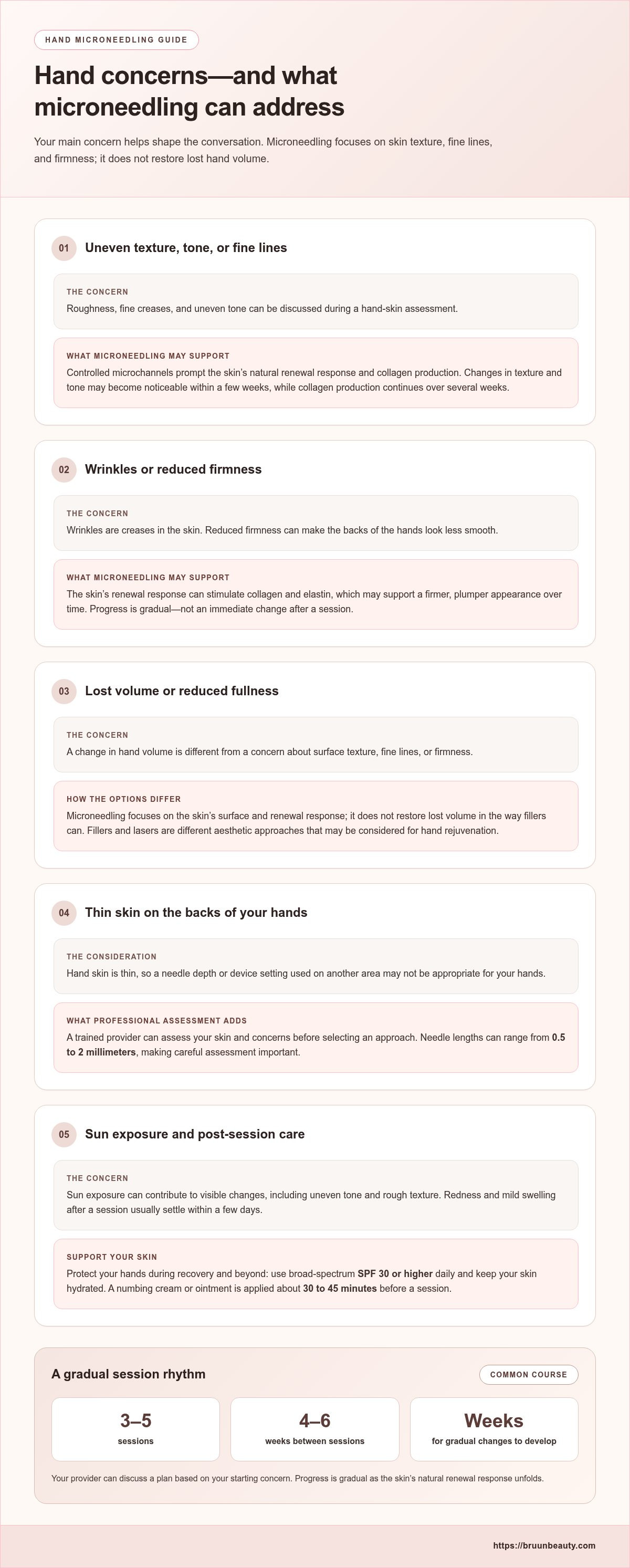
Microneedling may improve the appearance of hand texture, fine lines, wrinkles, and firmness by stimulating collagen production. Because the skin on the backs of the hands is thin, an assessment of your skin and concerns is important before choosing an approach.
Skin Texture, Tone, and Fine Lines
Uneven texture, fine lines, and changes in tone are concerns to discuss during an assessment. Microneedling creates controlled microchannels that prompt the skin’s renewal process and collagen production. You might ask whether roughness or fine creases are suitable goals for treatment. Changes in texture and tone may become noticeable within a few weeks, while collagen production continues over several weeks.
Wrinkles and Skin Firmness
Wrinkles are creases in the skin, while reduced firmness can make the backs of your hands look less smooth. Microneedling may support a firmer, plumper appearance over time by stimulating collagen and elastin. It may soften the appearance of hand aging, but it does not restore lost volume in the way fillers can. Before choosing an approach, identify whether texture, wrinkles, or volume is your main concern.
Aging, Damaged Skin, and Sun Exposure
Sun exposure can contribute to visible changes in hand skin, including uneven tone and rough texture. During a consultation, describe your concerns and share your sun-protection habits, since protecting your hands remains important during healing and beyond. Use broad-spectrum SPF 30 or higher on your hands daily, and keep skin hydrated. Redness and mild swelling after microneedling usually settle within a few days.
Professional microneedling gives a trained provider the opportunity to assess the thin skin on your hands and select an appropriate needle depth. Needle lengths can range from 0.5 to 2 millimeters, so careful assessment matters. A numbing cream or ointment is applied about 30 to 45 minutes before a session. For readers exploring professional microneedling, microneedling options offer a relevant overview.
At-home dermarolling and professional microneedling both use fine needles, but professional care includes an assessment of your skin and controlled treatment. That assessment matters especially on the thin skin on the backs of the hands. Don’t assume that a device or depth suited to another area is appropriate for your hands.
Microneedling focuses on texture, fine lines, and firmness. Fillers and lasers may be combined for hand rejuvenation, while chemical peels offer another option for surface concerns; peeling after a hand peel usually lasts 5 to 7 days. Discuss which concern matters most, since these approaches address different goals.
In the United States, the amount you pay depends on factors such as location, provider, and whether sessions are purchased individually or as a course. Ask what a quoted session includes and whether a series is recommended; hand microneedling commonly involves 3 to 5 sessions spaced 4 to 6 weeks apart.
How microneedling stimulates collagen and elastin
Microneedling creates controlled microchannels that activate the skin’s natural renewal process. On your hands, this response involves fibroblasts, the cells that produce collagen and elastin.
Collagen Induction Through Microneedling
Collagen induction is the skin’s response to controlled microchannels, which signal fibroblasts to support new collagen production. Collagen helps provide structure, and gradual renewal may improve the appearance of hand texture and fine lines. The needles do not add collagen directly. They prompt a response that unfolds over time, so changes are not immediate after a session.
Collagen production continues for several weeks after the procedure. The goal is a gradual change in skin appearance, not an immediate increase in hand volume. Someone focused on crepey texture may notice a different improvement from someone concerned mainly with deeper wrinkles. The skin’s response develops through its own renewal activity.
Needle depth and technique influence how the skin responds. Because the backs of the hands have thin skin, a professional should assess the area before selecting an approach. This helps keep treatment controlled instead of applying the same settings used on another body area. An assessment can also clarify whether texture or firmness is the main concern.
Elastin and Filler-Related Collagen Production
Elastin supports skin flexibility, while collagen provides structure. Microneedling can stimulate both through the skin’s renewal response. These proteins have different roles, so improved firmness and smoother-looking texture are related but distinct goals. Bio-stimulating fillers are another aesthetic approach associated with collagen production, but they work differently from microneedling and are not interchangeable with it.
Microneedling creates controlled microchannels across the skin, while fillers address hand rejuvenation through a different approach. A dermatologist may recommend combining fillers and lasers, depending on the concerns being addressed. An assessment should distinguish texture, fine lines, firmness, and volume rather than treating them as a single issue.
Understanding that distinction helps clarify what each option is intended to change. Microneedling focuses on the skin’s surface and renewal response; fillers use a different aesthetic technique. Ask how the proposed approach relates to your specific concern, such as rough texture versus reduced fullness. Clear goals make it easier to assess progress over time.
For a professional setting, the microneedling collection can help you explore tools and supplies relevant to this procedure. Keep the focus on controlled technique and appropriate assessment, especially for the thin skin across the hands.
Treatment frequency and expected results
Think of hand microneedling as a gradual cosmetic process, with progress measured against your starting concern. A useful plan distinguishes surface roughness from wrinkles or changes in firmness, since each describes a different visible outcome. This helps you judge whether the approach matches your priorities.
Published findings on one variation require careful interpretation. A prospective study of microneedle fractional radiofrequency reported a 44 percent improvement in surface roughness in treated hands compared with controls. That finding applies to the radiofrequency method studied, not automatically to standard microneedling with a pen or roller. The device and procedure matter when interpreting results.
Track changes consistently instead of relying on memory. Note which areas concern you, such as the backs of your hands or the skin around your knuckles. Photos taken in similar lighting can make gradual texture changes easier to compare. Keep notes focused on your original goal rather than expecting one procedure to change every aspect of hand appearance.
Some people may have microneedling once a year for maintenance after their initial treatments. Maintenance planning is separate from the first course and should reflect how your skin looks over time. If uneven tone is your main concern, compare that feature directly instead of judging the outcome only by firmness.
Can microneedling be combined with PRP or topical products for hand rejuvenation? A topical product may be part of a procedure plan, while PRP is a separate addition. The method chosen and the product’s intended use determine how they fit together, so don’t assume every serum or add-on belongs in every session.
Before committing to a plan, define what success would look like in practical terms. You might aim for a smoother appearance across the backs of your hands or less noticeable fine lines. Clear goals give you a more useful basis for discussing progress than a broad expectation of “younger-looking” hands.
Microneedling results may last up to five years, but that is not guaranteed for everyone. A course of treatments may be needed for the best results, so keep both the possible duration and the need for a course in mind when setting expectations.
Ideal candidates and contraindications
Microneedling may suit adults seeking gradual improvement in hand texture, fine lines, or firmness. Suitability depends on your skin condition, health history, medications, and the concern you want to address. Be specific about your goal: smoother-looking texture is different from restoring lost hand volume, which microneedling does not provide.
Before screening, list your current medications and relevant skin history. Include steroid use and blood thinners, even if you take them for a condition unrelated to your hands. Don’t stop or change prescribed medication for a cosmetic procedure without direction from the clinician who manages it.
- Disclose steroid use or blood thinners.
- Describe active skin conditions on your hands.
- Share a personal history of keloid scars.
- State the specific change you hope to see.
Active infections, eczema, psoriasis, or a tendency to develop keloid scars can make someone unsuitable for microneedling. Mention the affected area and whether you have symptoms now. For example, describe a psoriasis flare on the backs of your hands rather than only mentioning a past diagnosis. This context helps assess the skin being considered.
What are the risks and side effects of microneedling on hands? Redness and mild swelling can occur after the procedure. Contact your healthcare provider if swelling lasts longer than a week or bleeding continues beyond 24 hours.
Use the screening conversation to clarify what the procedure can and cannot address. Fine lines and texture differ from volume loss. If fuller-looking hands are your priority, say so directly; that goal points to a different aesthetic approach than microneedling.
Bring questions about your routine, too. Share the products you use on your hands and any recent changes, such as adding an active ingredient or experiencing irritation. These details give the clinician a clearer picture of your skin when considering whether microneedling fits your goals.
Timing matters if your hands have a current flare, rash, or infection. Describe when it began and whether it has changed, not just how it looks on the day of your appointment. Clear, accurate details help distinguish a stable cosmetic concern from a skin issue that needs attention first.
Why hands show signs of aging
Your hands are visible during everyday tasks, yet they often get less attention than your face. Walking outside, driving, or gardening can expose the backs of your hands while sleeves cover your arms. Repeated exposure over time can contribute to changes in appearance and skin tone.
Coverage is only part of the difference. The backs of your hands have thin skin, so changes in texture and firmness can stand out. Crepey-looking skin or fine lines may be easier to notice there than on areas with thicker skin. The palms have a different texture, so cosmetic concerns often focus on the backs of the hands.
Hand aging can appear in different ways. You might notice uneven tone alongside rough texture, or crepey skin alongside fine lines. These features do not necessarily share the same cause or respond to the same approach. Naming the specific change you want to address makes an assessment more focused than asking for general rejuvenation.
Daily routines can shape which areas draw your attention. Someone who drives often, for example, may notice that the hand resting near the window looks different from the other. A gardener may focus on roughness or uneven tone across several fingers. These examples can help describe a concern, but do not establish its cause.
Skin structure also affects how aging appears. Collagen supports skin structure, while elastin contributes flexibility. Changes in these features can make lines and reduced firmness more visible. An approach focused on skin texture differs from one intended to address hand volume, so describe whether your concern is crepey texture, tone, or fullness.
Think of hand rejuvenation as matching an approach to a visible concern, not choosing one procedure for every change. Microneedling may focus on texture and fine lines, while other cosmetic options have different aims. A chemical peel, for instance, is a separate procedure. Discussing your priorities helps keep the conversation specific and realistic.
Look at both hands in consistent lighting before describing what you see. Note whether the change is concentrated on the backs, around the knuckles, or across several fingers. This gives you concrete language for discussing appearance and skin tone without assuming every visible difference has the same explanation.
Bruun Beauty: Advanced Microneedling Serum SD - Control Salmon DNA Ampoule Serum
Advanced Microneedling Serum SD - Control Salmon DNA Ampoule Serum is a skincare option to explore alongside a microneedling routine. Its salmon DNA ampoule format may interest professionals and experienced skincare enthusiasts considering serum pairings. Follow professional guidance on product choice and application, especially while skin is recovering.
Browse the Salmon DNA ampoule serum to learn more about this offering. Bruun Beauty also carries Jelly Mask Kits and BB Glow Treatment Supplies for other skincare routines. Choose products based on your specific routine and how they fit its needs.
Visit bruunbeauty.com to explore the serum and related skincare products.
Take the Next Step Toward Thoughtful Hand Care
If you’re considering microneedling for hands aging, make your next step a clear conversation about your goals, skin history, and aftercare. This helps focus on the changes you want to address and the approach suited to them. A gradual skincare plan can also include everyday habits, such as moisturizing your hands and protecting them from sun exposure.
Bruun Beauty offers Advanced Microneedling Serum SD - Control Salmon DNA Ampoule Serum, professional microneedling devices, and Jelly Mask Kits. These products serve different roles in a skincare routine, so choose based on your needs and professional guidance. The serum may suit those exploring microneedling-focused skincare, while the specialized tools are designed for effective microneedling use.
Small, informed choices can help you build a practical, consistent routine. Keep your goals realistic, care for your hands gently, and take the next step when you’re ready.
Frequently Asked Questions
What is microneedling?
Microneedling is a cosmetic procedure that uses fine needles to create controlled microchannels in the skin. These channels prompt a natural renewal response, including collagen production. For hands, the aim is to improve the appearance of texture, fine lines, and firmness gradually. It differs from applying a serum alone because the procedure uses a device to create the channels.
What happens during a professional hand treatment?
A professional session begins with an assessment of your hands and the concern you want to address. A numbing cream or ointment is applied about 30 to 45 minutes beforehand. The provider then selects an approach for the thin skin on the backs of your hands and performs the procedure. Appointment length varies with the treatment area, from 15 minutes to a few hours.
How does microneedling work on hand skin?
Fine needles create controlled microchannels that activate the skin’s renewal response. Fibroblasts, which are skin cells, support the production of collagen and elastin. These structural proteins help skin maintain firmness and flexibility. Production continues over several weeks, so the appearance of hand skin changes gradually, not immediately. A professional assesses needle depth carefully because the backs of the hands have thin skin.
What results can you expect from hand microneedling, and how long do they last?
You may notice changes in hand texture, tone, and firmness within a few weeks, with continued improvement over several months. The skin may look improved for around three months after a session. Results vary with your starting skin condition, the concern addressed, and your ongoing care. Daily sun protection helps protect your hands during recovery and afterward.
How many hand microneedling sessions are needed, and how far apart?
A common course includes 3 to 5 sessions, spaced 4 to 6 weeks apart. The series gives your skin time between appointments while its renewal response continues. Your plan can depend on whether your priority is fine lines, texture, or firmness. Ask how progress will be assessed across the course, rather than judging the result immediately after one appointment.
What is the recovery time and aftercare for microneedling hands?
Redness and mild swelling usually settle within a few days, and most people resume normal activities within 24 to 48 hours. Keep your hands out of the sun until the skin heals, then use SPF 30 or higher daily. An ice pack may ease irritation. Contact your healthcare provider if swelling lasts longer than a week or bleeding continues beyond 24 hours.
Who should avoid microneedling for aging hands?
Active infection, eczema, psoriasis, or a tendency to develop keloid scars can make microneedling unsuitable. Tell the provider about steroid use and blood thinners before planning a session. Also mention any rash, flare, or unusual scarring on your hands. This information helps assess whether the procedure suits your skin and health history, not just your cosmetic concern.
How does microneedling compare with laser treatment, IPL, fillers, and chemical peels for aging hands?
Microneedling supports gradual improvement in texture, fine lines, and firmness, while fillers address volume; lasers may be combined with fillers for hand rejuvenation. Chemical peels are another option for surface concerns, with peeling usually lasting 5 to 7 days. The article provides no comparison with IPL.
Dr Pen Microneedling for Body Treatments
Dr Pen Microneedling for Body Treatments
Related Posts

PDRN Benefits for Skin: Regeneration, Results and Safety

How to Dispose of Used Microneedle Cartridges Safely

Self-care rituals for better skin through mindful daily habits

How to Explain Microneedling Benefits for Skin and Scars

How to use a Korean 10-step skincare routine for hydration

Microneedling for atrophic scars: clinic or at-home results

V-Line Lifting Masks and Their Claimed Face-Shaping Effects
