

Microneedling Serum Mistakes: Are You Sabotaging Your Glow?
What if the very product you're using to enhance your results is actually the reason your skin is red, itchy, and breaking out? You've invested in a quality microneedling device and carved out time for your session, so it's incredibly frustrating when you don't see that immediate "glass skin" radiance. Many skincare enthusiasts unknowingly make common microneedling serum mistakes by applying formulas that contain hidden irritants like synthetic fragrances, alcohols, or harsh preservatives into newly opened micro-channels.
We all want that lit-from-within glow, but forcing the wrong ingredients deep into your dermis can lead to lingering irritation and unexpected breakouts. You deserve a safe, radiant finish without the fear of permanently damaging your skin barrier. In this article, you'll learn exactly which professional-grade formulas to trust and how to choose the right "slip" for your device to ensure a smooth, effective treatment.
We're going to dive into the science of Salmon DNA (PDRN) and explain why certain K-beauty staples are the gold standard for nourishment. You will discover how to avoid common pitfalls and which soothing steps, like applying a cooling jelly mask, can significantly speed up your recovery time for a flawless finish.
Key Takeaways
- Learn how to identify and avoid common microneedling serum mistakes that cause deep-tissue inflammation and prevent your skin from glowing.
- Discover why standard daily serums are often unsafe for micro-channels and which "red flag" actives like Retinoids can sabotage your results.
- Understand the importance of molecular weight and "slip" to help your Dr. Pen device glide effortlessly without dragging or scratching the skin surface.
- Master the essential 24-hour recovery protocol to protect your skin barrier and ensure your micro-channels close safely for a radiant finish.
- Explore the benefits of using professional-grade Salmon DNA (PDRN) serums specifically formulated for deep absorption and nourishment.
The 'Channel' Theory: Why Your Daily Serum Might Fail
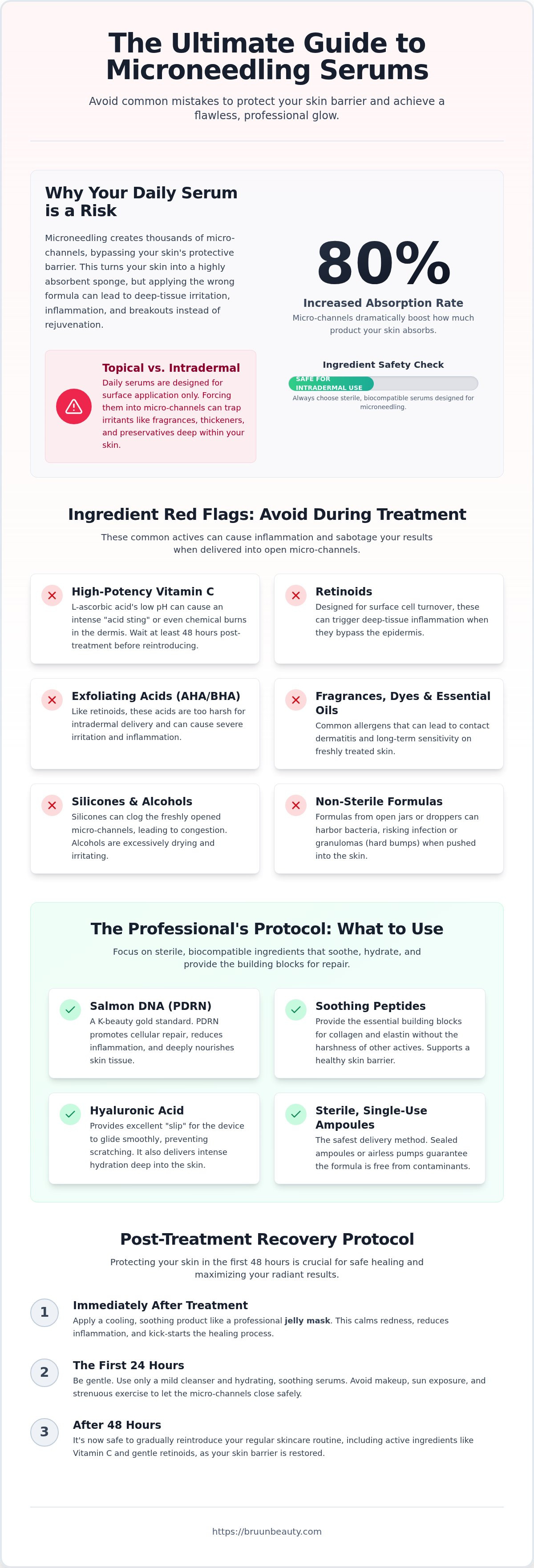
Think of your skin as a protective shield. Its main job is to keep the outside world out, which is why most of your expensive skincare just sits on the surface. When you perform Collagen induction therapy, you're using a device like a Dr. Pen to create thousands of microscopic pathways into the dermis. These micro-channels increase your skin's absorption by up to 80%, turning your face into a literal sponge.
One of the most common microneedling serum mistakes is assuming your favorite daily moisturizer or serum is safe to use during this process. Standard skincare is designed for topical application. It contains thickeners, fragrances, and large molecules intended to stay on the skin's surface. When these ingredients are forced into micro-channels, they become trapped under the surface, which can lead to long-term irritation or even scarring.
Topical vs. Intradermal Delivery
Your skin barrier naturally filters out molecules larger than 500 Daltons to protect your body. Microneedling bypasses this security system entirely. This shift from topical to intradermal delivery means your serum acts as a "payload" rather than just a lubricant. The serum isn't just there to help the needles glide; it's being delivered directly into your living tissue.
Micro-channels are temporary gateways for deep nourishment that stay open for a short window after your session. Because these pathways lead directly to the deeper layers of your skin, the ingredients you choose must be specifically formulated for internal delivery. Using a serum with the wrong molecular weight or complex chemical fillers is a common way people accidentally sabotage their results.
The Danger of Non-Sterile Formulas
Many "clean beauty" products use botanical preservatives that are wonderful for the skin's surface but potentially reactive when pushed deep into the dermis. If these non-sterile ingredients are trapped in the micro-channels, your immune system may react by forming granulomas. These are small, hard bumps that occur when the body tries to wall off a foreign substance it doesn't recognize.
Packaging also plays a huge role in safety. Serums in open jars or droppers that touch your face can easily harbor bacteria. For a safe, professional-grade result, you should always opt for sealed ampoules or airless pumps designed for single-use sessions. You can explore professional microneedling serums that are specifically designed to be biocompatible and sterile, ensuring you avoid the most frequent microneedling serum mistakes.
Ingredient Red Flags: Actives to Avoid During Your Session
Applying the wrong formula can quickly turn a rejuvenating session into a skin disaster. The absolute number one of all microneedling serum mistakes is using high-potency Vitamin C, specifically L-ascorbic acid, while the needles are active. While it's a "holy grail" for brightening on the surface, its low pH causes an intense "acid sting" when it enters open micro-channels. This can lead to localized irritation or even chemical burns in the deeper layers of your skin.
Similarly, you must avoid Retinoids and exfoliating acids like AHAs or BHAs during the actual needling process. These ingredients are designed to speed up cell turnover on the surface. If they reach the dermis directly, they trigger deep-tissue inflammation rather than healthy collagen production. You should also watch out for synthetic dyes and "natural" fragrances like essential oils. These additives can lead to contact dermatitis on sensitized skin, which is why following proper microneedling aftercare is so important for a safe recovery.
The Vitamin C Paradox
Vitamin C is a paradoxical ingredient in the world of skincare. You definitely need it for collagen synthesis, but using it *during* the procedure is counterproductive. It's best to wait at least 48 hours before resuming your high-potency antioxidant routine. During the actual session, focus on soothing peptides. These support your skin's natural barrier and provide the building blocks for repair without the harsh acidity of traditional brightening serums.
Preservatives and Fillers That Clog
Many daily serums contain silicones like dimethicone to give the product a silky feel. These are fine for topical use, but they can clog micro-channels and lead to congestion or breakouts after your treatment. Alcohol-based serums are another major red flag to avoid. They dehydrate the skin so severely that they can create an "orange peel" texture and extreme redness instead of a smooth, hydrated glow.
For deep delivery, look for Polydeoxyribonucleotide (PDRN), also known as Salmon DNA. It's a biocompatible powerhouse that provides the intense nourishment your skin craves without the risks associated with surface-level actives. If you want to ensure your routine is safe and effective, you can browse professional-grade serums designed specifically for micro-channel compatibility. This simple switch helps you avoid common pitfalls and achieve that coveted K-beauty finish.
The 'Slip' Factor: Why Molecular Weight Matters
Think of "slip" as the invisible cushion between your needle and your skin. It is the essential lubrication that allows your device to glide effortlessly across the surface without dragging, pulling, or "chattering." One of the most common microneedling serum mistakes is choosing a product that lacks this glide, which can lead to physical trauma like micro-tearing or even "track mark" scarring. When your needles stutter instead of gliding, you're no longer creating clean micro-channels; you're causing unnecessary surface damage.
The secret to perfect slip lies in the molecular weight of your ingredients. Many daily serums use high-molecular-weight Hyaluronic Acid (HA) because it creates a beautiful, hydrated film on the skin's surface. However, during a treatment, this large molecule stays on top and dries down into a sticky residue. This often causes "pilling," where the serum rolls into tiny balls under the needle head, blocking the very channels you just worked so hard to open.
The Science of Hyaluronic Acid Weights
To get the best results, you need a multi-molecular HA formula. Low-molecular-weight HA is small enough to actually enter the micro-channels, providing deep hydration where your skin needs it most. The best microneedling serums use a specific blend of weights to ensure the product provides enough surface glide for the device while still delivering active ingredients deep into the dermis. To ensure your technique is as professional as your products, you should always pair your serum with a Dr. Pen device for precision and safety.
Avoiding the 'Dry Needle' Trap
You'll know you've fallen into the "dry needle" trap if your skin starts to feel tacky or if you hear a scratching sound during your session. This happens when the serum evaporates or absorbs before you've finished a section. To prevent this, never apply serum to your entire face at once. Instead, work in small sections, such as the forehead, then the right cheek, then the left, ensuring the skin is visibly wet before the needles touch it.
Using a professional ampoule format like the SD Control Salmon DNA provides a consistent, fluid consistency that won't dry out prematurely. While Cleveland Clinic explains post-microneedling recovery involves some natural redness and shedding, you can minimize downtime by ensuring your "slip" is perfect. Maintaining a wet surface prevents the needles from creating friction heat, which helps your skin transition straight into the repair phase rather than dealing with surface-level abrasions.
Post-Procedure Blunders: The 24-Hour Recovery Rule
The first 24 hours after your session are the most critical for your skin's health. During this window, your micro-channels are still open, making your skin extremely vulnerable to environmental pollutants and bacteria. One of the biggest microneedling serum mistakes is washing your face too soon. You should wait at least 4 to 6 hours before even touching your face with water, and when you do, use only lukewarm water. Hot water can increase inflammation and lead to prolonged redness.
Avoid the gym for at least 24 to 48 hours. Sweating is your skin's way of releasing toxins, but when your channels are open, that sweat and bacteria can travel deep into the dermis. This is a fast track to post-needling breakouts or "milium" bumps. Avoiding these common microneedling serum mistakes ensures your skin stays clear and focused on regeneration rather than fighting off infection.
You might be tempted to slather on a thick, petroleum-based balm to "protect" your skin, but this can actually suffocate it. Heavy occlusives can trap heat and bacteria inside the micro-channels. Stick to lightweight, sterile serums until the channels have fully closed to avoid congestion. Once the 24-hour mark passes, you can transition to a simple, bland moisturizer to support the barrier.
The First 72 Hours: A Timeline
- 0-24 Hours: Use only your professional serum. No makeup, no sun exposure, and avoid touching your face to keep the area sterile.
- 24-48 Hours: You can introduce a very gentle, fragrance-free cleanser and a bland moisturizer. Continue avoiding direct sunlight and heavy exercise.
- 48-72 Hours: This is the time to safely reintroduce mild antioxidants and a mineral SPF. Wait at least 5 to 7 days before going back to high-potency Vitamin C or Retinol to prevent deep-tissue irritation.
Cooling Down the 'Heat' Response
Your skin will likely feel like it has a mild sunburn, but don't reach for ice cubes. Applying ice directly can cause a cold burn on compromised tissue. Instead, use a K-beauty favorite to lower skin temperature safely. You can Soothe skin with a Professional Jelly Mask, which provides an immediate cooling effect while delivering hydration without the harshness of ice.
The BRÜUN Protocol: Elevating Your K-Beauty Glow
Avoiding common microneedling serum mistakes isn't just about what you leave out; it's about the quality of what you put in. When your skin's absorption increases by up to 80% during a session, you need a formula designed specifically for that deep journey. Salmon DNA, also known as PDRN, has become the gold standard for licensed estheticians because it supports the skin's natural regenerative processes without the inflammation risks of surface-level actives. By moving away from DIY guesswork and toward professional-grade solutions, you ensure your skin stays clear, nourished, and glowing.
The "Perfect Session" is a simple three-step protocol that guarantees results while prioritizing safety. First, use a high-quality DR. PEN device to create clean micro-channels. Second, apply a biocompatible serum like Salmon DNA to provide the essential "slip" and deep nourishment. Finally, finish with a professional jelly mask to lower the skin's temperature and lock in moisture. This combination transforms a standard treatment into a luxury K-beauty experience with minimal downtime.
Why PDRN is the Esthetician's Choice
PDRN is a regenerative powerhouse that focuses on skin vitality at a cellular level. It supports your skin's natural ability to appear nourished and clear, making it the ideal "payload" for your micro-channels. Professionals across the US consistently give our Salmon DNA Ampoule 5-star reviews because it delivers that coveted "glass skin" finish without the irritation caused by traditional serums. It's the ultimate solution to the "wrong serum" problem, providing deep hydration that standard topical products simply can't match.
Your Next Steps for Radiant Skin
Ready to elevate your results? We invite you to explore our full curated collection of professional-grade tools and serums. From award-winning devices to the most advanced K-beauty ampoules, we provide everything you need for a safe and radiant finish from the comfort of your home or clinic. Stop guessing and start glowing with products trusted by the pros.
Your Path to a Flawless K-Beauty Finish
You now have the knowledge to transform your skincare routine from guesswork to professional-grade precision. By understanding how micro-channels work and why molecular weight matters for that perfect glide, you can ensure every session is both safe and effective. Mastering these details helps you avoid the most common microneedling serum mistakes that often lead to lingering redness or unwanted breakouts.
BRÜUN is here to support your journey with professional-grade PDRN formulas that are trusted by US estheticians for their purity and performance. We focus on providing the gold standard in nourishment, ensuring your skin remains clear and vibrant. With fast shipping from our hubs in Miami and Los Angeles, you won't have to wait long to start your next session with complete confidence.
Your skin is a delicate barrier, but with the right tools and serums, it can achieve a level of radiance you never thought possible. Stick to the BRÜUN protocol, listen to your skin's needs, and celebrate every step of your journey toward a healthy, nourished glow. You've got this!
Frequently Asked Questions
Can I use my regular Hyaluronic Acid serum for microneedling?
You shouldn't use your daily Hyaluronic Acid serum unless it's specifically labeled as sterile or professional-grade. Most retail serums contain thickeners, synthetic fragrances, and preservatives designed to stay on the skin's surface. When these enter micro-channels, they can cause deep-tissue irritation or even granulomas. Stick to low-molecular-weight formulas that provide the correct "slip" without the risk of trapping surface-level fillers deep inside your dermis.
What happens if I use Vitamin C immediately after microneedling?
Using Vitamin C immediately after your session is a major error. The low pH of L-ascorbic acid causes an intense "acid sting" in open pathways, leading to severe inflammation or chemical burns. Wait at least 48 to 72 hours before reintroducing high-potency antioxidants. This allows your skin barrier to close safely so you don't accidentally turn a rejuvenating treatment into a painful and prolonged recovery.
How long should I wait to apply makeup after using a microneedling serum?
You should wait at least 24 hours before applying any makeup to your face. Your micro-channels remain open during this window, and makeup particles can become trapped, leading to congestion or infection. Even mineral makeup should be avoided for the first full day. Once the 24-hour mark passes, ensure your brushes are freshly cleaned to prevent introducing new bacteria to your newly sensitized and recovering skin.
Is it normal for my skin to feel like a sandpaper texture after treatment?
Yes, a sandpaper-like texture is a completely normal part of the recovery process. This usually happens between day three and five as old skin cells move to the surface and begin to flake off. It's a sign that your skin's natural renewal process is working as intended. Don't pick or exfoliate these flakes. Instead, keep the area hydrated with a gentle, bland moisturizer to support the transition.
Can I use a microneedling serum if I have active acne?
You should never perform microneedling over active, inflamed acne or cystic breakouts. The needles can easily spread bacteria across your face, leading to a much larger flare-up or potential infection. It's best to wait until your skin is clear of active lesions before starting a session. You can still use nourishing serums topically, but keep the device away from any areas with whiteheads or painful, red inflammation.
Why does my skin feel tighter and drier after using a serum during needling?
Your skin feels tighter because of temporary transepidermal water loss. Creating micro-channels temporarily disrupts the barrier, allowing moisture to escape faster than usual. This is one of the most common results when microneedling serum mistakes occur, such as failing to follow up with enough hydration. Using a professional jelly mask immediately after your session helps lock in moisture and provides a cooling effect to soothe that tight sensation.
How do I know if my microneedling serum has gone bad or is contaminated?
Watch for changes in color, smell, or consistency. If a clear serum turns yellow or cloudy, it has likely oxidized or grown bacteria. Using contaminated products is one of the dangerous microneedling serum mistakes that can lead to skin infections. Always check expiration dates and opt for single-use ampoules. These sealed containers ensure your active ingredients are sterile every time you open a new micro-channel for delivery.
Microneedling Under Eye Wrinkles: The Ultimate Guide to Brighter, Smoother Eyes in 2026
Dr. Pen Aftercare: The Ultimate Esthetician-Approved Recovery Guide
Related Posts

Getting Spa Results on a Budget: Build a Smart At-Home Routine

Professional vs. At-Home Microneedling: Cost Comparison

Hydrogen Water Bottle Buying Guide: Choose the Right Size and Features

Microneedling for Men’s Skincare: What to Know in 2026

What Results to Expect After 3 Microneedling Sessions: A Realistic Guide

Creating a Yearly Microneedling Schedule: A Practical 2026 Guide

How to Choose Professional Esthetician Lighting: A Moon Lash Light Buying Guide
