

How Long After Microneedling Can I Do Microdermabrasion?
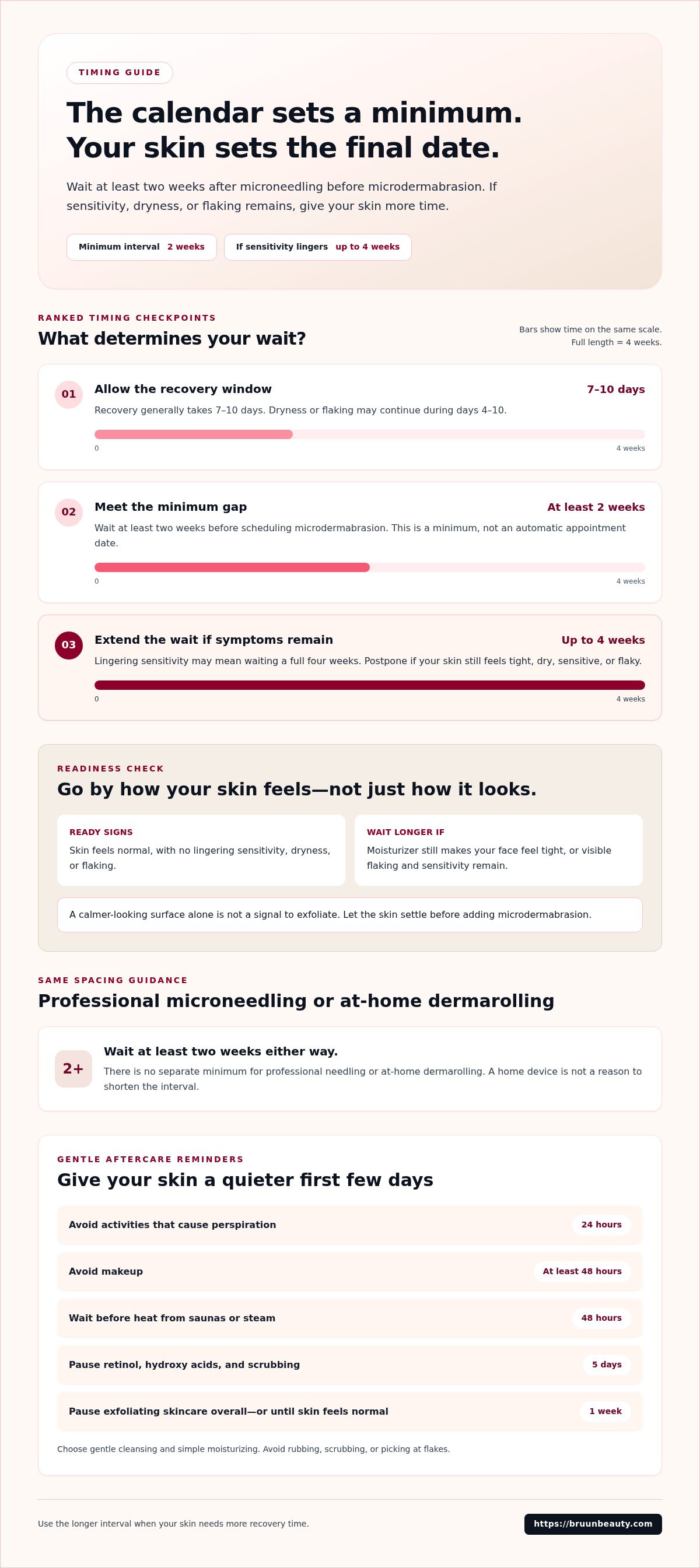
Wait at least two weeks after microneedling before scheduling microdermabrasion. If you’re wondering how long after microneedling you can do microdermabrasion, treat two weeks as the minimum and wait longer if your skin still feels sensitive, dry, or flaky. Microdermabrasion exfoliates the skin’s surface, so doing it too soon can cause additional irritation while your skin is recovering.
It’s understandable to want to maintain that smooth, refreshed feeling after a treatment. Spacing the procedures gives your skin time to settle before you add another exfoliating step.
Here, you’ll learn why waiting at least two weeks matters, which signs suggest your skin needs more time, and how to care for it between treatments. You’ll also see how microdermabrasion and microneedling differ, so you can plan their timing without rushing your skin.
Key Takeaways
- Give exfoliating skincare a break for one week after microneedling, or until your skin feels normal. Avoid retinol, hydroxy acids, and scrubbing for five days.
- Recovery can take 7-10 days. Dryness or flaking may continue during days 4-10, so don’t use smooth-looking skin alone as your signal to exfoliate.
- If your skin still feels sensitive, extend the wait before microdermabrasion; lingering sensitivity may mean waiting a full four weeks.
- Keep early aftercare gentle: avoid makeup for at least 48 hours and activities that cause perspiration for 24 hours after microneedling.
- Explore microneedling skincare options such as Bruun Beauty’s Advanced Microneedling Serum SD - Control Salmon DNA Ampoule Serum as you plan your post-treatment routine.
Avoiding exfoliation during skin recovery
After microneedling, pause exfoliation while your skin recovers. Microdermabrasion removes surface cells, so doing it too soon can intensify irritation rather than refine texture.
Recovery Time After Microneedling
Skin recovery after microneedling generally takes 7-10 days, though visible changes can continue during that period. This matters because your skin may look calmer before it feels ready for another exfoliating treatment.
During days 1-3, redness, tightness, dryness, and sensitivity can occur. From days 4-10, flaking or dry patches may appear, so don’t mistake shedding for a signal to scrub. Let the surface settle before adding microdermabrasion or abrasive products.
Risks of Early Microdermabrasion
Yes. Microdermabrasion too soon may worsen redness and irritation, and added friction can be unhelpful while your skin remains sensitive. Disrupted skin can also be more vulnerable to infection, while inflammation may contribute to uneven pigmentation, especially if your skin is prone to dark marks.
These outcomes aren’t inevitable, but waiting helps avoid adding surface exfoliation soon after microneedling. If redness, sensitivity, or flaking persists, postpone microdermabrasion rather than trying to smooth the texture yourself.
Pause exfoliating skincare for one week after microneedling, or until your skin feels normal. That includes products designed to lift dead surface cells, not just professional treatments. A cleanser that leaves your face feeling tight or stinging may also be too harsh during this pause.
Some aftercare guidance sets shorter minimums for specific ingredients: avoid retinol and hydroxy acids for five days after treatment. Avoid manual exfoliation and scrubbing for five days, too. For exfoliating products overall, the broader rule of pausing for one week, or until your skin feels normal, is practical.
- Skip: scrubs, exfoliating brushes, retinol, and hydroxy acids during the recommended pause.
- Choose: gentle cleansing and simple moisturizing without rubbing or peeling flakes.
- Resume: exfoliation only after the pause and once your skin feels normal.
Keep the rest of your aftercare gentle, too. Avoid makeup for at least 48 hours after microneedling, and avoid activities that cause perspiration for 24 hours. Heat from saunas or steam can wait 48 hours. These steps reduce extra irritation while your skin settles.
Microdermabrasion and microneedling work on different skin processes. One exfoliates the surface; the other uses needles to create controlled punctures. A microneedling routine centers on controlled needling and gentle aftercare, not extra surface exfoliation; explore microneedling care options when planning that routine.
Don’t pick at flakes or use a rough washcloth to speed up shedding. For example, if your cheeks still feel tight when you apply moisturizer, postpone microdermabrasion. Your skin’s comfort and normal feel matter more than the calendar alone.
Timing microdermabrasion after microneedling
Wait at least two weeks after microneedling before scheduling microdermabrasion. Your skin’s surface needs time to settle before another exfoliating procedure.
Should you ask your dermatologist or esthetician before scheduling? Yes, especially if sensitivity, redness, or flaking remains. They can assess these signs and your treatment timing before another procedure.
Timing by Microneedling Method
The general guidance is to wait at least two weeks after microneedling, with no separate minimum for professional needling or at-home dermarolling. Changing the setting doesn’t make early exfoliation a safe shortcut.
Allow the full interval, then consider how your skin feels and looks. If sensitivity remains, wait longer rather than assuming a home device means less recovery time.
Signs Skin Is Ready
Your skin is more likely to be ready when it feels normal, without lingering sensitivity, dryness, or flaking. These signs matter because microdermabrasion exfoliates the surface, and residual irritation can make the next treatment uncomfortable.
Use two weeks as a minimum, not an automatic appointment date. If your face still feels tight when you apply moisturizer, postpone the session until the tightness and any visible flaking have passed.
Getting Professional Guidance
Professional guidance can help if your skin still feels reactive after the waiting period or you’re unsure how to space treatments. A dermatologist can assess your suitability for both procedures, while an esthetician can review your treatment timing and visible skin condition.
Ask for guidance before booking if you have persistent redness, sensitivity, or flaking. These signs can indicate that your skin needs more recovery time, so scheduling by the calendar alone may not suit your current condition.
Recommendations vary: one dermatologist says microdermabrasion may be performed seven days after microneedling, while broader guidance recommends waiting at least two weeks. If sensitivity remains, a full four-week wait is advised. The longer interval gives irritated skin more time before surface exfoliation.
Spacing matters in the other direction, too. Guidance for a microdermabrasion preparation series recommends beginning microneedling one to two weeks after the last facial. Another professional-treatment guide advises avoiding microdermabrasion for four weeks beforehand. Because the intervals differ, use the more conservative four-week gap before professional microneedling.
So, how long should you wait after microdermabrasion before getting microneedling? Allow four weeks before a professional skin treatment, following the more conservative pre-treatment guidance. If you’re planning a series, discuss the sequence with your skincare professional, especially if exfoliation leaves your skin dry or sensitive.
Microdermabrasion may also be performed immediately before microneedling in some treatment plans, but that doesn’t mean the combination suits every schedule. The interval and order matter because both procedures affect the skin’s surface. If you’re planning microneedling, explore microneedling care options alongside a recovery-first schedule.
Does the recommended wait differ between professional microneedling and at-home dermarolling?
The practical minimum remains two weeks after either type of microneedling before microdermabrasion. The setting alone doesn’t make your skin’s surface ready sooner.
Professional microneedling and at-home dermarolling differ in where and how they’re performed. Both involve needles passing into the skin’s surface, so plan around your skin’s response rather than assuming a home session needs less recovery time. The available timing guidance sets a two-week minimum after microneedling, not separate schedules by device or setting.
That distinction matters because microdermabrasion adds surface exfoliation. If you used a roller at home, don’t treat the procedure like ordinary skincare or schedule exfoliation immediately afterward. Take the same recovery-first approach as after a professional session.
Use the same baseline, then assess your skin
Start with the two-week minimum, then consider whether your skin feels normal. If sensitivity continues, wait longer; guidance advises waiting a full four weeks when skin still feels sensitive. The calendar gives you a starting point, while lingering sensitivity is a reason to delay.
For example, if you dermarolled at home and your face still feels unusually tender after two weeks, don’t book microdermabrasion for the next day. Give your skin more time. A four-week interval is the guidance when sensitivity remains.
Keep a clear record of your method. Write down the microneedling date, whether it was done professionally or at home, and any lasting sensitivity or flaking. These details help you describe the timing accurately when planning microdermabrasion.
Why the device setting isn’t the only factor
Needle depth, technique, and your skin’s response can affect how a session feels afterward. The timing guidance doesn’t give separate wait periods for different at-home rollers or professional devices. Don’t take a device label as proof that your skin can tolerate earlier exfoliation.
Skin needling punctures the surface and starts a recovery response. Microdermabrasion, by contrast, removes dead cells from the surface. Doing the two too close together can add friction while your skin remains sensitive, regardless of where you used the microneedling device.
If you’re unsure of the date or method, use the later date as your starting point. For example, after repeated home sessions, count from the most recent session, not the first. Wait at least two weeks from that last session, and longer if sensitivity persists.
In short, don’t shorten the interval just because you used an at-home dermaroller. Apply the two-week minimum after either method, and follow the four-week guidance if sensitivity remains. Skin that still feels reactive needs more time before another exfoliating procedure.
How long does skin take to recover after microneedling?
Skin recovery after microneedling generally takes 7-10 days. That timeline describes the early recovery period, not a signal that every person’s skin is ready for exfoliation. Your skin’s feel and appearance matter alongside the calendar.
During the first 24 hours, temporary redness, warmth, or flushing can occur. Pinkness or redness may last 24-48 hours. These early changes can fade before dryness or sensitivity does, so don’t use redness alone to judge readiness.
Days 1-3 may bring tightness, dryness, redness, and sensitivity. Keep your routine gentle during this stretch instead of adding exfoliating products. For example, avoid scrubbing if cleansing leaves your face feeling tender.
From days 4-10, skin may look dry or flaky, sometimes in patches. Let flakes shed naturally rather than rubbing them away with a washcloth. Flaking is one reason a face can look uneven even as early redness settles.
Some guidance describes typical recovery as 5-7 days, while broader estimates span 7-10 days. These timelines aren’t contradictory measures of one exact moment. Visible redness, surface dryness, and sensitivity can ease at different times.
Microneedling also starts a longer process beneath the surface. New collagen initiated by the procedure develops over four to six weeks. This gradual process differs from the initial recovery period, so a refreshed appearance after one week doesn’t mean all skin changes have finished.
For microdermabrasion planning, separate those two timelines. The early 7-10-day recovery window describes common surface changes; the recommended wait before microdermabrasion is at least two weeks. If your skin remains sensitive at that point, extend the interval rather than exfoliating through discomfort.
Keep aftercare simple during the first days. Avoid makeup for at least 48 hours, and skip activities that cause perspiration for 24 hours. Avoid sauna or steam for 48 hours, since indirect heat can add discomfort while your skin feels sensitive.
Direct sun exposure also matters after microneedling. Guidance advises avoiding it for 10 days after skin needling and wearing sunscreen daily. Sunbeds and sunbathing should wait at least two weeks. These precautions help you protect the skin while surface changes settle.
Use practical checkpoints, not just one look in the mirror. Note the treatment date, then observe whether redness, dryness, flaking, and sensitivity have passed. If moisturizer still stings or your face feels unusually tight, postpone microdermabrasion. The two-week minimum is a starting point, not permission to exfoliate through lingering symptoms.
What signs show skin is ready for microdermabrasion?
Use the two-week minimum after microneedling, then assess how your skin feels and looks. A date on the calendar alone can’t tell you whether lingering dryness, flaking, or sensitivity has settled enough for surface exfoliation.
Start by noticing how your skin feels during your usual routine. Your face should feel normal when you cleanse and apply moisturizer, without unusual tightness or sensitivity. For example, if moisturizer still stings, don’t schedule microdermabrasion just because two weeks have passed.
Look for flaking to stop. Skin can look dry or shed in areas during days 4-10 after microneedling. If flakes remain beyond that window, avoid trying to remove them with a scrub or microdermabrasion. Let the surface return to its usual feel first.
Check for lingering redness, too. Temporary redness or warmth often passes within 24 hours, though pinkness or redness can last 24-48 hours. If redness persists alongside tenderness or dryness, give your skin more time instead of treating the color alone as a green light.
Use a simple readiness check before booking:
- Your skin feels normal during cleansing and moisturizing.
- Visible flaking and unusual dryness have stopped.
- Sensitivity and lingering redness have settled.
- At least two weeks have passed since microneedling.
Consider these signs together. A cheek that looks smooth may still feel sensitive, while mild dryness can make texture look uneven. Don’t cover redness with makeup and then judge the covered area as ready. Check bare skin in good light and notice how it feels when you gently apply your usual moisturizer.
Consider the full recovery pattern, not just one symptom. During days 1-3, tightness, dryness, redness, and sensitivity may occur; flaking can appear during days 4-10. If one of those changes continues after the minimum wait, extend the interval. Guidance advises waiting a full four weeks if skin remains sensitive.
Pause exfoliating products for one week after microneedling, or until your skin feels normal. Avoid retinol and hydroxy acids for five days after treatment, along with manual exfoliation and scrubbing for five days. Resuming these products isn’t a test of readiness: if an active ingredient irritates your skin, microdermabrasion should wait.
When your skin feels normal, shows no flaking, and has passed the two-week minimum, those are practical signs to discuss before scheduling. If sensitivity remains at four weeks, postpone rather than exfoliating through it.
Bruun Beauty: Advanced Microneedling Serum SD - Control Salmon DNA Ampoule Serum
Advanced Microneedling Serum SD - Control Salmon DNA Ampoule Serum is a microneedling-focused option for your skincare routine. Consider it only when your skin is comfortable with your usual products, not as a reason to shorten the wait before microdermabrasion.
Keep your routine gentle while sensitivity, dryness, or flaking remains. Once your skin feels normal, choose products that suit your routine and follow their directions. The serum doesn’t replace the two-week minimum between microneedling and microdermabrasion, or the longer wait needed if sensitivity persists.
If you’re planning your routine around microneedling, explore the serum details and decide whether it suits your skincare approach. Contact Bruun Beauty or visit Bruun Beauty online to learn more.
Plan Your Next Skincare Step With Intention
Think of your skincare calendar as part of your routine, not just a list of appointments. Knowing how long after microneedling you can do microdermabrasion helps you plan, but your next step should also reflect how your skin responds to products and procedures.
Keep your routine simple while you decide what to use next. Bruun Beauty offers Professional Microneedling Devices, Jelly Mask Kits, and Advanced Microneedling Serum SD - Control Salmon DNA Ampoule Serum for different parts of a microneedling-focused routine. Choose products to suit your needs and follow their directions rather than adding extra exfoliation.
A thoughtful pace lets you enjoy skincare without rushing from one procedure to another. Build a routine that feels manageable, keep your skin’s comfort in mind, and make each appointment part of a considered plan.
Care for your skin with patience and confidence.
Frequently Asked Questions
How Do I Care For My Skin Post Treatment?
Keep your post-procedure routine gentle: cleanse without rubbing, then apply a simple moisturizer with clean hands. For the first 24 hours, touch your face as little as possible and skip activities that cause perspiration. Avoid makeup for at least 48 hours, except pure mineral makeup. Keep perfume and perfumed products off the treated area for 48 hours to limit extra irritation.
How long should you wait after microneedling before microdermabrasion?
If you're asking, “How long after microneedling can I do microdermabrasion?” wait at least two weeks before scheduling. Use how your skin feels as an additional guide: if sensitivity lingers, wait longer, with four weeks advised when sensitivity remains. For example, don’t book based only on the date if your face still feels tender when you apply moisturizer. The minimum interval is a starting point, not a reason to exfoliate through discomfort.
What do dermatologists recommend for spacing microneedling and microdermabrasion?
Recommendations vary. One dermatologist says microdermabrasion may be done seven days after microneedling, while broader guidance recommends at least two weeks. If you're wondering how long after microneedling you can do microdermabrasion, wait a full four weeks if sensitivity continues. For the reverse order, guidance recommends avoiding microdermabrasion for four weeks before a professional skin procedure. These intervals help you plan the sequence rather than scheduling procedures too close together.
What are the risks of microdermabrasion too soon after microneedling?
Microdermabrasion too soon can increase redness, irritation, or discomfort by exfoliating a surface that remains sensitive. Extra friction can also disrupt the skin’s protective surface and increase infection risk. Inflammation may contribute to uneven pigmentation, particularly if your skin tends to develop dark marks after irritation. Don’t use a session to remove flakes; let them shed naturally and postpone exfoliation if tenderness or redness remains.
What skincare should you avoid after microneedling and before microdermabrasion?
Pause exfoliating products for one week after microneedling, or until your skin feels normal. Avoid retinol and hydroxy acids for five days, along with manual exfoliation and scrubbing for five days. Also avoid waxing or bleaching facial hair on the treated area for two weeks. Before a professional skin procedure, avoid scrubbing or exfoliating in the days beforehand so your routine doesn’t add unnecessary friction.
Microdermabrasion vs Microneedling for Scars: Which Should You Choose
What Serum to Use With Dr. Pen: The Professional Guide to Flawless Results
Related Posts

Consistent Microneedling and the Long-Term Changes to Expect

Aftercare choices to lower infection risk at home after microneedling

How to Create a Relaxing At-Home Spa Day With Simple Rituals

Sunscreen Recommendations After Microneedling: How to Protect Healing Skin

Investing in my skin for the future: what deserves my budget

Post-microneedling skincare routine for masks, makeup, and recovery

Skin Peeling After Microneedling: What to Avoid and When to Resume Makeup
