

Bubble Foam and Revital Cream: How to Choose Between Them
You don’t have to choose between bubble foam and Revital Cream: they serve different steps in your skincare routine. Bubble foam cleanses your face, while Revital Cream adds moisture afterward. Identify which step you need, or use both for cleansing followed by moisturizing.
It’s easy to assume two skincare products do the same thing, especially when both fit into a simple routine. But a cleanser and a moisturizer aren’t interchangeable: one washes away surface buildup, while the other adds moisture. The right choice depends on what your routine needs.
Learn how each product fits into your routine, what to consider when choosing between them, and how to layer them if you use both. The product description presents Revital Cream as lightweight, with hyaluronic acid, so you can compare its features when deciding what suits your routine.
Key Takeaways
- Choose a foam cleanser when your routine needs a cleansing step; choose a cream when your skin needs moisture.
- These products serve different purposes, so you can use them in sequence rather than treating them as substitutes.
- Look at the product’s role and texture to decide where it fits best in your routine.
- Learn what to consider when pairing a hydrating cream with other skincare products.
Bubble foam and revital cream
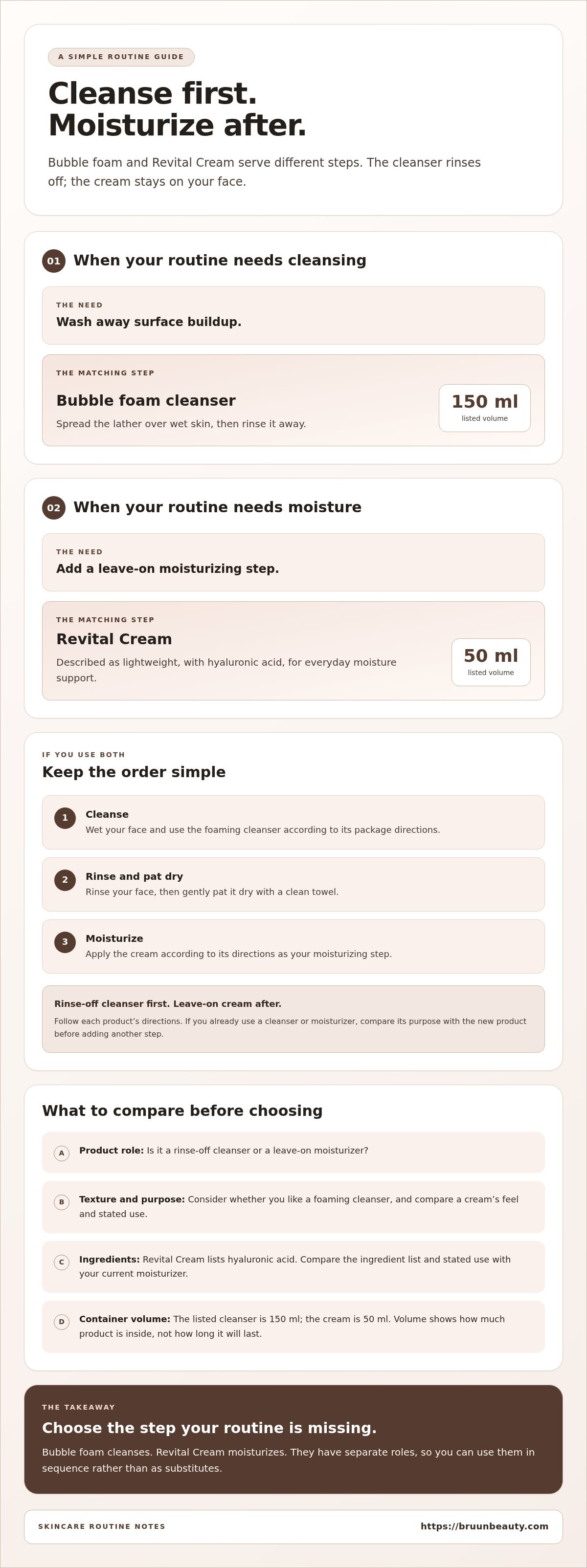
Bubble foam cleanser and Revital Cream belong at different stages of a skincare routine. A cleanser is rinsed off; a cream stays on your face after application. Decide whether you need one step or both by considering their distinct roles, rather than expecting either product to do the other’s job.
A foaming cleanser belongs in the cleansing step. Spread its lather over wet skin, then rinse it away. A cream goes on after cleansing as a leave-on moisturizer. Choose a cleanser when you need to wash your face, and a cream when you want a moisturizing step.
The listed bubble foam cleanser has a volume of 150 ml, while the cream has a volume of 50 ml. Container size tells you how much product is inside, not how long it will last. Use amount and frequency affect how quickly you finish either product, so compare packaging based on your own routine rather than assuming the larger container lasts a set time.
For a cleanser, consider whether you like a foaming texture. For a cream, compare its texture and stated purpose. Revital Cream is described as lightweight and intended to support everyday moisture, and lists hyaluronic acid as an active ingredient. These details help you compare it with other moisturizers.
If you choose both, use them in sequence:
- Wet your face and use the foaming cleanser according to its package directions.
- Rinse your face, then gently pat it dry with a clean towel.
- Apply the cream according to its directions as your moisturizing step.
Use the rinse-off cleanser before the leave-on cream. Follow each product’s directions for specific instructions. If you already use a cleanser or moisturizer, compare its purpose with the new product before adding another step.
Texture can help you compare moisturizers, but it’s only one factor. The Cleveland Clinic explains that moisturizing products include creams and may contain emollients that soothe and hydrate skin. Check ingredient lists and stated uses, too, for a more practical basis for deciding whether a cream fits your routine.
Hyaluronic acid is a named active ingredient in Revital Cream. Its description also calls the texture lightweight and identifies everyday moisture support as its purpose. Compare these details with your current moisturizer, including how each feels and fits your routine. Don’t choose based on one ingredient name alone.
At week 12, the study recorded improvements from baseline in facial skin texture (79%), lines/wrinkles (50%), and skin tone (44%), according to National Library of Medicine. Those findings describe the study’s recorded outcomes. They do not replace product directions or explain how a particular cleanser or moisturizer will feel in your routine.
First, identify the step you want to fill. For a wash-off product, compare cleanser directions and textures. For a leave-on moisturizer, consider the cream’s stated purpose, ingredients, and feel. If you need both steps, use each product for its separate role and follow its directions.
In practical terms, bubble foam and Revital Cream are not interchangeable. The cleanser’s 150 ml volume and the cream’s 50 ml volume distinguish the listed containers. The cream’s hyaluronic acid and lightweight texture offer details to consider when choosing a moisturizer. Let your routine’s missing step guide your selection.
The product description characterizes Bruun Beauty Revital Cream as a lightweight moisturizer intended for everyday moisture support and post-treatment skincare routines. This gives the cream two stated contexts to consider when comparing it with other leave-on products: everyday moisture support and skincare routines after treatment. These are descriptions of its intended role, not a reason to assume every routine needs an extra cream step. Consider whether either stated context matches what you are looking for, then use the product’s directions to determine its place in your routine. Keeping intended use separate from texture and ingredient details can make the comparison clearer, without treating any single description as a guarantee of a particular result.
Bruun Beauty: Advanced Microneedling Serum SD - Control Salmon DNA Ampoule Serum
Advanced Microneedling Serum SD - Control Salmon DNA Ampoule Serum is an option for professionals and experienced skincare users exploring microneedling serums. Compare it with other microneedling products to find supplies that fit your routine or professional needs.
Bruun Beauty also offers Jelly Mask Kits and BB Glow Treatment Supplies. These serve different purposes, so choose according to the product or supplies you need, rather than treating them as substitutes for a cleanser or moisturizer.
Review the Salmon DNA ampoule serum details, or visit bruunbeauty.com to explore Bruun Beauty’s skincare offerings.
FAQs
Can you use a foaming cleanser if your skin feels dry?
Consider how your skin feels after cleansing and whether the cleanser’s directions suit your routine. If your face feels uncomfortable afterward, review the instructions and your other cleansing steps. A simpler routine can make it easier to identify which product or step affects how your skin feels.
Should you change your routine when the seasons change?
Your routine can change as your needs and preferences shift. Notice whether your products still feel comfortable and suit your daily habits. Adjust one product at a time, then observe the difference before making another change. This makes routine adjustments easier to assess.
How can you avoid adding too many products at once?
Introduce one new product at a time and follow its packaging directions. Keep the rest of your routine consistent as you get familiar with the new step. This makes it easier to see how the product fits and decide whether to keep using it.
What should you compare on skincare product labels?
Check each product’s intended use, application directions, and ingredient list. Compare these details with your existing routine instead of choosing by texture or packaging alone. Clear directions help you see where a product belongs and whether it duplicates a step you already follow.
How do you choose between a simple routine and a more involved one?
Start with steps you can use consistently. Add another product only to meet a specific need, such as a missing cleansing or moisturizing step. A routine that suits your habits is easier to follow than one filled with products you’re unsure how to use.
What is PDRN in Skincare? The Professional Guide to Salmon DNA Regeneration
The Ultimate Guide to Using a Jelly Mask After Microneedling for Glowing Skin
Related Posts

Consistent Microneedling and the Long-Term Changes to Expect

Aftercare choices to lower infection risk at home after microneedling

How to Create a Relaxing At-Home Spa Day With Simple Rituals

Sunscreen Recommendations After Microneedling: How to Protect Healing Skin

Investing in my skin for the future: what deserves my budget

Post-microneedling skincare routine for masks, makeup, and recovery

Skin Peeling After Microneedling: What to Avoid and When to Resume Makeup
