

PDRN vs. Hyaluronic Acid: Which Is Better for Your Skin?
What if your favorite hydrating serum is actually ignoring the deeper structural damage in your skin? When comparing pdrn vs hyaluronic acid, it is vital to understand that while one quenches thirst, the other rebuilds the foundation. Hyaluronic acid provides instant, dewy plumpness by holding moisture, but PDRN uses DNA fragments to support the skin's natural collagen production and long term density.
You aren't alone if you're confused by "salmon DNA" marketing or frustrated by results that seem to vanish by lunchtime. It's time to move beyond temporary fixes and learn how these K-beauty staples work in tandem. This guide will teach you how to master both ingredients to achieve a professional grade complexion, whether you're a licensed esthetician or an advanced at-home enthusiast.
You will discover the biological differences between hydration and regeneration, along with a clear protocol for your next microneedling session. We also break down the 2026 regulatory updates for topical versus injectable options, ensuring your skincare journey is both safe and effective.
Key Takeaways
- Learn to distinguish between surface-level hydration and cellular regeneration so you can invest in products that provide lasting change.
- Compare the immediate plumping effects of pdrn vs hyaluronic acid against the four-to-six-week timeline required for structural skin support.
- Gain confidence in using purified salmon DNA by understanding the science that makes it safe and non-allergenic for your skin.
- Discover the professional microneedling techniques that help these active ingredients penetrate deeper for enhanced results at home or in the clinic.
- Master the "Layering Logic" approach to combine these ingredients for a resilient, glowing complexion that looks professional-grade.
Understanding PDRN and Hyaluronic Acid: The Science of Regeneration vs. Hydration
Choosing between pdrn vs hyaluronic acid often feels like picking between a quick fix and a long term investment. As your knowledgeable esthetician friend, I always tell my clients that hydration is temporary while regeneration is structural. One ingredient makes your skin look better today, while the other ensures it functions better tomorrow.
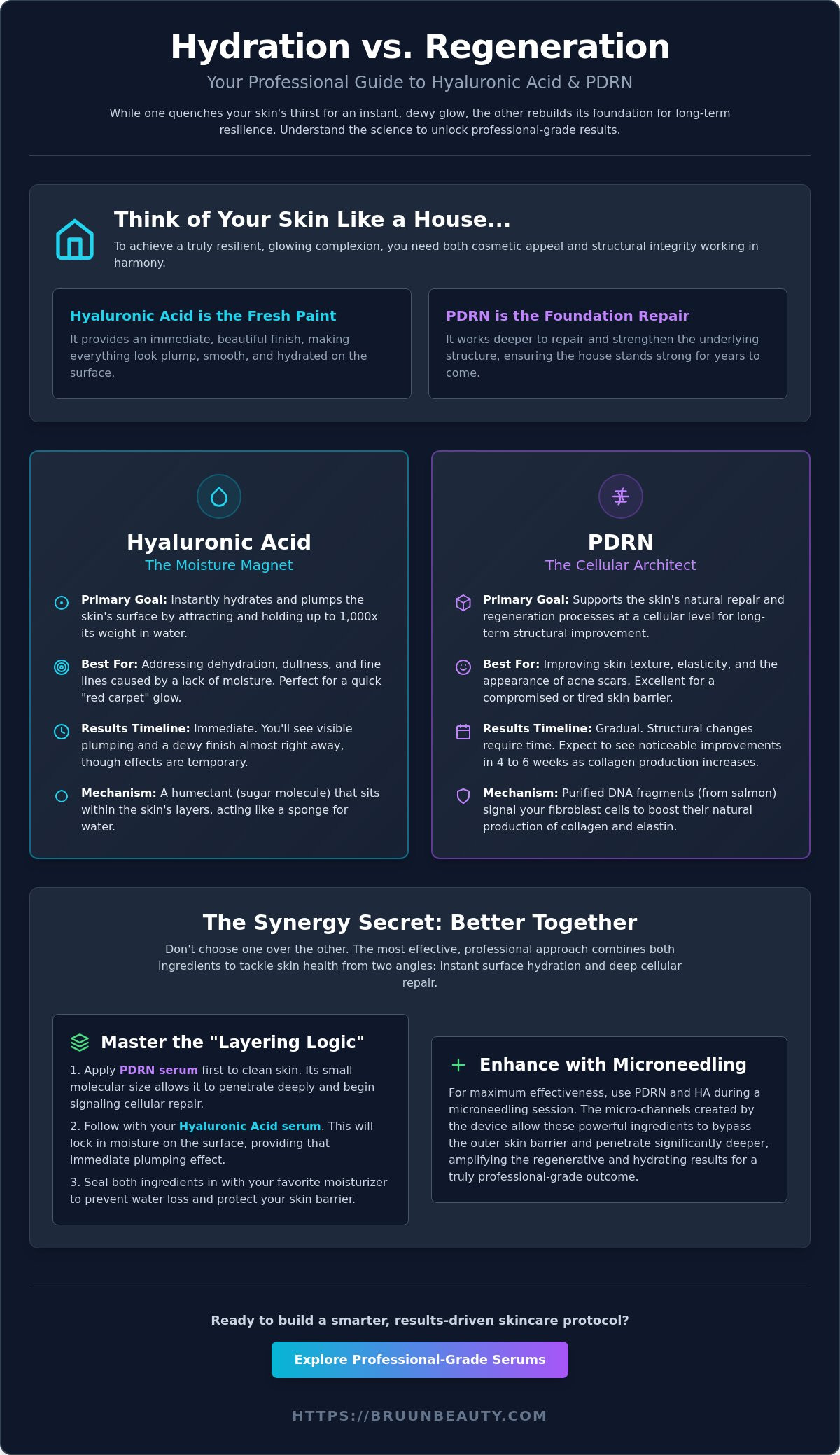
Think of your skin like a house. Hyaluronic acid is the fresh coat of paint and the polished windows that make everything shine. PDRN, on the other hand, is the crew repairing the foundation and strengthening the beams. To achieve that resilient, glowing K-beauty complexion, you really need both working in harmony.
What is Hyaluronic Acid (The Moisture Magnet)?
Hyaluronic acid is a naturally occurring sugar molecule found in your skin, eyes, and joints. It acts as a lubricant and cushion within the extracellular matrix, keeping your tissues supple. Its claim to fame is its ability to hold up to 1,000 times its weight in water, making it the ultimate humectant for instant plumping.
Not all HA is created equal. Different molecular weights determine how deep the moisture travels. High molecular weight HA sits on the surface to prevent water loss; meanwhile, low molecular weight versions penetrate deeper to hydrate from within. Unfortunately, your natural levels deplete with age and UV exposure, which is why topical replenishment is so vital for maintaining a bouncy texture.
What is PDRN (The Cellular Architect)?
PDRN stands for Polydeoxyribonucleotide. These are DNA fragments that act as the building blocks for tissue repair and DNA synthesis. Unlike HA, which focuses on moisture, PDRN signals your skin to increase the metabolic activity of fibroblasts. These are the specific cells responsible for producing the collagen and elastin that keep your skin firm.
You might have heard this ingredient called "salmon sperm" in viral marketing. While it's derived from salmon DNA, it's actually a highly purified biological material that is bio-compatible with human skin. This purification process removes proteins and fats, leaving only the regenerative fragments. If you want to see these benefits in action, a professional-grade SD Control Salmon DNA Ampoule is a fantastic way to introduce cellular support into your routine.
The beauty of PDRN is its ability to support the skin's natural repair cycle without causing irritation. It doesn't just sit on the surface; it actively encourages the skin to act younger and more resilient. When you understand the science of pdrn vs hyaluronic acid, you can stop guessing and start building a smarter, results-driven skincare protocol.
PDRN vs. Hyaluronic Acid: A Side-by-Side Comparison of Benefits
Comparing pdrn vs hyaluronic acid isn't about finding a single winner. It's about matching the right tool to your specific skin goal. Hyaluronic acid (HA) is your go-to for an immediate, dewy glow. It works on the surface to pull moisture in, making fine lines look less visible almost instantly.
PDRN takes a slower, more deliberate approach. Instead of just soaking the skin, it supports the underlying structure. This makes it superior for addressing the appearance of old acne scars or a compromised skin barrier that just won't stay hydrated. While HA quenches thirst, PDRN focuses on the long-term integrity of your complexion.
The "Skin Booster" category is a staple in Korean skincare for a reason. These treatments aim to improve skin quality from the inside out rather than just masking issues. While HA remains the classic choice for volume and bounce, PDRN has quickly become the gold standard for texture refinement and elasticity.
Recent research supports this dual approach to skincare. A clinical trial on PDRN and Hyaluronic Acid specifically looked at how these ingredients work together to improve the appearance of wrinkles. The data suggests that while HA provides the initial volume, PDRN provides the cellular support needed for lasting, structural results.
When to Reach for Hyaluronic Acid
You should reach for HA when your skin feels tight, looks dull, or shows fine lines caused by dehydration. It's the perfect "red carpet" ingredient because it provides a visible lift right away. If you live in a dry climate or travel often, keeping an HA serum in your kit is essential for maintaining your moisture barrier.
When to Prioritize PDRN (Salmon DNA)
Prioritize PDRN if you're dealing with "damaged" rather than just "dry" skin. This includes lingering sun damage, thinning skin, or a loss of firmness. It's particularly effective for those who want to improve the appearance of uneven texture over time. You'll typically see the most significant changes in elasticity after 4 to 6 weeks of consistent use.
For professional-grade results, I recommend the SD Control Salmon DNA Ampoule. It delivers concentrated cellular support to help your skin bounce back. If you want to maximize these benefits, pairing your serum with microneedling helps the active fragments reach the layers where they can do the most good.
Beyond the Hype: Is Salmon DNA (PDRN) Safe for Your Skin?
The term "salmon DNA" might sound like a science experiment, but it's actually one of the most bio-compatible ingredients in modern aesthetics. When you weigh the safety of pdrn vs hyaluronic acid, both are exceptionally well-tolerated by the human body. PDRN is specifically designed to work with your skin's natural repair signals without triggering an adverse immune response.
The secret to its safety lies in a rigorous purification process. Manufacturers extract the DNA fragments and strip away all fish proteins and fats. This leaves behind a pure, bioactive molecule that is virtually identical to human DNA. Because the allergenic proteins are removed, the risk of a reaction is incredibly low, making it a reliable choice for almost every skin type.
Unlike high-strength retinol or aggressive chemical peels, PDRN doesn't rely on irritation to see results. It's naturally anti-inflammatory and soothing. This makes it a fantastic alternative for anyone who wants structural anti-aging benefits but has a skin barrier too fragile for traditional harsh actives. It supports the skin's integrity without the peeling or redness often associated with vitamin A derivatives.
PDRN for Sensitive and Acne-Prone Skin
If you struggle with persistent redness or the lingering marks left behind after a breakout, PDRN can be a total game-changer. It helps calm visible inflammation and supports the skin's ability to bounce back after stress. Unlike some heavy, oil-based moisturizers that can feel suffocating, PDRN serums are typically lightweight and non-comedogenic. You don't have to worry about clogging your pores while you work on your skin's texture.
Many licensed estheticians use PDRN immediately after a microneedling session. It helps support the skin's natural recovery process and reduces the appearance of downtime, allowing you to get back to your routine faster. It provides a soothing effect that helps the skin feel comfortable and nourished after professional-grade procedures.
Safety Standards and Professional Quality
When you're comparing pdrn vs hyaluronic acid products, concentration and purity are everything. At BRÜUN, we pride ourselves on providing professional-grade inventory shipped directly from our US hubs in Miami and Los Angeles. This ensures you receive active, high-quality formulas that meet the rigorous standards of top clinics and spas.
I always recommend looking for serums like the SD Control Salmon DNA Ampoule, which focuses on high purity levels. Even though these ingredients have a stellar safety profile, I still encourage my "skincare friends" to do a 24-hour patch test. Applying a small amount behind the ear or on the inner arm is a simple way to ensure your skin loves the formula as much as mine does.
How to Use PDRN and Hyaluronic Acid with Microneedling
Microneedling acts as the ultimate delivery vehicle for your skincare actives. By creating thousands of microscopic channels in the surface, you allow ingredients to bypass the stubborn outer barrier. When considering pdrn vs hyaluronic acid for this procedure, you're essentially choosing between structural repair and intensive soothing. Using them together during a session transforms a standard facial into a professional-grade mesotherapy treatment.
PDRN is widely considered the gold standard for these types of procedures. Its molecular structure is designed to support the skin's natural recovery process right where it starts. To ensure safety and results, always use sterile, single-use needles and cartridges for every session. This prevents cross-contamination and ensures the needles are sharp enough to create clean channels without tearing.
The Ultimate Microneedling Protocol
Follow this simple three-step protocol to get the most out of your session. It ensures you're utilizing the unique properties of both ingredients at the right time.
- Step 1: Cleanse and Prep. Start with a double cleanse to ensure the skin is pristine. Set up your Dr. Pen device to the appropriate depth for your target area, typically 0.25mm to 0.5mm for general rejuvenation.
- Step 2: Apply PDRN as Slip. Instead of using water or a basic gel, apply your PDRN ampoule directly to the skin section by section. This provides the necessary "slip" for the device to glide smoothly while pushing the DNA fragments into the micro-channels.
- Step 3: Layer Hyaluronic Acid. Once you've finished needling, apply a pure Hyaluronic Acid serum. This helps soothe the skin immediately and provides a surge of moisture to the newly opened channels.
Post-Treatment: Sealing the Glow
The work doesn't end when you turn off the device. To maximize the absorption of your pdrn vs hyaluronic acid cocktail, you need to seal it in. Applying a professional jelly mask is the perfect follow-up. These masks create a vacuum-like seal over the face, which physically forces the remaining serums deeper into the skin layers.
I love pairing the Salmon DNA ampoule with a Hyaluronic Acid or Vitamin C jelly mask. The cooling sensation of the mask reduces the appearance of redness while the occlusive seal ensures not a single drop of your serum goes to waste. If you're ready to upgrade your routine, explore our full range of microneedling serums and tools to find your perfect match.
Choosing Your Hero Ingredient: Why BRÜUN Recommends Synergy
When you weigh the benefits of pdrn vs hyaluronic acid, the conclusion isn't about finding a winner. It's about recognizing that they serve two completely different, yet complementary, roles in your skincare journey. You don't have to choose between a hydrated surface and a strong foundation; you deserve both.
Our "Layering Logic" is simple. Think of PDRN as your foundation. It works within the skin to support long-term resilience and structural integrity. Hyaluronic Acid is your finish. It sits closer to the surface to provide that immediate, dewy glow and essential moisture. By using both, you address the skin's needs at every level.
Taking your skin journey to a professional level requires more than just high-quality ingredients. It requires a strategic approach that mimics the results you'd find in a top-tier clinic. BRÜUN has established itself as a US-based leader in K-beauty products, shipping directly from our hubs in Miami and Los Angeles to ensure you get professional-grade tools when you need them.
Building Your Professional Kit
If you're ready to start, I always suggest looking at a bundle product. These curated pairings are designed to help you save while ensuring your serums work together perfectly. Professional-grade serums offer higher concentrations and cleaner formulations than what you'll typically find at a drugstore; this is why they're the preferred choice for licensed estheticians.
Don't just take my word for it. Our community is filled with 5-star reviews from spa owners and at-home enthusiasts who have seen a visible difference in their skin's texture and bounce. Investing in the right tools today means your skin will look and feel more resilient for years to come.
The BRÜUN Difference
We believe that everyone should have access to the same technology used by professionals. That's why every device we carry is expert-vetted for safety and performance. With our fast US shipping and dedicated support, you can build your dream skincare routine with total confidence.
Ready for your most resilient skin yet? Join the BRÜUN community today and discover the power of professional-grade K-beauty. Whether you're looking for advanced microneedling serums or the latest in beauty machines, we're here to help you achieve that clear, nourished, glowing skin you've always wanted.
Elevate Your Routine with Professional-Grade Synergy
Mastering the balance of pdrn vs hyaluronic acid is the secret to moving beyond surface-level hydration. You now understand that while HA quenches immediate thirst, PDRN works behind the scenes to support your skin's structural foundation. Combining these two during your microneedling sessions ensures you're addressing both instant glow and long-term resilience for a truly professional result.
BRÜUN is proud to be a trusted leader for licensed estheticians and advanced enthusiasts nationwide. We provide vetted K-beauty technology with fast shipping from our Los Angeles and Miami hubs. You don't have to settle for temporary fixes when a structural transformation is within reach.
Shop our professional Microneedling Serums and start your transformation today!
Your journey to a clear, nourished, and glowing complexion starts with the right ingredients and a little professional confidence. We're here to support every step of your skin's evolution.
Frequently Asked Questions
Can I use PDRN and Hyaluronic Acid together in the same routine?
You can certainly use PDRN and Hyaluronic Acid together, and they are actually a power duo. While the pdrn vs hyaluronic acid debate is common, combining them allows you to address structural integrity and surface hydration at the same time. Apply your PDRN serum first to let the DNA fragments penetrate deep, then follow with Hyaluronic Acid to lock in moisture and create that signature dewy K-beauty glow.
Is PDRN better than Vitamin C for brightening skin?
These ingredients serve different purposes in a professional routine. Vitamin C is a powerful antioxidant that focuses on surface pigment and environmental protection. PDRN works deeper by supporting cellular turnover and skin density. If your goal is a glow from within, PDRN is excellent, but for specific dark spots, you might still want your Vitamin C. Using both provides a comprehensive approach to luminosity without compromising on repair.
How long does it take to see results from PDRN serums?
You'll likely notice an immediate improvement in skin softness, but structural changes require more time. Because PDRN supports the natural production of collagen and elastin, most users see significant results after four to six weeks of consistent use. This timeline matches your skin's natural renewal cycle. For the best outcome, stay patient and maintain a regular application schedule to allow these cellular building blocks to do their best work.
Does PDRN actually come from salmon?
Yes, PDRN is derived from salmon DNA, which is remarkably bio-compatible with human skin. Scientists use a rigorous purification process to extract these DNA fragments while removing all fishy odors, fats, and proteins. This ensures the final product is a pure, bioactive ingredient that your skin recognizes and uses for repair. It has become a gold standard in K-beauty for its ability to support skin without causing irritation.
Is it safe to use a Dr. Pen with PDRN at home?
It is safe to use a Dr. Pen with PDRN at home if you follow professional safety protocols. Always use a sterile, single-use needle cartridge and ensure your skin is thoroughly cleansed before starting. PDRN makes an excellent slip for the device, helping the needles glide while delivering repair signals deep into the micro-channels. Just keep your needle depth conservative, typically between 0.25mm and 0.5mm for your home sessions.
Can PDRN help with deep cystic acne scars?
PDRN is a favorite among estheticians for improving the appearance of acne scars and uneven texture. While it doesn't resolve scars overnight, it supports the skin's natural ability to rebuild and smooth out indentations over time. When used alongside microneedling, PDRN helps encourage a more uniform skin surface. It is especially helpful for the post-inflammatory redness that often lingers after a breakout has finally cleared from your complexion.
What is the best age to start using PDRN skin boosters?
There isn't a single perfect age, but many people start in their late 20s or early 30s. This is when natural collagen production begins to slow down, making it a great time for prevention. However, PDRN is also highly effective for mature skin that needs extra support for thinning or loss of elasticity. Whether you are 25 or 55, your skin can benefit from the regenerative signals these DNA fragments provide.
Do I need to keep PDRN ampoules in the refrigerator?
You don't need to keep most PDRN ampoules in the refrigerator unless the specific manufacturer's label says so. However, keeping them in a cool, dark place away from direct sunlight helps maintain the stability of the active ingredients. Some users enjoy the depuffing effect of a cold serum, but it isn't strictly necessary for the ingredient to work. Just make sure the cap is tightly sealed after each use to prevent any unnecessary oxidation.
How Often Should You Microneedle? Safe Frequency Guide
7 Best Korean Microneedling Serums for Radiant Results
Related Posts

Consistent Microneedling and the Long-Term Changes to Expect

Aftercare choices to lower infection risk at home after microneedling

How to Create a Relaxing At-Home Spa Day With Simple Rituals

Sunscreen Recommendations After Microneedling: How to Protect Healing Skin

Investing in my skin for the future: what deserves my budget

Post-microneedling skincare routine for masks, makeup, and recovery

Skin Peeling After Microneedling: What to Avoid and When to Resume Makeup
