

Microneedling PIH Risk Management: Downtime and Prevention
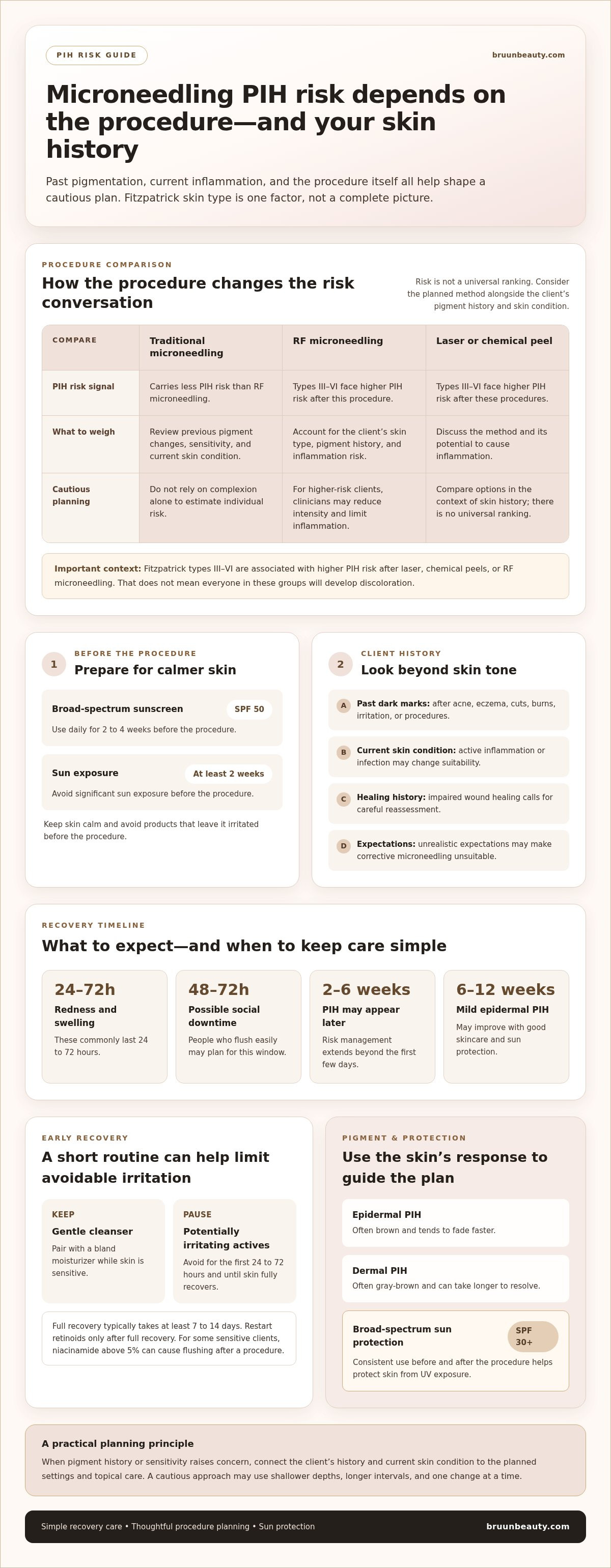
After radiofrequency microneedling, redness and swelling usually last 24 to 72 hours; people who flush easily may plan 48 to 72 hours of social downtime. Post-inflammatory hyperpigmentation can appear 2 to 6 weeks later, so microneedling PIH risk management extends beyond the first few days.
This guide explains how skin history, technique, and recovery care shape risk, plus which signs merit follow-up.
Key Takeaways
- Keep post-procedure care simple with a gentle cleanser, bland moisturizer, and sun protection; wait until your skin has fully recovered before restarting retinoids.
- Past pigmentation and inflammation, including marks after acne or eczema, can help identify clients who need a more cautious approach.
- Uncontrolled inflammation, active infection, impaired wound healing, or unrealistic expectations may make someone unsuitable for corrective microneedling.
- A thorough history review can guide preparation, technique, and aftercare, especially when a client has reacted to skin irritation or procedures before.
- For higher-risk clients, shallower depths and longer intervals can reduce treatment intensity; choose topical products with post-procedure sensitivity in mind.
Topical treatments for PIH
Topical care supports the skin barrier and helps limit irritation around microneedling. Preparation, gentle aftercare, and careful timing of active ingredients all matter.
Before microneedling, use daily broad-spectrum SPF 50 for 2 to 4 weeks and avoid significant sun exposure for at least two weeks. This preparation matters because UV exposure can add to pigmentation risk. Keep the skin calm; avoid products that leave it irritated before the procedure.
Afterward, avoid potentially irritating active ingredients for the first 24 to 72 hours. Continue avoiding them until your skin has fully recovered, typically at least 7 to 14 days. Restart retinoids only after full recovery. For some sensitive clients, niacinamide above 5% can cause flushing after a procedure, so choose post-procedure products with care.
Moisturizing and Skin-Barrier Care
Skin-barrier care means using a gentle cleanser and bland moisturizer after microneedling to reduce avoidable irritation. Apply these simple products while your skin is sensitive, rather than layering multiple active formulas. During the first 24 to 72 hours, a short routine makes it easier to avoid ingredients that could aggravate post-procedure skin.
Procedure Adjustments and Combinations
Tailor technique to the client’s Fitzpatrick skin type and sensitivity. For clients at higher PIH risk, clinicians may reduce intensity and limit inflammation. For melasma, protocols should minimize heat and inflammation, include strict sun protection, and consider pigment-regulating topicals. Avoid combining procedures in ways that add irritation before the skin recovers.
Consultation connects a client’s skin history and current condition with planned settings and topical care. Assessment should consider previous pigment changes and sensitivity to products. If skin is already inflamed, irritating ingredients or another procedure may add to the skin’s burden. Build the plan around one change at a time.
PIH can look different depending on its depth. Epidermal PIH is often brown and tends to fade faster; dermal PIH is often gray-brown and can take longer to resolve. Mild epidermal PIH often improves over 6 to 12 weeks with good skincare and sun protection. Consistent broad-spectrum SPF 30+ before and after the procedure helps protect skin from UV exposure.
For clinicians selecting supplies, the microneedling collection can support protocol planning. Keep product choices aligned with the procedure’s timing: prioritize gentle barrier care during early recovery, then resume pigment-regulating topicals only as the skin tolerates them.
Which Clients Carry the Highest Risk for Hyperpigmentation After Microneedling?
Fitzpatrick skin types III to VI call for careful PIH risk assessment, particularly when a client has a history of pigmentation. Skin tone, past pigment changes, current skin condition, and procedure type all help shape the plan.
People with Fitzpatrick skin types III to VI face higher PIH risk after laser, chemical peels, or radiofrequency microneedling. Traditional microneedling without radiofrequency carries less PIH risk than RF microneedling. These differences inform a discussion of the procedure, rather than assigning a single risk level based on complexion.
Previous acne-related PIH, eczema, active inflammation, infection, or impaired wound healing also matter. Each can affect whether corrective microneedling is suitable and how cautiously to plan it. For example, someone with active irritation and a history of dark marks after acne has different considerations from someone with calm skin and no similar history.
Skin Tone and Prior Pigmentation
Skin tone and prior pigmentation reflect both visible complexion and the skin’s past response to inflammation or injury. That history matters because acne, eczema, cuts, burns, and procedures can precede PIH. Ask about dark marks after breakouts or irritation, where they appeared, and whether they recurred. These details make the assessment more specific than appearance alone.
Fitzpatrick Skin Types and PIH
The Fitzpatrick scale classifies skin by its response to sun exposure. Types III to VI carry higher PIH risk after laser, chemical peels, or RF microneedling. This classification does not mean every person in those groups will develop discoloration. Consider it alongside pigment history and the planned procedure when discussing individual risk.
Darker Skin Types and PIH Considerations
For darker skin tones, preparation and conservative technique matter because overly aggressive microneedling can worsen hyperpigmentation. Ask whether acne, eczema, or irritation has left persistent marks. Discoloration after inflammation is a useful signal to plan cautiously, while skin tone alone does not tell the whole story.
Comparing Procedure-Related PIH Risk
PIH risk varies by procedure and settings, so there is no universal ranking. Fitzpatrick types III to VI face higher risk after laser or chemical peels, while traditional microneedling carries less PIH risk than RF microneedling. Discuss the planned method, its potential to cause inflammation, and the client’s pigment history when comparing options.
Active infection, uncontrolled inflammation, or impaired wound healing can make corrective microneedling unsuitable. These concerns call for pausing and reassessing the plan, not assuming skin tone alone determines suitability. A client’s previous response to acne or eczema can provide useful context.
Patient selection and contraindications
Patient selection considers current skin health, healing history, pigmentation patterns, and realistic goals. Fitzpatrick skin type is one factor, not a complete suitability assessment.
Uncontrolled inflammatory conditions, active infections, impaired wound healing, or unrealistic expectations may make someone unsuitable for corrective microneedling. The procedure creates controlled skin injury, and excess inflammation can contribute to post-inflammatory hyperpigmentation. For example, someone with an active infection needs a different plan from someone whose skin is calm and intact.
Before proceeding, Bruun Beauty specialists review the client’s current condition and relevant history. Clarify whether they have:
- Active infection or uncontrolled inflammation
- A history of slow or impaired wound healing
- Prior pigmentation after acne, eczema, or a procedure
- Expectations that don’t match what microneedling can reasonably provide
These points help determine whether to proceed, postpone, or reconsider the procedure. Fitzpatrick skin types III to VI carry higher PIH risk after certain procedures, but skin type alone does not determine suitability. Consider it alongside the client’s pigment history and current skin condition. A collagen-focused goal, for example, should not outweigh an active inflammatory concern.
In professional clinical settings nationwide, clients have the right to receive comprehensive information about a proposed procedure before giving informed consent, except in emergencies. That information includes medically significant risks, alternatives, and the risks of each alternative. Standard patient-rights frameworks incorporate relevant federal regulations, state health codes, and national healthcare conditions of participation to ensure transparent communication.
Clients also retain the right to refuse participation in any experimental procedures or treatments that affect their care. These consent and refusal rights are distinct from skin assessment, but reinforce the need for clear discussion before a procedure. Bruun Beauty practitioners explain the planned approach, relevant risks, and alternatives in language the client can understand.
Clients may file a formal complaint through appropriate regulatory channels or state health departments if standard grievance processes are not met. For microneedling decisions, keep the discussion focused on the person’s health history, skin response, and goals. If infection, uncontrolled inflammation, or impaired healing is present, pause corrective microneedling rather than treating it as routine.
Careful selection supports safer planning for every skin type. A history of persistent marks after acne or eczema deserves attention alongside Fitzpatrick classification. Document the factors discussed and the client’s questions so consent reflects their actual concerns, not just a standard form.
Client history and risk assessment
Post-inflammatory hyperpigmentation can follow inflammation or injury, including acne, eczema, cuts, burns, laser procedures, and microneedling. A focused history connects earlier skin reactions with the planned aesthetic procedure. Ask what triggered past marks, where they appeared, and how the skin responded afterward.
Inflammation is the key link. An eczema flare, irritating topical product, or recent acne breakout can leave pigment changes, even without a procedure. Record whether discoloration followed one clear event or repeated irritation. This pattern helps distinguish an isolated mark from a recurring response that needs extra planning.
During consultation, document specific examples instead of relying on a general question about “sensitive skin.” Ask whether a client has experienced:
- Dark marks after acne, eczema, cuts, burns, or laser procedures
- Irritation after a particular topical product
- Slow recovery after a previous skin procedure
- New inflammation or pigment changes near the planned area
Review current skin condition alongside those answers. Active irritation can add inflammation before microneedling begins. A recent eczema flare or inflamed acne area may call for postponing the procedure. When the surface is calm, the clinician can assess existing pigment and plan the next step with more context.
Baseline documentation makes later changes easier to interpret. Record visible hyperpigmentation, its location, and the client’s own description of when it began. Consistent photographs can support comparison over time. In one reported case example, a 32-year-old woman with Fitzpatrick skin type III had grade 2, mild PIH before the procedure.
A second reported example involved a 25-year-old man whose PIH was grade 3, described as moderate, at initial evaluation. These different starting grades show why the baseline matters: a later observation needs context. Two dermatologists independently evaluated pigmentation using baseline and post-procedure photographs in the reported assessment.
History can also guide preparation before corrective microneedling. Consider the client’s past pigment response, current inflammation, and tolerance of topical products together. A product that caused irritation before may complicate preparation. The aim is to record triggers and skin responses, not promise a particular pigment outcome or result.
Use consultation to align expectations with the skin’s history. Ask what change the client hopes to see, then discuss how previous PIH or recurring inflammation affects planning. If significant concerns emerge, pause and reassess suitability rather than proceeding as scheduled. This keeps the procedure grounded in the client’s actual skin pattern.
Microchannel density, depth, and technique control
Needle depth and microchannel density determine the extent of controlled injury created by the procedure. For higher-risk clients, adjusting these settings can limit inflammation, a trigger for post-inflammatory hyperpigmentation. Effective microneedling PIH risk management means matching technique to the client’s skin response, not pursuing the deepest or most intensive session.
For clients at higher PIH risk, modified needle depths of 0.25 to 0.5 mm and extended treatment intervals are recommended. Shallower needling reduces the depth of each channel, while longer intervals give the skin more recovery time between sessions. A 0.5-mm dermaroller was used in one reported microneedling procedure, but that example isn’t a universal setting for every client.
Channel density matters too. More closely spaced microchannels create a broader area of controlled injury than fewer, more widely spaced channels. The added inflammatory load may matter for skin tones prone to pigment changes. For example, a client with prior PIH may need a less intensive pattern than someone without that history.
Consistent technique helps avoid unnecessary passes over the same area. Keep the treatment plan focused, and do not add intensity just because redness appears limited during the session. Visible redness does not measure the full inflammatory response. For higher-risk skin, reassess the area and the client’s response before deciding whether another session or a modified approach makes sense.
Radiofrequency microneedling adds energy as well as needle depth. A histological analysis reported a correlation of r = 0.976 between energy per needle and resulting coagulation volume, with p 0.005. This illustrates why energy settings matter: increasing energy can increase coagulation volume and add to the skin’s inflammatory burden.
Insulated radiofrequency microneedles can reduce surface damage and related complications such as PIH. This makes insulated systems worth considering for darker skin tones, where limiting surface injury matters. Device type, energy, depth, and channel pattern work together, so needle depth is not the only factor in technique control.
A consistent approach to microneedling PIH risk management considers the client’s risk profile before each session. Choose conservative depth, control channel density, and extend intervals when appropriate. Track the skin’s response before changing settings. This measured approach keeps collagen-focused procedures controlled while reducing avoidable irritation that can trigger pigment changes.
Bruun Beauty: Advanced Microneedling Serum SD - Control Salmon DNA Ampoule Serum
Advanced Microneedling Serum SD - Control Salmon DNA Ampoule Serum is an option for professionals and experienced skincare users planning microneedling aftercare. Product choice should fit the procedure, the client’s skin response, and the timing of topical use.
Keep the routine simple during early recovery, and follow the product directions alongside the skincare plan. Avoid adding a new active while skin remains irritated. You can explore the Salmon DNA ampoule serum as part of your product planning, without treating it as a substitute for careful assessment, technique, or sun protection.
For microneedling supplies suited to a considered approach, explore Bruun Beauty’s serums and devices.
Make your next microneedling decision with care
Thoughtful microneedling PIH risk management starts before the session and continues through recovery. Let each client’s skin history and response guide protocol choices instead of relying on the same settings for every face. Clear notes on products, technique, and recovery support more informed decisions in future sessions.
For your own routine, choose products that fit the procedure and avoid unnecessary irritation during recovery. For professional use, align supplies with your established protocol and each client’s needs. Consistency supports a considered experience for you and your clients.
Bruun Beauty offers microneedling devices, serums, and jelly mask kits for your skincare setup. Explore the available options as you plan your next step, keeping skin comfort and care at the center.
Thoughtful preparation can help you move forward with confidence and keep skin care focused, gentle, and intentional.
Frequently Asked Questions
How much downtime should patients expect?
Redness and swelling after radiofrequency microneedling usually last 24 to 72 hours. If you flush easily, plan for 48 to 72 hours of social downtime. Pigment changes may appear later, often 2 to 6 weeks after treatment, so clear skin during the first few days doesn’t rule out PIH. Keep plans flexible while your skin settles, and watch for changes after the initial redness fades.
Who is not a good candidate?
People with uncontrolled inflammatory conditions, active infections, impaired wound healing, or unrealistic expectations may not be suitable candidates for corrective microneedling. For example, proceeding when an eczema-prone area is actively inflamed may be a poor choice. Current skin condition matters alongside past pigmentation and the planned procedure. Selection should consider whether the skin is calm enough and whether the person’s goals fit the procedure’s likely role.
Why Does PIH Happen After Treatments?
PIH develops when inflammation or skin injury triggers excess pigment in the affected area. Acne, eczema, irritation, cuts, burns, and aesthetic procedures can all precede these marks. The skin’s response can vary: epidermal PIH often appears brown, while deeper dermal pigment can look gray-brown. This helps explain why marks may look different and fade at different rates after the original inflammation settles.
What is the risk of post-inflammatory hyperpigmentation (PIH) after microneedling, especially in darker skin tones?
PIH risk is higher for Fitzpatrick skin types IV to VI after radiofrequency microneedling, and types III to VI are considered higher risk across procedures such as peels and lasers. Traditional microneedling without radiofrequency carries less PIH risk than RF microneedling. Skin tone is not the only factor: past pigment changes and procedure intensity also matter when assessing risk.
How should microneedling needle depth and treatment intensity be adjusted to reduce PIH risk?
For higher-risk clients, a modified needle depth of 0.25 to 0.5 mm and longer treatment intervals are recommended. Depth isn’t the only setting to consider. With radiofrequency microneedling, energy per needle also affects coagulation volume, so technique planning should account for both needle depth and energy. A conservative session can help avoid adding unnecessary inflammatory stress to pigment-prone skin.
What aftercare and sun protection reduce PIH risk after microneedling?
Use a gentle cleanser, bland moisturizer, and broad-spectrum sunscreen during recovery. Broad-spectrum SPF 30 or higher is recommended during the first week, while significant sun exposure should be avoided for at least four weeks after microneedling. Shade and protective clothing add a practical layer, especially outdoors. Avoid heat and irritating active ingredients until the skin has recovered, typically at least 7 to 14 days.
What are signs of PIH after microneedling, and when should a dermatologist be contacted?
PIH often appears as brown or gray-brown discoloration after the initial redness settles, commonly 2 to 6 weeks after microneedling. Contact the clinic for blistering, increasing pain, spreading redness, or crusting. Arrange follow-up if pigmentation worsens or hasn’t improved after three to six months. A dermatologist can assess persistent discoloration and help distinguish pigment changes from other skin concerns.
How is PIH managed if it develops after microneedling?
Management depends on the skin’s condition, pigment depth, and recovery pattern. Keep sun protection consistent and use gentle cleansing and moisturizer while the skin remains sensitive. Pigment-regulating topicals may form part of a broader plan, but retinoids should wait until the skin has fully recovered. Mild epidermal marks may improve over 6 to 12 weeks; superficial PIH can take 3 to 6 months.
Microneedling for Textured Skin: Before and After Results You Can Expect
Improving Skin Texture Without Lasers: The Esthetician’s Guide to Smooth Skin
Related Posts

Consistent Microneedling and the Long-Term Changes to Expect

Aftercare choices to lower infection risk at home after microneedling

How to Create a Relaxing At-Home Spa Day With Simple Rituals

Sunscreen Recommendations After Microneedling: How to Protect Healing Skin

Investing in my skin for the future: what deserves my budget

Post-microneedling skincare routine for masks, makeup, and recovery

Skin Peeling After Microneedling: What to Avoid and When to Resume Makeup
