

How Often Should You Microneedle? Safe Frequency Guide
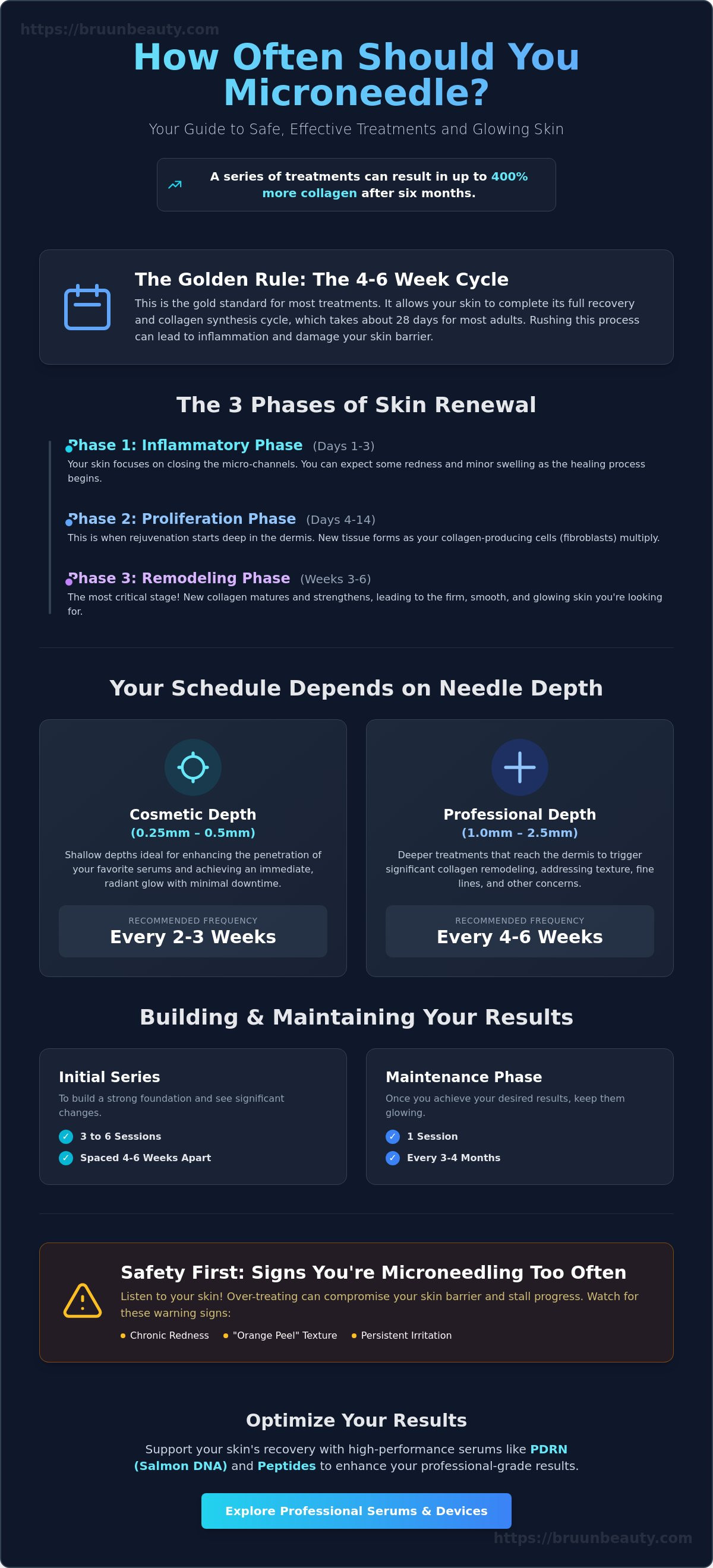
Did you know that a series of microneedling treatments can result in up to 400% more collagen after six months? This incredible transformation only happens when you respect your skin's biological clock. If you are wondering how often should you microneedle, the answer is usually every 4 to 6 weeks to allow for full cellular recovery and collagen synthesis.
It is completely normal to feel a bit anxious about over-treating your skin or causing accidental damage. You want those glowing results, but conflicting advice online makes it hard to know when it's truly safe to start your next session. We understand that you want a clear plan that prioritizes safety without sacrificing that professional-grade finish.
This guide provides a clear treatment calendar tailored to your specific needle depth and skin goals. You will discover which products, such as PDRN or peptides, can support your recovery and how to adjust your frequency as your skin improves. Let's build a routine that helps you achieve nourished, glowing skin with confidence.
Key Takeaways
- Learn why the 4-6 week biological cycle is the gold standard when deciding how often should you microneedle to ensure complete collagen synthesis.
- Understand how needle depth dictates your schedule; deeper medical-grade treatments require significantly more rest than shallow cosmetic sessions.
- Discover how to customize your frequency for specific concerns, such as maintaining a 4-week interval for texture or spacing sessions to manage hyperpigmentation.
- Find out how high-performance serums like PDRN and peptides can optimize your recovery timeline and enhance results during the post-treatment "golden hour."
- Identify the warning signs of over-treating, such as "orange peel" texture or chronic redness, to keep your skin barrier resilient and healthy.
The Golden Rule: Understanding the 4-6 Week Microneedling Cycle
Your skin operates on a biological rhythm that you can't rush. Most adults have a skin cell turnover cycle of about 28 days, but this can slow down as we age. When you're trying to figure out how often should you microneedle, this 28-day window is your absolute baseline. While it's tempting to perform sessions more frequently to speed up results, doing so can actually backfire. Rushing the process often leads to chronic inflammation and a compromised skin barrier, which stalls the very progress you're trying to make.
The process, clinically known as Collagen induction therapy, works by triggering your body's natural wound-healing response. This process activates fibroblasts, which are the cells responsible for producing new collagen and elastin. If you don't give these cells enough time to complete their work, you're essentially interrupting the construction crew before they've finished the foundation. Professional results come from consistency and patience, not from over-performing sessions.
The Biological Timeline of Skin Recovery
Understanding what happens beneath the surface helps you stay patient during the waiting period. Your skin goes through three distinct phases after a session with our Dr. Pen devices:
- Days 1-3 (Inflammatory Phase): Your skin focuses on closing the micro-channels and protecting itself. You'll likely see redness and minor swelling during this time.
- Days 4-14 (Proliferation Phase): New tissue begins to form as fibroblasts multiply. This is when the real work of rejuvenation starts deep within the dermis.
- Weeks 3-6 (Remodeling Phase): This is the most critical stage. The initial collagen matures and strengthens, leading to the firm, glowing skin you're looking for.
Initial Series vs. Maintenance Frequency
For most skin concerns, a single session isn't enough. You'll typically start with an initial series of 3 to 6 sessions spaced 4 to 6 weeks apart. This build-up phase is necessary to see significant changes in texture or to address the appearance of fine lines. Once you reach your desired results, you can transition to a maintenance schedule to keep that professional-grade glow.
Maintenance usually involves one session every 3 to 4 months. You should also adjust your calendar based on seasonal skin sensitivity. In the dry winter months, your skin might need an extra week of rest to stay hydrated. During the summer, you'll need to be extra cautious with sun exposure after your session. Always check our microneedling collection for the right serums to support your skin during these transitions.
How Needle Depth Dictates Your Treatment Schedule
Your needle depth is the most important factor in determining your recovery timeline. When you're deciding how often should you microneedle, you must first look at your device settings. A shallow depth barely grazes the epidermis, while deeper settings reach the dermis to trigger significant remodeling. The deeper the needle penetrates, the more intense the physical response becomes. This means your skin requires a longer rest period to build new tissue safely without the risk of scarring.
The speed of your device and the gauge of your needles also play a role. Higher speeds create more micro-channels per second, which increases the total surface area of the stimulus. While professional-grade devices like Dr. Pen offer incredible precision, they also require a disciplined approach to scheduling. Following FDA microneedling safety guidelines ensures you are using these tools within a range that promotes health rather than causing long-term damage.
Cosmetic Depth (0.25mm to 0.5mm)
Cosmetic microneedling focuses on the very top layer of your skin. These shallow depths are perfect for enhancing the penetration of your favorite Korean beauty serums and achieving an immediate glow. Because the skin trauma is minimal, your complexion recovers quickly. You can often perform these sessions every 2 to 3 weeks. It is essential to use high-quality needle cartridges to ensure clean, precise punctures that don't snag or tear the skin surface.
Medical and Professional Depth (1.0mm to 2.5mm)
Once you move past 1.0mm, you are entering professional-grade territory. This depth is necessary for addressing deeper concerns like the appearance of acne scars or significant fine lines. These sessions require a strict 6-week minimum wait time. Rushing these procedures increases the risk of "track-mark" scarring, where the skin doesn't have enough time to fill in the channels with healthy new collagen. We always recommend professional supervision for depths exceeding 1.5mm to ensure the highest safety standards.
To help your skin recover faster and maintain its resilience between sessions, consider exploring our full microneedling collection for professional-grade tools and soothing post-care essentials. Balancing depth with the right recovery time is the secret to professional results at home.
Customizing Frequency for Specific Skin Concerns
Your skin goals are unique, so your calendar should be too. When determining how often should you microneedle, your specific skin concern is the primary factor. For example, texture issues like large pores often respond best to consistent 4-week intervals. This rhythm keeps the skin in a state of constant, gentle renewal without overwhelming its natural defenses. It's a great way to maintain a smooth, airbrushed look year-round.
Hyperpigmentation requires a more cautious approach. If you needle too frequently, you risk triggering post-inflammatory hyperpigmentation (PIH), especially in deeper skin tones. We recommend spacing these sessions at least 6 weeks apart. This ensures the inflammatory response has fully subsided before you introduce a new stimulus. According to Yale Medicine's guide to microneedling, the procedure is effective for many conditions, but patience is vital for avoiding adverse reactions.
Age also plays a significant role in your recovery timeline. While a 25-year-old might bounce back in 28 days, skin that is 50 or older often experiences slower cellular turnover. If you're in this age group, extending your rest period to 6 or 8 weeks allows your skin to complete the remodeling process effectively. You can also combine sessions with specialized serums like BB Glow to enhance the appearance of your complexion, though this may require adjusting your schedule to allow for proper pigment setting.
Microneedling for Acne Scars and Deep Texture
Improving the appearance of acne scars is a marathon, not a sprint. Deep remodeling can take up to 6 months to become fully visible. A slow and steady approach with 6-week gaps prevents the formation of excess inflammation from over-performing. You might choose to target specific areas of concern more intensely while using a shallower depth for the rest of your face. This targeted strategy helps you achieve a more uniform skin texture over time.
Body Microneedling: Stretch Marks and Skin Laxity
The skin on your body is generally thicker than facial skin, but it often has fewer sebaceous glands, which can lead to a different recovery pace. When addressing stretch marks on the thighs or abdomen, you'll typically use larger microneedling cartridges with a higher needle count. Because body skin can take longer to show results, we suggest waiting 6 to 8 weeks between sessions. This allows the deeper layers of the dermis to respond to the stimulus and build resilient, firm skin safely.
The Role of Post-Care in Your Treatment Timeline
Your results depend heavily on what happens in the minutes and days following your treatment. The "Golden Hour" represents the first 60 minutes after your session when micro-channels are wide open. During this window, your skin can absorb topicals much more efficiently than normal. This is your best opportunity to flood the dermis with high-performance nutrients that support the remodeling process and potentially reduce your visible downtime.
Proper hydration is your most critical priority during the first 72 hours. Your skin barrier is temporarily open, which leads to increased moisture loss and potential sensitivity. To maintain a safe schedule for how often should you microneedle, you must avoid harsh actives like retinol, Vitamin C, or exfoliating acids for at least 5 to 7 days. Using these too early can cause unnecessary irritation and prolong redness, which might force you to push back your next scheduled session.
Supercharging Recovery with Salmon DNA and PDRN
Many professionals consider SD Control Salmon DNA Ampoules an essential part of a successful post-care kit. These ampoules contain Polydeoxyribonucleotide (PDRN), a DNA-derived ingredient that closely mimics human DNA to support rapid skin revitalization. By providing the essential building blocks for new tissue, PDRN helps strengthen the skin barrier and improves the overall quality of the new collagen. You can continue using these ampoules in your weekly routine between sessions to keep your skin nourished and resilient.
Soothing the Skin with Professional Jelly Masks
Applying a jelly mask immediately after your session provides instant relief and deep hydration. These masks create a vacuum-like seal that pushes moisture and electrolytes into the skin while lowering the surface temperature. This cooling effect is vital for reducing prolonged swelling and heat-induced inflammation. Look for ingredients like hyaluronic acid and algae to replenish the minerals your skin needs for optimal recovery. A calm, hydrated environment allows your skin to focus entirely on building new tissue.
Ready to optimize your recovery and achieve a professional-grade glow? Explore our full microneedling collection for the latest in post-treatment care and advanced serums.
Safety First: Signs You Are Microneedling Too Often
While chasing that professional-grade glow is exciting, your skin has a biological limit. Understanding how often should you microneedle requires a deep respect for your skin barrier. A healthy post-procedure glow looks like a slight flush that fades within 24 to 48 hours. Chronic inflammation, however, looks like persistent redness, heat, or a tight feeling that never quite goes away. If your skin feels raw or looks shiny but feels dry, you've likely performed sessions too frequently.
One of the most common signs of over-needling is the "Orange Peel" texture. This happens when the skin is traumatized too frequently, causing it to lose its natural elasticity. This leads to enlarged, pitted pores that resemble the surface of an orange. To check your skin's health, perform a simple "pinch test." Gently pinch the skin on your cheek; if it snaps back instantly, your skin is resilient. If it wrinkles or takes time to smooth out, your skin needs more rest before your next session.
Red Flags and Warning Signs
If you notice any of the following signs, it's time to put your device away and focus on deep hydration and barrier support:
- Persistent Redness: Any redness or "sunburn" feeling that lasts more than 4 days is a sign of deep irritation.
- New Sensitivity: If your regular, gentle moisturizer suddenly stings, your barrier is likely compromised.
- Extended Purging: While minor breakouts can happen, "purging" that doesn't resolve within 7 days is usually a sign of inflammation rather than rejuvenation.
If you find yourself in this situation, switch to a minimal routine. Use only a gentle cleanser and a ceramide-rich cream until your skin feels completely normal again.
The BRÜUN Commitment to Professional Results
At BRÜUN, we prioritize your skin's safety by curating only the highest-quality Dr. Pen devices. These tools offer the precision needed to avoid unnecessary trauma, ensuring every micro-channel is clean and controlled. As a US-based leader shipping from Miami and Los Angeles, we provide dedicated support to both licensed estheticians and advanced home enthusiasts to help you use these professional-grade tools correctly.
Our final recommendation is simple: always listen to your skin over your calendar. While the 4 to 6 week rule is a great guide, your skin's daily health is the ultimate authority. By balancing advanced technology with patience, you can achieve clear, nourished, and truly glowing skin safely.
Embrace the Journey to Radiant Skin
You now have the professional roadmap needed to navigate your rejuvenation journey with total confidence. By respecting your skin's biological clock and matching your frequency to your specific needle depth, you've mastered the science of safe collagen induction. You no longer have to guess how often should you microneedle to achieve those airbrushed results you've been dreaming of.
Whether you're addressing deep texture or maintaining a youthful glow, the right tools and post-care support make all the difference. BRÜUN is proud to be a US-based leader, offering professional-grade Dr. Pen devices and specialized K-beauty serums trusted by licensed estheticians nationwide. With fast shipping from our Miami and Los Angeles hubs, the path to clear, nourished, and glowing skin is closer than ever.
Ready to elevate your skincare game? Shop our professional Microneedling Collection today. We are excited to support you as you reveal your most confident, luminous complexion yet.
Frequently Asked Questions
Can I microneedle every week if I use a short needle length?
You can perform shallow cosmetic microneedling at a 0.25mm depth every 1 to 2 weeks to enhance product absorption. However, anything deeper requires more time for the skin to complete its natural recovery. When considering how often should you microneedle for collagen induction, a weekly schedule is too frequent. Stick to longer intervals for any depth that reaches the dermis to ensure your skin barrier remains healthy and resilient.
How many microneedling sessions do I need before I see results?
Most people notice a refreshed, glowing complexion within a week of their first session. For significant improvements in skin texture or the appearance of fine lines, you'll typically need a series of 3 to 6 treatments. Because collagen synthesis is a slow biological process, the full results often peak about 3 to 6 months after your final session. Consistency with your 4 to 6 week scheduling is the secret to professional results.
What happens if I microneedle too often?
Over-treating your skin can lead to chronic inflammation and a compromised skin barrier. This often manifests as persistent redness, increased sensitivity, or an "orange peel" texture where pores appear enlarged and pitted. If you needle too frequently, you interrupt the remodeling phase and prevent healthy tissue from forming. Always prioritize your skin's health over your calendar to avoid long-term damage and maintain a smooth, nourished complexion.
Is it safe to microneedle at home with a Dr. Pen device?
Yes, using a Dr. Pen device at home is safe and effective when you follow professional protocols for sanitation and depth. These devices are designed for precision, but you must use a new, sterile needle cartridge for every single session. Start with shallower depths while you're learning and never share cartridges with others. Following a strict recovery timeline ensures you achieve clinic-quality results safely in your own space.
Can I use Vitamin C or Retinol between my microneedling sessions?
You should wait at least 5 to 7 days after your session before reintroducing active ingredients like Vitamin C or Retinol. These potent ingredients can be too harsh for freshly needled skin and may cause unnecessary irritation or peeling. Once your skin has recovered and the micro-channels have closed, these actives can actually support your results. Always listen to your skin; if it feels sensitive, give it a few more days of rest.
How long does the redness last after a standard session?
For most standard sessions, redness typically lasts between 24 and 48 hours. It often looks and feels like a mild sunburn immediately after the procedure. If you are using deeper needle settings above 1.0mm, the flush might persist for up to 4 days. Using a professional jelly mask or a cooling LED mask right after your treatment can help lower the skin temperature and significantly reduce this visible downtime.
Does age affect how often I should perform microneedling?
Age definitely plays a role in determining how often should you microneedle safely. Younger skin typically has a faster cell turnover rate of about 28 days, allowing for sessions every 4 weeks. For those aged 50 and older, the natural recovery process slows down. Extending your wait time to 6 or 8 weeks gives your skin the extra time it needs to produce high-quality collagen and fully strengthen the new tissue.
Can I microneedle in the summer or before a vacation?
You can microneedle in the summer, but you must be extremely diligent about sun protection. Freshly needled skin is highly susceptible to sun damage and hyperpigmentation. We recommend avoiding a session at least 2 weeks before any vacation involving heavy sun exposure or swimming in pools and oceans. Always wear a broad-spectrum SPF 30 or higher and a wide-brimmed hat to protect your investment and keep your skin safe.
How to Use Dr. Pen for Acne Scars: Professional Results
PDRN vs. Hyaluronic Acid: Which Is Better for Your Skin?
Related Posts

Consistent Microneedling and the Long-Term Changes to Expect

Aftercare choices to lower infection risk at home after microneedling

How to Create a Relaxing At-Home Spa Day With Simple Rituals

Sunscreen Recommendations After Microneedling: How to Protect Healing Skin

Investing in my skin for the future: what deserves my budget

Post-microneedling skincare routine for masks, makeup, and recovery

Skin Peeling After Microneedling: What to Avoid and When to Resume Makeup
