

Choose Between Pin Counts, Nano Cartridges and Model Fit
Match a cartridge to your exact Dr. Pen model before comparing pin counts or nano styles. Pin count affects coverage and sensation, but it does not determine depth or compatibility.
Learn how to compare cartridge types and choose one that fits your device.
Key Takeaways
- Start with the exact device model and cartridge family; matching pin counts alone don’t guarantee a secure, compatible fit.
- Choose pin count by the area and level of coverage you want, not as a substitute for selecting needle depth.
- Compare Nano tips for very superficial cosmetic use with needle cartridges for traditional microneedling.
- Check the model-specific options before choosing a round Nano, square Nano, or combination pack.
- If a cartridge doesn’t lock into place, stop rather than forcing it.
Which Cartridge Should I Choose?
First choose a cartridge family that fits your exact Dr. Pen model. Then compare pin counts, coverage, and whether you need needles or nano tips.
Replacement cartridge prices in the United States vary by type and pack format. There is no single fixed price for every Dr. Pen cartridge.
Connector and Locking Features
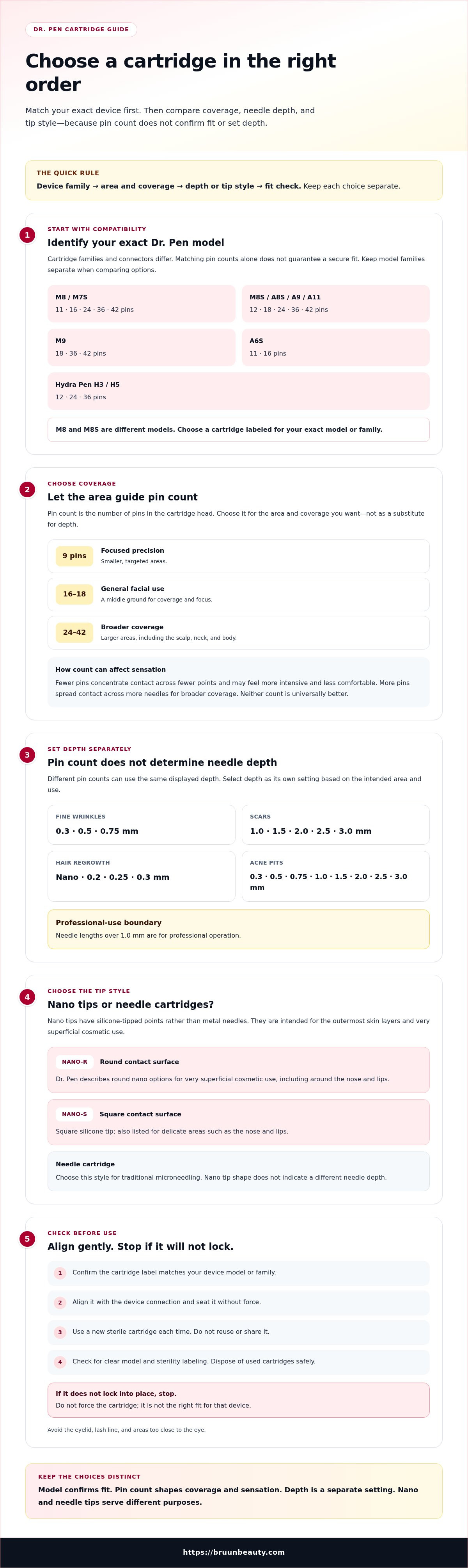
Pin count does not identify a cartridge’s connector or confirm compatibility. The model and connector must match your device, even if two cartridges have the same count. Align the cartridge with the device connection and fit it without force. If it does not lock into place, stop: it is not the right fit for that device.
Pin Count and Coverage
Pin count means the number of individual pins arranged in the cartridge head. A 9-pin option supports focused precision, while 16-24-pin cartridges suit general facial microneedling. Dr. Pen’s 24-42-pin cartridges are designed for larger areas, including the scalp, neck, and body. More pins may cover a broader area, but count alone doesn’t establish depth or effectiveness.
| Option | Typical use | Coverage consideration |
|---|---|---|
| 9 pins | Focused precision | Smaller, targeted areas |
| 16-18 pins | General facial use | Middle ground for coverage and focus |
| 24-42 pins | Larger areas | Broader coverage |
After confirming the device family, choose a pin count based on the treatment area and coverage you want.
Compatibility by Model Family
Cartridge families differ across Dr. Pen models, so matching counts don’t guarantee a correct fit. The M8S/A8S/A9/A11 family offers 12-, 18-, 24-, 36-, and 42-pin options. M9 cartridges include 18-, 36-, and 42-pin options, while A6S cartridges include 11- and 16-pin options. Keep each family separate when comparing replacement cartridges.
For the M8, M8S, A6S, and A9, select cartridges labeled for the exact model or family. M8S and M8 are different models, and their cartridge names aren’t interchangeable by assumption. A6S uses 11- and 16-pin options; A9’s family includes 12, 18, 24, 36, and 42 pins.
To install a cartridge, confirm that its model family matches, align it with the device connection, and seat it without force. Use one new sterile cartridge per treatment, and stop if it will not lock into place.
Dr. Pen cartridges are intended for one treatment, not reuse. Dispose of each used cartridge safely, and do not share it between treatments.
Pin count and fit alone do not prove that a cartridge is genuine or sterile. Check for clear model and sterility labeling, and use a new sterile cartridge for each treatment.
At-home use can carry risks, especially with incorrect fit or unsuitable needle depth. Avoid the eyelid, lash line, and areas too close to the eye; needle lengths over 1.0 mm are for professional operation.
How pin count affects sensation and depth
Use this Dr. Pen cartridge selection guide to distinguish pin count from depth. Pin count is the number of individual pins in the cartridge head; the depth displayed by the device is a separate setting. Neither figure alone tells you how much coverage or what sensation to expect during a session.
A 12-pin and 36-pin cartridge can use the same displayed depth. Yet they place different numbers of needles against the skin. A lower pin count concentrates contact across fewer points. It may feel more intensive and less comfortable. A higher count spreads contact across more needles for broader coverage.
That difference doesn’t make one count universally better. Dr. Pen’s 9-12-pin options are described for focused areas, including acne scars and fine lines. Counts of 16-18 are options for general texture concerns. Cartridges with 24, 36, or 42 pins suit broader coverage and medium-depth concerns. Choose by area and purpose, not by count alone.
Depth requires its own decision. Listed lengths for fine wrinkles include 0.3, 0.5, and 0.75 mm. Scar lengths include 1.0, 1.5, 2.0, 2.5, and 3.0 mm. For hair regrowth, listed lengths include nano, 0.2, 0.25, and 0.3 mm. The intended area and use guide the length choice.
For acne pits, listed lengths range from 0.3 to 3.0 mm. Those options include 0.3, 0.5, 0.75, 1.0, 1.5, 2.0, 2.5, and 3.0 mm. Needle lengths over 1.0 mm are for professional operation. A pin count doesn’t change that distinction or determine the appropriate depth.
Cartridge options also vary by model family. M8/M7S options include 11, 16, 24, 36, and 42 pins. M8S/A8S/A9/A11 options include 12, 18, 24, 36, and 42. A6S offers 11- and 16-pin options, while Hydra Pen H3/H5 offers 12, 24, and 36.
A useful Dr. Pen cartridge selection guide compares available pin counts only after you identify the treatment area. A broader area may call for more coverage, while a focused area may suit fewer pins. Consider sensation as well: lower counts can feel less comfortable, while higher counts distribute contact.
- Identify your device model before comparing cartridge counts.
- Choose the treatment area and intended use.
- Compare compatible pin counts for coverage and sensation.
- Select needle depth separately from pin count.
This order keeps your choice focused on fit, area, and depth. A higher pin count is not automatically a better match, and the same depth setting does not make different counts equivalent. Compare each factor separately before choosing a cartridge for your session.
Nano and combination cartridge options
Nano cartridges have silicone-tipped points, not metal needles. Before choosing a pen model, compare their contact shape and intended use with those of needle cartridges.
Nano-R Tips
Nano-R tips have a round contact surface. Dr. Pen describes its round nano options for very superficial cosmetic use, including around the nose and lips. This rounded shape differs from Nano-S tips, which have square contact surfaces. Choose Nano-R if its contact style suits your treatment area and the cartridge matches your pen model.
Nano-S Tips
Nano-S tips have a square contact surface, unlike Nano-R’s round face. Both have silicone tips and are intended for the outermost skin layers, rather than traditional microneedling. Dr. Pen lists round and square nano options for delicate areas such as the nose and lips. Tip shape helps you compare options, but does not indicate a different needle depth.
Nano Versus Needle Cartridges
Nano cartridges use silicone-tipped nano-points; needle cartridges contain metal needles. Nano tips are intended for very superficial cosmetic skincare, while needle cartridges are used for traditional microneedling. They serve different purposes, so do not choose nano just because its shape looks more precise. Match the cartridge type to your intended approach and treatment area.
Shape alone does not determine pressure or depth. Nano-R’s round surface and Nano-S’s square surface describe contact geometry, not pressure settings. Nano tips do not replace metal needles for traditional microneedling. For superficial cosmetic application, compare the nano options; for a microneedling session, compare compatible needle cartridges.
Options vary by collection. The M8S/A8S/A9/A11 family includes Nano-R and Nano-S cartridges. M9 cartridges include Nano-R options. The M8S and A9 catalogs also list combination packs alongside their round and square nano options. A6S catalogs list nano and combination packs, too. These product families don’t all offer the same mix.
Use this sequence when choosing:
- Identify your exact Dr. Pen model before comparing nano styles.
- Choose nano for very superficial cosmetic use, not traditional microneedling.
- Compare the round Nano-R surface with the square Nano-S surface.
- For a combination pack, read its product label to identify the included cartridge styles.
Keep pressure consistent with the device’s intended use; changing the tip shape does not turn a nano cartridge into a needle cartridge. For example, a square Nano-S may suit your preferred contact shape, while a needle cartridge is the distinct option for traditional microneedling. Choose the compatible format first, then compare styles for your treatment area.
Match the cartridge family to the exact Dr. Pen model
Start with the model printed on your Dr. Pen device. Compatibility depends on the device family and connector, not just pin count. A cartridge with the same count as one for another model may still have a different connection. This model-first approach narrows your replacement options before you compare features.
The M8 and M8S are separate models, so don’t assume their cartridge names are interchangeable. The M8/M7S family includes 11-, 16-, 24-, 36-, and 42-pin options. The M8S/A8S/A9/A11 family includes 12-, 18-, 24-, 36-, and 42-pin cartridges. Shared counts don’t establish a suitable fit across the two families.
| Dr. Pen model or family | Listed cartridge options | Compatibility detail |
|---|---|---|
| M8/M7S | 11, 16, 24, 36, 42 pins | Separate family from M8S |
| M8S/A8S/A9/A11 | 12, 18, 24, 36, 42 pins | Includes round and square nano options |
| M9 | 18, 36, 42 pins | Nano-R options are also listed |
| A6S | 11, 16, 36, 42 pins | Catalog also lists nano and combination packs |
| A20 | Dedicated cartridge platform | Don’t assume other families fit |
| Hydra Pen H3/H5 | 12, 24, 36 pins | Different format from standard families |
| H6 | 18 pins | H6-specific system, separate from H3/H5 |
Other model labels need close attention, too. A6 cartridges include 9-pin options, while A6 and A7 catalogs also list 12-pin, 36-pin, and nano cartridges. A11 listings include 12-, 18-, 24-, 36-, and 42-pin options, plus round and square nano styles. Read the full model name before selecting a replacement.
Q1S and Bio Pen Q2 share a cartridge family with 9-, 14-, and 25-pin options. That shared family doesn’t make those cartridges suitable for other pens. Hydra Pen H3 uses a different format from standard Dr. Pen families, and H6 uses its own cartridge system, separate from H3/H5.
Use this model-first sequence before purchase:
- Read the exact model name from your device label or documentation.
- Match the cartridge family name to that model.
- Compare pin count or nano style within the matching family.
- Check the connector and locking surface without forcing it.
A reliable Dr. Pen cartridge selection guide keeps model fit separate from treatment choices. For example, A20 uses a dedicated cartridge platform, while Hydra Pen H3/H5 uses a different format. Confirm the family before considering needle length, including lengths selected for concerns such as stretch marks. If a cartridge won’t lock into place, stop rather than forcing it.
When should I choose a nano cartridge instead of a needle cartridge?
Choose a nano cartridge for very superficial cosmetic use and a needle cartridge when your session calls for traditional microneedling. Dr. Pen nano-points have silicone tips, while needle cartridges contain metal needles. These options serve different purposes, so start with your intended application, not the cartridge’s appearance.
Use this quick decision path before a session:
- Choose nano for a cosmetic application focused on the outermost skin layers.
- Choose needles for traditional microneedling, using a suitable cartridge and depth.
- For areas around the nose or lips, compare round Nano-R and square Nano-S tips.
- Match either cartridge style to your exact Dr. Pen model.
Tip shape helps narrow your nano choice, but it does not change the cartridge category. Nano-R has a round contact surface; Nano-S has a square one. Dr. Pen describes both shapes for use around the nose and lips. Choose the contact shape that suits your application, not because you assume one reaches deeper.
Combination packs can include multiple cartridge styles, but their contents depend on the model family. M8S listings include needle cartridges, round and square nano options, and combination packs. A9 listings also show those styles. A6S catalogs include nano and combination packs, while M9 lists Nano-R options. Read the package details to identify the included styles.
Compatibility still comes first. M8S/A8S/A9/A11 cartridges include Nano-R and Nano-S options, while M9 listings include Nano-R. Those examples don’t mean every Dr. Pen model accepts either tip. An A20 has a dedicated cartridge platform, and Hydra Pen H3 uses a different format from standard Dr. Pen families.
For superficial cosmetic application around the nose, compare compatible nano shapes. For traditional microneedling, choose a compatible needle cartridge instead. Do not treat “nano” as a substitute for checking the model, cartridge type, or intended session.
Before use, confirm that the cartridge label matches your pen model. Align it as designed, and stop if it will not lock into place. Use one new sterile cartridge per treatment and do not reuse it. These steps apply to Nano-R, Nano-S, and needle cartridges.
Choose a cartridge type based on the application, then compare the options that fit your device. This keeps superficial cosmetic use distinct from traditional microneedling and helps you choose a suitable style without relying on tip shape alone.
Bruun Beauty: Advanced Microneedling Serum SD - Control Salmon DNA Ampoule Serum
Advanced Microneedling Serum SD - Control Salmon DNA Ampoule Serum is a skincare option to consider alongside your device and cartridge choices. Choose a compatible cartridge first, then decide whether this serum suits your broader skincare routine.
The product name identifies it as a Salmon DNA ampoule serum. Keep cartridge compatibility and serum selection as separate decisions, since the serum doesn’t determine which cartridge fits your Dr. Pen model. For a routine that includes microneedling supplies and skincare, explore Bruun Beauty’s Salmon DNA ampoule serum and follow its product directions.
For product questions or to explore your options, contact Bruun Beauty or visit Bruun Beauty online.
Build a Routine Around Your Device Choice
Treat cartridge selection as one part of a consistent skincare plan. Keep your device, cartridge, and product choices aligned with your goals, and follow each product’s directions. Use this Dr. Pen cartridge selection guide as a reference as your routine evolves.
Bruun Beauty offers DR. PEN Microneedling Devices and Advanced Microneedling Serum SD - Control Salmon DNA Ampoule Serum. Jelly Mask Kits are another product category to explore as you build a broader routine. Choose products for their stated purpose rather than assuming every item belongs in every session.
If you’re comparing microneedling products or want to explore cartridge options, browse the relevant collection. Take your time choosing products that fit your device and your approach. A thoughtful selection helps you move forward with clarity and confidence.
Keep learning, choose carefully, and enjoy building a skincare routine that feels right for you.
Frequently Asked Questions
What Does the Pin Count Actually Mean?
Pin count tells you how many individual pins sit in a cartridge head. For example, a 12-pin and 36-pin cartridge can use the same displayed depth but place different numbers of needles against the skin. That difference changes contact and coverage, not the depth setting itself. Compare the count alongside your device model and intended area, rather than treating a larger number as an automatic upgrade.
Are Dr Pen cartridges interchangeable between models?
No. Dr. Pen cartridge families are model-specific, and matching pin counts don’t prove that two cartridges fit the same device. For example, the M8 and M8S are different models, while the A20 uses its own dedicated cartridge platform. Hydra Pen H3 cartridges also use a different format from standard Dr. Pen families. Match the cartridge family to your exact model before selecting a replacement.
How do I identify the right cartridge before opening the pack?
Read the model name on your device, then compare it with the cartridge family named on the package. Check the listed pin count or nano style only after the family matches. For example, an A6S listing differs from an A6 listing, even though their names look similar. A matching pin count alone isn’t enough to establish compatibility, so keep the package closed until those labels align.
What is a Microneedling Cartridge?
A microneedling cartridge is the replaceable head that attaches to a compatible pen device and holds its needle configuration. Pin count is the number of pins in that head. The pen itself powers the cartridge. Use a new sterile cartridge for each treatment session, and do not reuse one after removing it from the device.
What is the difference between a pin-count listing and a nano listing?
A pin-count listing describes a cartridge with a stated number of needles, such as 18 or 36. A nano listing identifies silicone-tipped nano-points, rather than metal needles, for very superficial cosmetic use. Dr. Pen also distinguishes round Nano-R tips from square Nano-S tips. Choose based on the intended application, then match that cartridge style to the exact pen model.
Which Cartridge for Acne Scars?
Dr. Pen’s 9-, 11-, or 12-pin options are described for focused concerns, including acne scars. The 16- and 18-pin options are also listed for concerns such as scarring and uneven texture. Needle length is a separate choice: acne-pit lengths listed range from 0.3 to 3.0 mm. Lengths over 1.0 mm are for professional operation.
Which Cartridge for Around the Eyes?
Choose an eye-area cartridge only after matching its family to your exact Dr. Pen model. The listed speed guidance for the area around the eyes is levels 2-3. Avoid microneedling directly on the eyelid, along the lash line, or too close to the eye. These location limits matter regardless of the cartridge’s pin count or the device’s speed setting.
How do I choose the right Dr. Pen cartridge for my model?
Start with the exact model label, then choose a cartridge family specifically listed for that device. For example, A6 and A6S have different listed options, as do M8 and M8S. Once the family matches, compare available needle counts or nano styles for your intended use. If the cartridge won’t lock into place, stop rather than forcing it.
The Best Microneedling Aftercare Serum Guide: Post-Treatment Glow Secrets (2026)
The Best Microneedling Aftercare Serum Guide: Post-Treatment Glow Secrets (2026)
Related Posts

Consistent Microneedling and the Long-Term Changes to Expect

Aftercare choices to lower infection risk at home after microneedling

How to Create a Relaxing At-Home Spa Day With Simple Rituals

Sunscreen Recommendations After Microneedling: How to Protect Healing Skin

Investing in my skin for the future: what deserves my budget

Post-microneedling skincare routine for masks, makeup, and recovery

Skin Peeling After Microneedling: What to Avoid and When to Resume Makeup
