

Skincare Ingredients to Avoid After Microneedling: A Practical Checklist
Your post-microneedling glow doesn’t mean your usual skincare is ready to come back. Skincare ingredients to avoid after microneedling include retinoids, exfoliating acids, and other products that may irritate temporarily sensitive skin. Follow your provider’s aftercare instructions, since the right time to restart products can vary.
To check your products, look beyond the name on the front of the package. Review the full ingredient list and directions, and ask your provider about anything you’re unsure of.
This checklist covers which products to pause, what to ask your provider, and how to reintroduce familiar ingredients gradually.
Key Takeaways
- Use the skincare ingredients to avoid after microneedling checklist to spot products that may irritate sensitive skin.
- Check full product labels, not just the headline ingredient, and ask your provider about formulas you’re unsure of.
- Keep your routine simple while your skin feels sensitive, and follow your provider’s specific aftercare instructions.
- When you’re ready to restart actives, reintroduce one product at a time and pay attention to your skin’s response.
- Review product-specific usage directions before choosing any serum for your post-microneedling routine.
Skincare ingredients to avoid after microneedling: start with this checklist
Pause potentially irritating active products after microneedling, and follow the specific aftercare instructions from the person who performed your procedure. Your skin’s sensitivity and the right time to resume products can vary with procedure depth, your skin’s response, and your provider’s protocol.
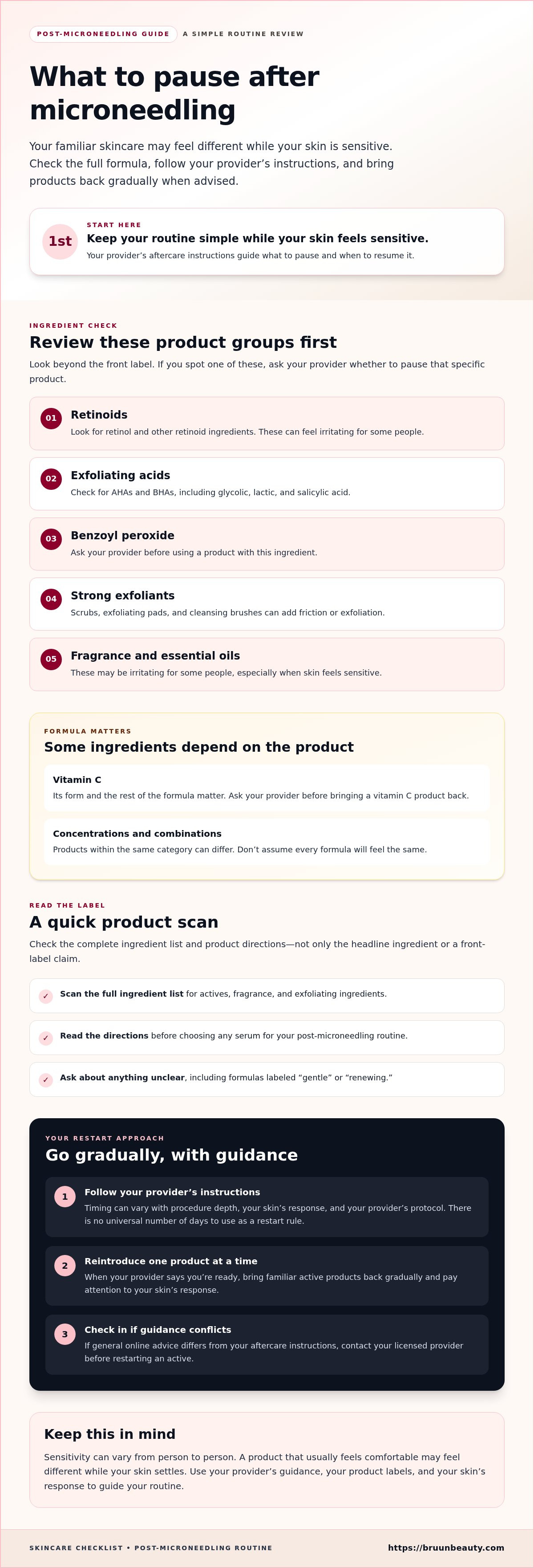
Use this checklist as a cautious starting point, not a substitute for personalized guidance. Begin by checking for retinoids, exfoliating acids, benzoyl peroxide, and strong exfoliating products. Ask your provider whether to pause each one.
Microneedling is also known as collagen induction therapy. Because the procedure temporarily changes the skin’s surface, a product that usually feels comfortable may feel different afterward. Reactions vary, so treat increased sensitivity as a reason to check your routine rather than assume every product will cause the same response.
The ingredient groups to review first
Check the full ingredient list and product directions for these categories. If you find one, ask your provider whether to pause that specific product:
- Retinoids: Look for retinol and other retinoid ingredients, which can be irritating for some people.
- Exfoliating acids: Review formulas with alpha- or beta-hydroxy acids, such as glycolic, lactic, or salicylic acid.
- Benzoyl peroxide: Ask before using products containing it, since it may add to irritation for some skin.
- Strong exfoliants: Scrubs, exfoliating pads, and cleansing brushes can add friction or exfoliation.
These are product groups to discuss or pause as directed, not a claim that every formula has the same strength or effect. Concentrations, ingredient combinations, and the rest of a formula differ. Read the full ingredient list rather than relying on front-label claims such as “gentle” or “renewing.”
Why your provider’s instructions matter
Your provider can account for procedure depth, how your skin responded, and the aftercare protocol they used. General online guidance can’t assess those details, so don’t use a fixed number of days as a universal restart rule.
If online advice conflicts with your instructions, contact your licensed provider before restarting an active. Keep their guidance handy as you review your routine. You can also browse microneedling products, then check each product’s directions with your provider before use.
Why active skincare ingredients may feel different after microneedling
Microneedling temporarily changes the skin’s surface. As your skin settles, products that usually feel comfortable may sting or feel more irritating than expected. Responses vary from person to person, so sensitivity alone doesn’t tell you that something is wrong.
Retinoids and exfoliating ingredients can add irritation when your skin is temporarily more sensitive. That’s why the skincare ingredients to avoid after microneedling are best considered in context, with your provider’s instructions guiding what you pause and when you resume it.
How to think about strong exfoliants and retinoids
Check labels for alpha hydroxy acids (AHAs), beta hydroxy acids (BHAs), and retinoids. AHAs and BHAs exfoliate, while retinoids can also make some people’s skin feel dry or sensitive. Formulas and concentrations vary, so don’t assume every product in a category will feel the same. Ask your provider when these ingredients can return to your routine.
For more background on aftercare and products that may feel irritating, read this overview of skincare after microneedling. Use general articles as context, not as a replacement for the instructions you received for your own procedure.
Ingredients that depend on the formula
Vitamin C isn’t one-size-fits-all. Its form and the rest of the formula matter, so ask your provider before bringing a vitamin C product back. Also check for fragrance and essential oils, which may be irritating for some people, especially when skin feels sensitive.
Rather than labeling an ingredient universally safe or unsafe, consider the full formula, your skin’s response, and your provider’s guidance. If you’re comparing products marketed for microneedling, review the directions and discuss them with your provider. You can browse microneedling products as you assess your options.
A product-label checklist for skincare after microneedling
Before using a product on skin that feels sensitive, scan its full ingredient list and directions. The full formula matters more than a single front-label claim. Check for active ingredients, fragrance, and exfoliating claims, then ask your provider about anything unclear.
What to pause and what to check
| Ingredient or product group | Why to pause or review it | What to ask your provider |
|---|---|---|
| Retinoids, such as retinol | They may feel irritating on temporarily sensitive skin. | When can this specific product return to my routine? |
| Exfoliating acids, including AHAs and BHAs | Products with glycolic, lactic, or salicylic acid exfoliate and may add irritation. | Should I pause this formula, and what should guide restarting it? |
| Benzoyl peroxide | This active may feel too strong for some people after a procedure. | Should I avoid this product for now? |
| Fragrance | Fragrance may bother skin that feels sensitive. | Is this product’s formula appropriate for my current aftercare? |
| Essential oils | These ingredients may also cause discomfort for some people. | Should I leave this product out of my routine? |
Look beyond the ingredient list, too. Product directions and phrases like “exfoliating,” “resurfacing,” or “renewing” can signal that a formula contains active ingredients worth checking with your provider. Similar claims don’t mean two products have the same ingredients or strength, so compare the actual labels.
How to keep a simple routine
Ask your provider whether you can use a gentle cleanser and a simple moisturizer, and follow their directions for application. Don’t test a new or unverified product on freshly microneedled skin just because its label says “soothing” or “clean.”
Follow your provider’s instructions and the sunscreen product label for when and how to apply sunscreen. If you’re uncertain about an ingredient, share the full product label with your provider before using it. Keeping to a short, approved routine also makes it easier to track what your skin tolerates.
When and how to reintroduce active ingredients
There isn’t one restart schedule that fits every person or procedure. Let your provider’s instructions set the timing, then bring products back in a way that makes it easier to notice how your skin responds.
A cautious step-by-step restart
Use this checklist when you and your provider are planning your routine. Bringing back one product at a time helps you keep track of what you’ve added and makes it easier to identify a product that may be contributing to discomfort.
- Wait for the go-ahead. Restart an active only when your provider’s instructions allow it.
- Review the formula. Check the complete ingredient list and product directions. Ask your provider about any active ingredient or claim you’re unsure of.
- Choose one product. Add one active back at a time instead of restarting your full routine together.
- Follow directions. Use the product label, and ask your provider how often to apply it as you resume use.
- Observe your skin. Pay attention to how it feels and looks after you restart the product.
This gradual approach can make the skincare ingredients to avoid after microneedling easier to manage. It also gives you a clearer way to identify which product may be contributing to discomfort, without assuming every active will cause a reaction.
When to check in with your provider
If discomfort or visible irritation appears after you restart a product, pause it and contact your provider for guidance. Reach out if sensitivity persists, worsens, or your skin responds in a way you didn’t expect. Don’t try to solve an unexpected reaction by adding more active products.
Your provider can advise you based on the procedure and your skin’s response. Until you get guidance, follow the aftercare directions you were given rather than testing another product or changing how you use the one you paused.
Choose microneedling skincare with clear product guidance
Ingredient checklists are useful, but a product’s full directions matter just as much. Follow the aftercare instructions from your provider, then check the current product label before adding any serum or other skincare to your routine. A product marketed for microneedling isn’t automatically right for every procedure or for immediate post-procedure use.
Questions to ask before choosing a serum
Before using a serum, confirm that its product information describes its intended use and explains how to apply it. Then ask your provider whether that specific formula fits your procedure and current routine. This is especially helpful if the label doesn’t clearly explain when to use it or whether it’s intended for freshly microneedled skin.
Bruun Beauty lists the Advanced Microneedling Serum SD - Control Salmon DNA Ampoule Serum. Review its current product information and directions, and confirm use with your provider. Don’t assume that its listing alone establishes when it should go on after a procedure.
Apply the same careful check to any product you’re considering: compare the label with ingredients you’ve been told to pause, and ask your provider about unclear directions or formulas. Your provider’s guidance should take priority over a general product description or online checklist of skincare ingredients to avoid after microneedling.
A simple next step for your routine
Save this checklist and bring the labels of products you’re considering to your provider. That gives you a practical starting point for discussing what to set aside, which directions to follow, and when to review your routine again. Keep the product packaging or directions available so you can ask about the exact formula rather than relying on memory.
For product browsing, start with Bruun Beauty’s microneedling range, then check each product’s directions with your provider before use.
Build a routine that feels clear and manageable
After microneedling, keep your provider’s instructions at the center of your routine. Review labels for retinoids, exfoliating acids, benzoyl peroxide, fragrance, and essential oils, and ask about any formula you’re unsure of. When your provider says you can restart actives, add one product at a time and pay attention to how your skin responds.
The right timing depends on your procedure and your skin, so use general checklists as a starting point rather than a personal schedule. If a product causes discomfort or visible irritation, pause it and check in with your provider before trying something else.
Bruun Beauty lists microneedling supplies and a microneedling serum. Review the serum’s current product directions and confirm with your provider whether its use fits your routine. Bruun Beauty ships from warehouses in Miami and Los Angeles.
With a careful label check and provider-led guidance, you can return to familiar skincare at a pace that feels right for your skin.
Frequently Asked Questions
Which skincare ingredients should I avoid after microneedling?
Common skincare ingredients to avoid after microneedling, or ask your provider about, include retinoids, exfoliating acids, and benzoyl peroxide. Fragrance and essential oils may also irritate some people. Check the full ingredient list, since formulas differ. Follow your licensed provider’s aftercare instructions for what to pause and when to consider bringing a product back.
Can I use vitamin C after microneedling?
Ask your provider before restarting your specific vitamin C product. Its form, full formula, your skin’s response, and your procedure all matter. Some formulas may feel irritating when skin is sensitive, but that doesn’t mean every vitamin C product is unsuitable. Check the label and directions, then follow your provider’s advice on whether and when to use it again.
How long should I avoid retinol after microneedling?
There isn’t one restart timeline that fits every procedure, product, and person. Follow your provider’s aftercare instructions, which can account for procedure depth and your skin’s response. If your instructions don’t clearly address retinol, contact your provider before applying it. Don’t use a general online schedule instead of guidance specific to your procedure.
Can I use hyaluronic acid after microneedling?
The ingredient name alone can’t confirm whether a product suits your aftercare routine. A formula with hyaluronic acid may also include fragrance or active ingredients your provider has asked you to pause. Read the full label and product directions, then ask whether that specific formula fits your routine at this stage. Don’t apply an unverified product to freshly microneedled skin.
What happens if I use an active ingredient too soon after microneedling?
Your skin may feel more sensitive or irritated, though responses vary. If you notice discomfort or visible irritation, pause the product and contact your provider, especially if the reaction persists or worsens. Don’t add more active products to counteract the response. Follow your aftercare instructions and ask your provider before changing your routine or trying another product.
What skincare can I use after microneedling?
Follow your provider’s directions for cleansing, moisturizing, and sun protection. Ask whether a gentle cleanser or simple moisturizer fits your routine, and follow each product’s label. Check the full ingredient list because gentle-sounding products may still contain fragrance or active ingredients. If you’re unsure about a formula, confirm with your provider before applying it.
How to Make Microneedling Less Painful: A Practical Guide
Botanical Stem Cell Serum for Anti-Aging: What to Know
Related Posts

Consistent Microneedling and the Long-Term Changes to Expect

Aftercare choices to lower infection risk at home after microneedling

How to Create a Relaxing At-Home Spa Day With Simple Rituals

Sunscreen Recommendations After Microneedling: How to Protect Healing Skin

Investing in my skin for the future: what deserves my budget

Post-microneedling skincare routine for masks, makeup, and recovery

Skin Peeling After Microneedling: What to Avoid and When to Resume Makeup
