

Botanical Stem Cell Serum for Anti-Aging: What to Know
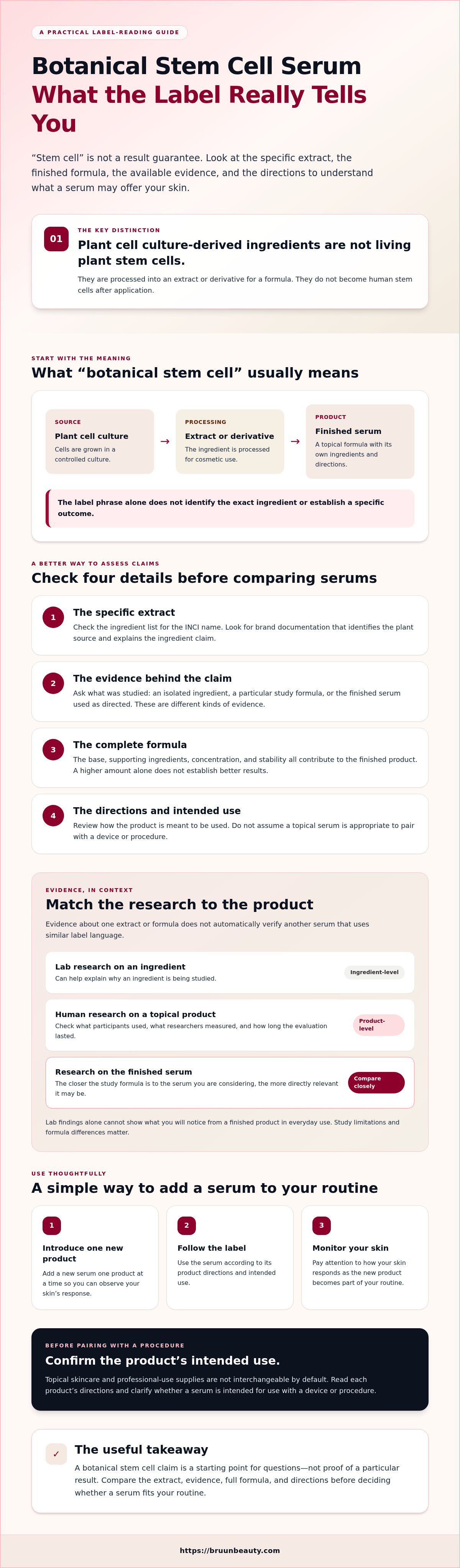
A botanical stem cell serum doesn’t contain living plant stem cells, so the ingredient name alone can’t tell you what a product may do for your skin. A botanical stem cell serum for anti-aging generally features plant cell culture-derived ingredients, but the exact ingredient and formula vary by product.
To weigh label claims against available evidence, check the specific extract, the finished formula, and the product’s directions. These details are more useful than a broad “stem cell” or “anti-aging” claim.
This guide explains how to compare those details and decide whether a topical serum fits your routine. It also covers what to check before combining skincare with a procedure.
Key Takeaways
- Learn what “botanical stem cell” usually means on a skincare label, and why checking the ingredient list matters.
- Assess a botanical stem cell serum for anti-aging by reviewing the specific extract, supporting evidence, full formula, and product directions.
- Compare product claims using available documentation rather than assuming an ingredient name guarantees a particular result.
- Introduce a new serum one product at a time, follow its label directions, and monitor how your skin responds.
- Clarify a product’s intended use before pairing topical skincare with procedures or professional-use supplies.
What Is a Botanical Stem Cell Serum for Anti-Aging?
A botanical stem cell serum for anti-aging is a topical skincare product that uses ingredients derived from plant cell cultures, rather than living plant stem cells. The phrase “anti-aging” describes the product’s cosmetic positioning, not a guaranteed result. To understand what a specific serum contains, check its ingredient list and the brand’s ingredient documentation.
What does “botanical stem cell” mean on a skincare label?
Plants have stem cells in growing regions, where cells can renew and develop into different types of plant tissue. For background, see what plant stem cells are. In skincare, the label generally refers to ingredients made from plant cells grown in a controlled culture, then processed into an extract or derivative for a formula.
That’s different from putting living plant cells in a finished serum. An ingredient derived from a plant cell culture isn’t a whole, living cell, and it doesn’t become a human stem cell after application. The exact ingredient can vary, so check the International Nomenclature of Cosmetic Ingredients (INCI) name on the label. If the name or source isn’t clear, look for the brand’s ingredient documentation rather than relying on “stem cell” wording alone.
What can a topical serum realistically do?
A serum is one step in a broader routine. Its formula may be designed to support the look and feel of skin, but its potential depends on the actual ingredients, the finished product, and how you use it. The phrase “anti-aging” doesn’t tell you the strength of the evidence or predict how your skin will respond.
A cosmetic serum may support the appearance and feel of your skin, but that alone doesn’t establish a specific clinical outcome. Don’t assume a botanical stem cell claim means a serum will remove wrinkles or cause cellular regeneration. Assess the specific ingredient and any evidence the brand provides for the finished formula. Then follow the product directions and consider how it fits with the other steps in your routine.
How Botanical Stem Cell Ingredients and Serum Formulas Differ
Evidence about a plant extract doesn’t automatically tell you how a serum containing it will perform. The ingredient’s source and processing matter, as do the finished formula’s base, ingredient levels, stability, and supporting ingredients. All of these affect the product you apply.
Why the extract and the finished formula both matter
“Botanical stem cell extract” isn’t one uniform ingredient. Plant source, cell-culture process, and extraction methods can differ, so similar label language doesn’t prove that two serums use the same material. Check the product’s INCI list and look for brand documentation that identifies the extract and explains the claims being made.
The formula also affects how an ingredient is delivered and maintained. A serum’s vehicle, or base, influences its texture and how it sits on your skin. Stability matters because an ingredient may change over time or under certain storage conditions. Concentration and other ingredients also affect the formula, but a higher amount alone doesn’t establish better results.
Ask what the evidence actually studied. Was it a lab finding about an isolated ingredient, a study of a specific formula, or an evaluation of the finished serum used as directed? These are different kinds of evidence. Results from one extract or formula shouldn’t be assumed to apply to another.
What anti-aging evidence should you look for?
Give more weight to human research on a topical product when it’s available, and check whether the study formula matches the serum you’re considering. Look for details about how participants used it, what outcomes researchers measured, and how long the evaluation lasted. Lab research can help explain why an ingredient is being studied, but it can’t by itself show what you’ll notice from a finished product in everyday use.
A scientific review discusses research on specific plant stem cell extracts and related cosmetic claims. You can read its overview of evidence for their effectiveness, while keeping in mind that findings tied to one ingredient or study formula don’t verify every serum using similar language. Study limitations and product differences matter.
Ingredient research can support a reason to study an extract, but it isn’t proof that every finished serum will produce the same outcome. If you’re also exploring professional-use skincare supplies, browse the microneedling product selection separately. Check each product’s directions and intended use rather than assuming a serum is appropriate for use with a device.
How to Compare Botanical Stem Cell Serums With Other Skincare Options
Compare the information each product provides, not the results its marketing may promise. Assess a botanical stem cell serum for anti-aging by its stated extract, supporting evidence, full formula, directions, and intended role in your routine. The same checklist applies to other serum categories, even though their ingredients aren’t interchangeable.
Which label details help you compare products?
Start with the complete ingredient list and product directions. Look for a clearly identified botanical extract and specific cosmetic claims you can connect to product documentation. A scientific review on plant stem cells in cosmetics can provide background on ingredient research, but it won’t verify every product that uses similar label language.
If the brand doesn’t identify the extract, explain its evidence, or make the intended use clear, note what’s missing. Check with the brand before buying instead of filling gaps with assumptions.
| What to compare | Botanical serum | Other serum categories |
|---|---|---|
| Ingredient identity | Check the named plant-derived ingredient and its INCI listing. | Confirm the stated ingredients, such as peptides or PDRN, on the label. |
| Evidence | Look for research on the specific extract and, separately, the finished product. | Look for documentation relevant to the named ingredient or finished formula. |
| Formula details | Review the full ingredient list and any disclosed formula information. | Use the same checks; a category name alone doesn’t describe the complete formula. |
| Directions and role | Follow the product’s application instructions and stated routine role. | Compare directions and intended use rather than assuming products serve the same purpose. |
How does a botanical serum compare with other serum categories?
Compare what’s actually stated: ingredient identity, texture, directions, and intended place in your routine. Plant extracts, peptides, and PDRN are different ingredient categories, so don’t treat one as a substitute for another or rank them by name alone. Bruun Beauty’s Salmon DNA/PDRN serum is a separate category, not a botanical stem cell serum.
If you’re planning a broader routine, explore Korean beauty skincare products by their listed ingredients and directions. Choose based on product details that match your routine, not on a universal “best” ingredient claim.
How to Add a Botanical Serum to Your Skincare Routine
Use the product label as your guide. Formulas differ, so there isn’t one universal amount or application schedule for every botanical stem cell serum for anti-aging. Keep the rest of your routine familiar as you introduce the serum, so you can better notice how your skin responds.
Where can a serum fit in a basic routine?
Follow the directions for application and layering. In a simple routine, you might cleanse, apply the serum as directed, then use moisturizer. In the morning, finish with sunscreen according to its label. This is general skincare guidance, not a way to verify a serum’s claims.
Introduce one new product at a time. Patch testing according to the product’s instructions can help you observe how your skin responds in a limited area, but it can’t guarantee that you won’t have a reaction later. If you notice discomfort or a reaction, stop using the product and seek qualified guidance if needed.
Keep your routine steady while evaluating the new addition. Avoid changing several products at once, and note any changes in comfort or appearance. This gives you a clearer basis for deciding whether the serum fits your routine, without assuming a particular result.
Can you use a botanical serum with microneedling?
Don’t assume a serum for ordinary topical use is appropriate during microneedling. The product’s directions may not support that use, and device instructions and qualified professional guidance matter when you’re considering a procedure. Check both before combining a product with a device.
Only use a product during a procedure when its directions support that specific use. Bruun Beauty’s microneedling skincare supplies are a separate category to explore, not a recommendation to use any particular serum with a device. Confirm each product’s intended use and directions first.
Choosing Your Next Step: Botanical Skincare or Microneedling Supplies
Your next step depends on what you’re choosing: a topical serum for your routine or products intended for microneedling. Keep those decisions separate, and use product-specific evidence and directions rather than relying on an ingredient name or broad anti-aging claim.
When should you keep your choice focused on a topical serum?
A botanical stem cell serum for anti-aging may fit your routine if its ingredients, directions, and intended use align with what you’re looking for. Before choosing, check:
- Ingredient clarity: Is the botanical extract clearly identified in the ingredient list or brand documentation?
- Relevant evidence: Does the information relate to that extract or finished product, rather than a different ingredient or formula?
- Formula details: Can you review the complete ingredient list and understand the product’s stated cosmetic purpose?
- Intended use: Do the directions explain how to apply and layer it?
Ingredient names alone don’t establish how a finished product will perform. Choose based on your routine, preferences, and verified directions. If a key detail is missing, check with the brand before buying. That gives you a clearer basis for comparing options without expecting a guaranteed result or assuming what your skin needs.
When is microneedling inventory relevant to your research?
Microneedling is a separate consideration from adding a topical botanical serum. Product and device directions matter, and you shouldn’t assume that a serum for ordinary topical use is intended for use during a procedure. Check the specific product’s intended use and seek qualified professional guidance if you have questions about combining products and procedures.
Bruun Beauty’s inventory includes professional microneedling devices and specialized microneedling serums. The Salmon DNA ampoule serum is a separate Salmon DNA/PDRN ingredient category, not a botanical stem cell serum. Check its product directions and intended use; don’t assume it’s suitable for use with a device.
If you’re researching that separate category, you can explore microneedling products at your own pace.
Choose Your Next Skincare Step With Confidence
A botanical stem cell serum for anti-aging is best assessed by its specific plant-derived ingredient, the evidence behind its claims, and the finished formula’s directions. “Botanical stem cell” on a label isn’t enough to predict how a product will perform, and research on an ingredient doesn’t automatically confirm results for every serum that contains it.
Keep your choice practical. If you’re considering a topical serum, check the full ingredient list, intended use, and application instructions, then introduce it thoughtfully into your routine. If you’re researching microneedling, treat that as a separate decision and confirm that each product’s directions support the way you plan to use it.
Bruun Beauty offers microneedling serums and devices, including a Salmon DNA/PDRN serum. This is a separate ingredient category, not a botanical stem cell serum. The company ships from its Miami and Los Angeles warehouses.
Explore Bruun Beauty’s microneedling products and review each item’s directions and intended use before deciding whether it fits your needs.
Frequently Asked Questions
What is a botanical stem cell serum?
A botanical stem cell serum is a skincare product whose label generally refers to ingredients derived from plant cell cultures. The exact ingredient and formula can vary, so the phrase doesn’t identify one standardized extract or product. It also doesn’t mean the serum contains human stem cells. Check the full ingredient list and the brand’s documentation to confirm what the product contains and how the brand describes its use.
Do botanical stem cell serums really work for anti-aging?
Results depend on the specific ingredient, the finished formula, the available evidence, and how you use the product. A study of an ingredient doesn’t show that every serum containing a similar ingredient will produce the same effect. If you’re considering a botanical stem cell serum for anti-aging, look for evidence on the exact finished product and its stated use. Don’t treat broad claims as guaranteed outcomes.
Are plant stem cell ingredients the same as human stem cells?
No. Botanical stem cell skincare language refers to plant-derived material, often an extract or derivative, depending on the product. It doesn’t mean a serum contains human stem cells, and plant cells don’t become human cells when you apply a product. Check the ingredient list for the specific INCI name, then consult brand documentation if the ingredient’s source or identity isn’t clear.
Can I use a botanical stem cell serum with other skincare products?
It depends on the serum’s formula and directions, so check its label before layering it with other products. Keep your routine simple while you introduce it, and add one new product at a time so you can monitor your skin’s response. Follow application instructions, including any cautions. Stop using the serum if irritation occurs, and seek qualified guidance if you’re unsure what to do next.
Can you use a botanical serum during microneedling?
Don’t assume a serum made for ordinary topical use is intended for use during microneedling. Check both the product directions and the device instructions, and ask a qualified professional for guidance if the intended use remains unclear. Only use a product during a procedure when its own directions explicitly support that use. A product’s ingredient category alone doesn’t establish compatibility.
How do I choose a botanical stem cell serum?
Compare the named botanical ingredient, full ingredient list, available product-specific evidence, directions, and intended use. Treat broad anti-aging language as a claim to evaluate, not proof of a particular result. Check whether the evidence concerns the ingredient or the finished serum. If the brand doesn’t clarify what an ingredient is or how to use the product, ask for documentation before choosing.
Skincare Ingredients to Avoid After Microneedling: A Practical Checklist
Best Korean Ampoule for Mature Skin: How to Choose in 2026
Related Posts

Consistent Microneedling and the Long-Term Changes to Expect

Aftercare choices to lower infection risk at home after microneedling

How to Create a Relaxing At-Home Spa Day With Simple Rituals

Sunscreen Recommendations After Microneedling: How to Protect Healing Skin

Investing in my skin for the future: what deserves my budget

Post-microneedling skincare routine for masks, makeup, and recovery

Skin Peeling After Microneedling: What to Avoid and When to Resume Makeup
