

Microneedling for Shallow and Deep Boxcar Scars
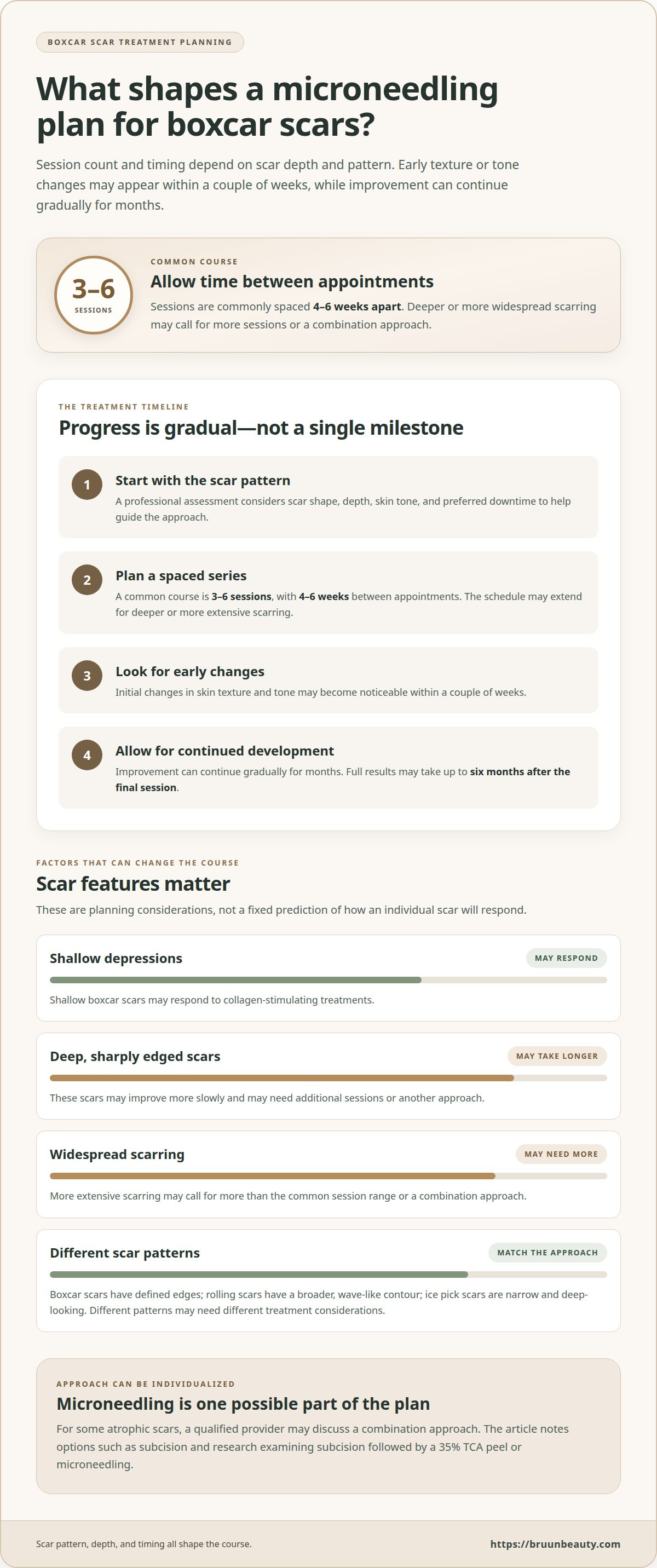
Microneedling for boxcar scars commonly involves 3 to 6 sessions, spaced 4 to 6 weeks apart, though deeper or widespread scarring may require more sessions or a combination approach.
Shallow boxcar scars may respond to collagen-stimulating treatments, while deep, sharply edged scars can improve more slowly and may need additional sessions or other procedures.
Early changes in skin texture and tone may appear within a couple of weeks, with improvement continuing gradually for months after treatment.
Key Takeaways
- Session needs vary with scar depth and pattern; shallow depressions and deep, sharply edged scars may respond at different rates.
- Microneedling may gradually soften the edges and improve the appearance of shallow boxcar scars through collagen remodeling.
- Learn how rolling, boxcar, and ice-pick scars differ, and why scar type helps shape the treatment approach.
- Deeper or more extensive scarring may call for a combination approach rather than microneedling alone.
- Explore how skincare products can complement a microneedling routine and support a nourished-looking complexion.
How Many Microneedling Sessions for Acne Scars?
Microneedling plans for acne scars commonly involve 3 to 6 sessions, spaced 4 to 6 weeks apart. Deep or widespread scarring may need more than 6 sessions or a combination approach.
For boxcar scars, fractional CO2 laser can improve scar scores, while microneedling offers a different collagen-stimulating approach. Subcision may address tethered scars, and research has also examined subcision followed by 35% TCA peeling or microneedling.
There’s no single useful average cost per session across the United States. The total depends on the treatment area, number of sessions, provider, and whether the plan combines procedures such as microneedling and subcision.
Session Timing and Recovery Intervals
A treatment schedule spaces sessions to allow recovery between appointments. Microneedling for acne scars is usually spaced 4 to 6 weeks apart, giving the skin time to settle before the next procedure. That interval also helps structure a course of 3 to 6 sessions. Deep boxcar scars may take longer to address, so the schedule can extend beyond a standard series.
Expected Improvement Over Treatment
Improvement is gradual, not an overnight change. Initial shifts in texture and tone may become noticeable within a couple of weeks, while results can continue developing for months. Full results may take up to six months after the final session. Deep, sharply cut boxcar scars may change more slowly than shallow depressions.
Professional Treatment and At-Home Dermarolling
Professional microneedling lets a provider tailor the procedure to your scar pattern and skin response. At-home dermarolling is not equivalent for boxcar scars, and treatment by an untrained provider raises the risk of long-lasting discoloration. Choose a qualified US dermatologist or provider with relevant training and experience. They should assess your scar shape and explain the planned approach.
Combination treatment may suit atrophic scars with different features. For example, subcision followed by 35% TCA peeling and subcision followed by microneedling have both been studied for acne scars. A professional plan can match the procedure to the scar, rather than relying on one technique for every depression. Explore professional microneedling resources for related equipment and supplies.
Session counts can also be viewed as milestones rather than a fixed promise: the clinic says many people start to notice visible improvement after 2-3 microneedling sessions, and recommends 5 scar-treatment sessions for optimal results. These are guidance points, not a guarantee that every scar will respond on the same timetable. Microneedling treatments are generally spaced several weeks apart, allowing the course to follow the recommended interval while progress is assessed.
The page states that subcision is among the advanced options that may be included in a combination acne-scar treatment strategy. It also reports that a study found fractional CO2 laser improved boxcar scar scores but caused more post-inflammatory hyperpigmentation and longer healing than microneedling. This comparison shows that treatment choice involves more than scar-score change: recovery time and pigment-related effects are also relevant. A qualified provider can discuss these trade-offs when considering a treatment approach for a particular scar pattern.
What Types of Acne Scars Does It Help?
Microneedling is used for depressed acne scars, with treatment choice shaped by scar pattern, skin tone, and acceptable downtime. A personalized assessment helps distinguish scars that may suit collagen-stimulating approaches from those needing another technique.
Responsive Scar Types and Treatment Fit
SkinPen microneedling may be considered for atrophic scars, including boxcar and rolling scars, because these marks are depressions. Their depth and pattern help determine whether microneedling fits your treatment goal. Raised keloid scars have a different structure and are not the target of this approach. Identifying the scar type first helps focus the plan on the concern you want to address.
Skin tone is another planning factor, alongside scar number and preferred downtime. A 2022 review in the Journal of the American Academy of Dermatology identifies these considerations when selecting acne-scar treatments. For example, a person with a few shallow depressions and limited recovery time may have different priorities from someone with widespread scarring and more flexible downtime.
A personalized plan also accounts for the way different scar patterns appear together. One area may have broad depressions, while another has narrow or more sharply defined marks. Mapping these differences helps a practitioner decide where microneedling may fit and where another technique may better match the scar’s shape.
Boxcar and Rolling Scar Differences
Boxcar scars have defined edges and are typically 1 to 4 mm across; rolling scars are typically 4 mm or wider, with a broader, wave-like contour. These visible differences matter because the shape and area of each depression influence treatment selection. A face can show both patterns, so the same approach may not suit every mark.
For example, sharply edged boxcar depressions differ from rolling contours that create unevenness across a wider area. A professional assessment can distinguish these patterns while considering scar depth, skin tone, and downtime. This supports a tailored plan rather than assuming all depressed acne marks respond in the same way.
The practical takeaway is to identify your scar pattern before choosing an approach. Microneedling may suit some boxcar and rolling scars, while raised keloid scars have a different structure and call for a different treatment discussion. Matching the method to the scar’s shape helps set a clearer, more relevant goal.
Microneedling for boxcar and other atrophic acne scars
Atrophic acne scars create depressions, but their shapes call for different approaches. Knowing whether marks are boxcar, ice pick, or rolling scars helps clarify when microneedling may fit.
Boxcar, Ice Pick, and Rolling Scars
Boxcar scars have defined sides and a flatter-looking base, while ice pick scars form narrow, deep-looking openings. Rolling scars create a wider, wave-like contour, sometimes with bands that pull the skin downward. These patterns can occur together, so an appointment may involve assessing several scar types instead of treating every depression alike.
Microneedling is used for atrophic scars, including boxcar scars, but it is usually an adjunct rather than the main approach for ice pick scars. A combination strategy can address these differences: subcision may release bands beneath rolling scars, while TCA CROSS may be considered for individual ice pick marks. The method depends on the scar pattern.
How Microneedling Improves Acne Scars
Microneedling prompts a healing response that supports collagen production and gradual remodeling around depressed acne scars. For shallow boxcar marks, this process may soften defined edges and improve the appearance of the scar floor. Changes develop gradually as the skin responds, rather than appearing immediately after one procedure.
Combination approaches can address different features in the same area. For example, research has examined subcision followed by microneedling, as well as subcision followed by a 35% TCA peel. Fillers offer another approach by adding volume beneath selected depressions, while microneedling focuses on collagen remodeling. Each procedure has a distinct role.
Treatment Depth for Acne Scars
Microneedling depth is selected according to the scar, treatment area, and intended approach. A surface-focused facial and treatment directed at an individual depression are not interchangeable procedures. Depth alone does not determine whether a scar responds; the scar’s shape and the technique also matter.
A practitioner’s plan should distinguish broad texture work from focused treatment of individual scars. Avoid copying a depth from an online post or using one setting across every acne scar. During an appointment, the provider can map boxcar, rolling, and ice pick patterns, then explain how the selected procedure fits each area.
An Indian study described a sequence combining subcision, microneedling and TCA CROSS for atrophic scars, illustrating how techniques may be paired rather than treated as interchangeable. Dr. Flora Waples advised that microneedling for scars requires at least 2.5mm of depth. By contrast, the clinic says microchannel facial needle depth is less than 1.5 mm, indicating that facial treatments and scar-focused work may use different depths.
How microneedling stimulates collagen and elastin
Microneedling prompts a healing response that supports collagen production and tissue remodeling. For a depressed boxcar scar, these changes may gradually soften visible edges and improve skin texture.
Collagen Stimulation
Collagen is a structural protein that helps support the skin’s framework. During microneedling, a device creates controlled channels that prompt the skin’s healing response. As tissue remodels, collagen production can help improve the appearance of shallow depressions.
This process takes time. A boxcar scar’s defined edges and lowered center reflect changes in the skin’s surface, so one appointment will not instantly level the area. Collagen remodeling develops gradually after treatment. Skin texture may begin to look different within a couple of weeks, with changes continuing for months.
For example, a shallow boxcar scar may look less sharply edged as the surrounding tissue remodels. A deeper depression has more pronounced contours and may need a different treatment plan. Scar shape and depth help determine how collagen stimulation fits into the overall approach.
Elastin Stimulation
Elastin is a protein that helps skin stretch and return toward its resting shape. Microneedling prompts a healing response, and the resulting tissue remodeling can involve both collagen and elastin. These proteins contribute different qualities: collagen supports structure, while elastin supports flexibility.
For a depressed acne scar, improved flexibility alone will not fill the lowered center. The overall remodeling process matters because scar appearance involves both surface texture and the tissue beneath it. A practitioner considers scar shape and depth when deciding whether microneedling fits the goal.
Collagen and elastin do not change the skin overnight. After microneedling, the healing response unfolds over time, and visible texture changes may emerge gradually. For instance, the edge of a shallow boxcar depression may look softer as surrounding tissue remodels, while a sharply defined or deep scar can remain more noticeable.
The device, treatment pattern, and scar characteristics all influence how microneedling is applied. The procedure focuses on stimulating a broader remodeling response, while individual scars may need a more targeted approach. Understanding this distinction helps set realistic expectations for how collagen and elastin relate to gradual changes in acne-scar texture.
Microneedling for shallow and deep boxcar scars
Shallow boxcar scars with defined edges may respond to collagen-stimulating treatments such as microneedling. Deep, sharply cut boxcar scars often improve more slowly and may need additional sessions or a combination approach.
Scar depth changes the challenge. With a shallow scar, collagen remodeling may soften the edges and raise the depressed floor, making the surface look more even. A deeper scar has a more pronounced depression, so microneedling alone may not produce the same degree of visible change. The scar’s shape helps guide the approach.
Microneedling prompts a healing response that supports collagen production. Because this response develops gradually, changes to a shallow boxcar scar may become noticeable over a series of sessions. Deep scarring can take longer to improve, and a longer course may be considered. Session needs depend on scar depth, pattern, and skin response.
For deep boxcar scars, combination treatment may address more than one feature. A provider might consider microneedling alongside other procedures as part of a broader acne-scar strategy. Subcision is one option in combination approaches, while radiofrequency microneedling adds heat to deeper skin layers and promotes tighter, firmer tissue remodeling.
These methods serve different purposes. Microneedling stimulates collagen across the treated area; subcision addresses fibrous bands tethering rolling scars, while radiofrequency adds energy beneath the surface. A mixed pattern, such as shallow boxcar scars beside deeper depressions, may call for distinct techniques instead of one setting across every area.
Scar appearance can continue changing gradually after the final appointment. Early texture shifts may appear within a couple of weeks, while improvement can continue for months. Deep, sharply edged scars may progress more slowly than shallow ones, so assessing them too early may miss later changes.
The practical takeaway is to match the method to the scar: shallow, clearly edged depressions may suit microneedling, while deep boxcar scars may call for additional sessions or a combination plan. This distinction matters more than treating all boxcar scarring as one uniform concern. A personalized approach considers depth, edges, surrounding texture, and the desired degree of change.
Bruun Beauty
Bruun Beauty sells skincare and beauty supplies for estheticians, clinic owners, and advanced at-home users. Its range includes microneedling serums, Jelly Mask Kits, and BB Glow Treatment Supplies. These products serve different skincare purposes, so choose them for the role they play in your routine, not as a way to change scar depth.
The Advanced Microneedling Serum SD - Control Salmon DNA Ampoule Serum is a cosmetic product for external use only. It is not injectable. Consider it as one skincare option in a broader routine, and follow the product directions and guidance relevant to your chosen procedure. A serum does not replace a scar-focused treatment plan.
Jelly Mask Kits offer an option for facial skincare routines. Estheticians may include them in their service setup, while advanced at-home users may incorporate a mask into a home routine. This is a separate skincare step, not a substitute for microneedling or other procedures selected for acne-scar concerns.
BB Glow Treatment Supplies serve a different cosmetic purpose. They may interest readers exploring complexion-focused treatments, but they are not a scar-remodeling method. Keeping these goals distinct can help you choose products that align with the results you want from each part of your routine.
These products give professionals and advanced at-home users options across microneedling skincare, masks, and BB Glow supplies. If your focus is acne-scar appearance, let your scar pattern and treatment approach guide those choices, and use cosmetic products for their intended roles. This keeps your skincare aligned with your routine without confusing it with procedural outcomes.
Explore the microneedling skincare and product options from Bruun Beauty to find items that fit your routine.
Frequently Asked Questions
Can Microneedling Improve the Appearance of Different Scar Types?
Microneedling is used to improve the appearance of some depressed acne scars, including rolling scars, but results can vary by scar shape and pattern. Narrow ice pick marks and broad texture concerns may call for different approaches. A qualified professional can help you understand which techniques may suit your skin goals.
What Should You Expect During Microneedling?
Your experience depends on the treatment area and approach. Before your session, ask the qualified professional performing it to explain the process and what to expect. They can also walk you through the procedure and your aftercare routine in plain language.
How Long Does It Take to See Full Results?
Full results may take up to six months after the final session because skin remodeling continues over time. Early changes in texture or tone may appear sooner, but they do not show the complete outcome. For a useful comparison, take photos in consistent lighting before treatment and at intervals afterward. Compare the same areas and angles rather than relying on memory.
How Can You Support Your Skin After Microneedling?
Follow your professional’s aftercare directions and keep your routine gentle as your skin settles. Give your skin time to return to its usual appearance before adding exfoliating products or other active ingredients. A qualified professional can explain what to expect during recovery from your procedure.
How effective is microneedling for atrophic boxcar acne scars?
Microneedling may improve the appearance of atrophic boxcar scars by gradually softening edges and supporting a more even-looking texture. Shallower depressions may respond more readily than deep, sharply cut scars, which can require a broader plan. Results vary with scar depth, pattern, and skin response. The goal is visible improvement, not a promise that every scar will disappear.
How many microneedling sessions are typically needed for boxcar scars, and how far apart?
A common course for acne scars is 3 to 6 sessions, usually spaced 4 to 6 weeks apart. The number depends on scar depth, coverage, and how the skin changes during the series. Deep or widespread scarring may need more than 6 sessions. A treatment plan also considers whether another procedure should complement microneedling for particular scar features.
What results and timeline can you expect from microneedling for boxcar scars?
Expect gradual changes, not immediate smoothing of every depression. Texture or tone may begin to look different within a couple of weeks, while improvement can continue for months. Deep boxcar scars may change more slowly than shallow ones. Focus expectations on softened edges and a more even-looking surface, and assess progress over the full treatment timeline.
How Can You Care for Your Skin After Microneedling for Boxcar Scars?
Keep your routine gentle and follow your provider’s aftercare plan. Wait 3 to 5 days before using exfoliating products, and use broad-spectrum SPF 30 or higher as part of your sun-care routine. Give your skin time to settle, and ask your provider for guidance on your post-session routine.
Choosing an At-Home Microneedling Pen for Beginners
Choosing an At-Home Microneedling Pen for Beginners
Related Posts

Choosing an At-Home Microneedling Pen for Beginners

How to Repair Your Skin Barrier After Microneedling at Home

How to Protect Skin After Microneedling in Summer Heat

How to Care for Oily Skin After Microneedling

Exercise After Microneedling: How Long to Wait Before Working Out

How to Choose Safer Microneedling for Melasma-Prone Skin
