

How to Microneedle at Home While Reducing Infection Risk
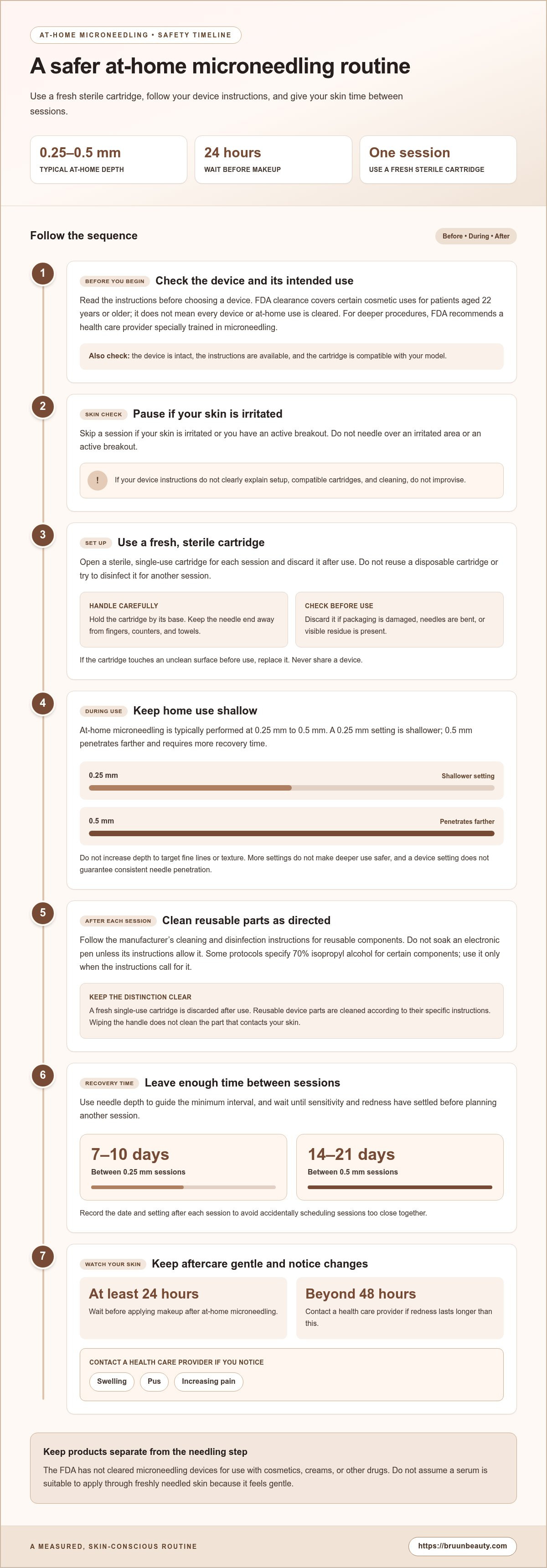
Makeup can wait; safe handling can’t. After at-home microneedling, wait at least 24 hours before applying makeup, use a fresh, sterile cartridge for each session, and clean reusable device parts according to the manufacturer’s instructions. A practical safety checklist for at-home microneedling also starts with knowing when to skip a session.
It’s natural to want smoother-looking skin without unnecessary risks. At-home devices and professional microneedling are not interchangeable: treatment depth and who performs the procedure affect safety. If your skin is irritated or you have an active breakout, pause rather than needle over it.
This guide covers safe handling of your device and cartridges, skin preparation, aftercare, and when to postpone treatment. It also compares at-home and professional care and explains what to do if redness persists or you notice concerning changes, helping you make a more informed choice for your skin.
Key Takeaways
- Understand what FDA clearance covers: certain cosmetic uses for patients aged 22 years or older, not every device or treatment goal.
- Build cartridge replacement and device cleaning into your routine to reduce avoidable contamination risks.
- Review your skincare products and health circumstances before a session, since some ingredients and conditions call for a pause.
- Compare needle depth and professional oversight to see how at-home and in-office microneedling differ in risk.
- Keep post-session care gentle and pay attention to changes that may call for medical attention.
Choosing and sanitizing an at-home microneedling device
Choose a device you can clean exactly as its instructions require, and use only compatible cartridges. If redness lasts beyond 48 hours, or you notice swelling, pus, or increasing pain, contact a health care provider.
-
Check Device Regulation and Clearance
Check the device’s intended use before choosing a model, and don’t assume clearance covers every purpose. According to the U.S. Food and Drug Administration, microneedling devices are cleared for certain cosmetic uses in patients aged 22 years or older. FDA clearance for a specific use doesn’t mean every at-home use is cleared. For deeper procedures, FDA recommends choosing a health care provider specially trained in microneedling.
-
Confirm Cleaning and Reuse Details
Read the manufacturer’s cleaning instructions before opening the device, then identify which parts are reusable. Clean and disinfect reusable parts as directed, and never share a device. Some protocols specify 70% isopropyl alcohol for certain components, but don’t soak an electronic pen unless its instructions allow it. Ask a trained provider about their device-cleaning process before professional microneedling.
- Match the device style to how it contacts your skin. Rollers move across the surface, while stampers press into selected areas. Pens move cartridges across the skin with powered motion, and infusion devices are designed to combine needling with product application. These styles are not interchangeable, and a smooth glide does not prove the needle depth or technique is appropriate. Compare the instructions and intended use before choosing.
- Keep home use shallow and follow the device directions. At-home microneedling is typically performed at 0.25 mm to 0.5 mm. Some devices offer adjustable depth, but more settings don’t make deeper use a safer choice. Avoid treating a setting as a guarantee of consistent needle penetration. If the instructions don’t clearly explain setup, compatible cartridges, and cleaning, don’t improvise.
- Distinguish single-use from reusable components. Use a fresh, sterile cartridge for each session if it is labeled single-use, then discard it. Do not try to disinfect a disposable cartridge for reuse. For a reusable roller or other reusable component, follow its specific cleaning instructions after every use. Wiping the handle does not clean the part that contacts your skin.
- Make your checklist practical. Before starting, confirm the device is intact, its instructions are available, and the cartridge matches the model. Keep the manufacturer’s cleaning steps beside your supplies so you can follow them rather than guessing. For a closer look at device and cartridge options, explore microneedling devices and supplies and use the product instructions to guide setup.
Needle cartridge reuse and infection prevention
Plan each session around a sterile cartridge, careful handling, and enough recovery time. These habits help reduce avoidable contamination and keep your routine measured rather than aggressive.
- Open a sterile cartridge for each session. Use a fresh, sterile, single-use cartridge every time and discard it after treatment. Reusing microneedling cartridges can cause or spread infection, even if the needles look clean. Include checking the sealed packaging before opening and setting the used cartridge aside for disposal immediately afterward in your safety checklist for at-home microneedling.
- Don’t rely on soaking to make a disposable cartridge reusable. A cleaning step doesn’t turn a single-use item into a sterile cartridge. Some guidance mentions replacing disposable cartridges after 3–5 uses at most, but single-use cartridges for every session are the clearer prevention choice. Follow the product label, and discard any cartridge with damaged packaging, bent needles, or visible residue.
- Handle the cartridge without touching the needles. Hold it by the base while attaching it to the device, keeping the needle end away from counters, towels, and fingers. If the cartridge touches an unclean surface before use, replace it. This simple setup habit helps keep skin debris and environmental contaminants away from the needles.
- Choose shallow depths for home use. At-home microneedling is typically performed at 0.25 mm to 0.5 mm. A 0.25 mm setting is shallower, while 0.5 mm penetrates farther and requires more recovery time. Don’t increase depth to target fine lines or texture. A deeper setting raises the chance of irritation and skin injury without making home use more controlled.
- Match the interval to needle depth. Guidance recommends waiting 7–10 days between 0.25 mm sessions and 14–21 days between 0.5 mm sessions. Record the date and setting after each session, then wait until sensitivity and redness have settled before planning another. A safety checklist for at-home microneedling can include this simple log, helping you avoid accidental back-to-back sessions.
- Keep serums separate from the needling step. The FDA has not cleared microneedling devices for use with cosmetics, creams, or other drugs. Don’t assume a serum is suitable to apply through freshly needled skin because it feels gentle. If you’re comparing compatible device supplies, browse microneedling supplies and follow the instructions for each product.
What safety tips should I know before microneedling?
Before starting, review your skin, products, device instructions, and aftercare plan. A safer at-home routine means cleansing first, using shallow settings, and avoiding ingredients and activities that may irritate freshly needled skin.
-
Check Whether to Avoid Treatment
Pause if you have active acne, a cold sore, a rash, eczema, psoriasis, sunburn, or open or irritated skin. Needling over active acne can spread bacteria, while a flare may become more irritated. If you have diabetes, a weakened immune system, or a bleeding disorder, microneedling may not be suitable. Discuss your situation with a health care professional before proceeding.
Also consider your medication history. Avoid microneedling while taking isotretinoin or within 6 months of stopping it. Blood-thinning medicine can raise bleeding concerns. If you have a history of cold sores, ask a health care provider about prevention before needling near that area.
-
Select Serums and Avoid Certain Actives
Review your routine before choosing a serum, and do not assume a cosmetic product is intended for use during needling. The FDA has not cleared microneedling devices for use with cosmetics, creams, or other drugs. Avoid applying serum through freshly needled skin unless the device instructions specifically support that use.
Pause retinoids and vitamin A products 5 to 7 days beforehand. Stop chemical exfoliants such as AHAs and BHAs 3 to 5 days beforehand; also pause vitamin C, benzoyl peroxide, and salicylic acid 3 days beforehand. These active ingredients can add irritation when skin is already sensitive.
-
Follow the Safe At-Home Technique
Cleanse your skin thoroughly, prepare the device as instructed, and use a depth no greater than 0.5 mm at home. Work in small sections with light, even contact. Don’t press hard, keep returning to one spot, or needle across a blemish. Limit passes to 4–6 over the same area, and stop if you notice unexpected pain or bleeding.
Keep the cartridge moving as directed rather than holding it in place. A consistent, gentle technique matters more than pursuing redness or a collagen-focused sensation. Follow the device instructions for direction and pressure. Do not improvise a pattern or increase depth to target fine lines.
-
Follow Post-Treatment Skincare and Activity Guidance
Keep aftercare simple. Avoid makeup for at least 24 hours, and avoid fragrances, acids, retinol, and other active ingredients for 24–48 hours. Choose gentle hydration rather than layering multiple products. Skin can be more sensitive to skincare after microneedling, including products with alcohol or exfoliating ingredients.
Skip sweaty workouts and direct sun exposure for a couple of days. Protect your skin from sunlight afterward, since freshly needled skin can be more vulnerable. If redness continues beyond 48 hours, or swelling, pus, or increasing pain appears, seek medical care.
Skin conditions and situations when treatment should be skipped
Use gentle, fragrance-free skincare after a session, and avoid retinoids, acids, and alcohol-based products while your skin is sensitive. Before needling, review active skin conditions, recent sun exposure, medications, and every product in your routine.
- Skip a session if your skin isn’t calm. Do not needle over active acne, cold sores, warts, eczema, psoriasis, inflammation, open wounds, cuts, or irritated skin. Wait until rosacea flares, sunburn, and active breakouts have settled. Needling over pustular acne can spread bacteria, while treating a cold sore or open cut can increase irritation and infection risk.
- Review health conditions and medication before planning a session. Eczema, diabetes, or a weakened immune system may make microneedling unsuitable. Clotting or bleeding disorders and blood-thinning medicine also matter because needling can cause bleeding. If you take oral isotretinoin, avoid microneedling while using it and within 6 months of stopping. Tell a health care provider about allergies or sensitivities to numbing medication.
- Adjust skincare and sun exposure ahead of time. Stop retinoids and vitamin A products 5 to 7 days before a session. Pause AHAs and BHAs 3 to 5 days beforehand, and vitamin C, benzoyl peroxide, and salicylic acid 3 days beforehand. Avoid tanning and sunburn for 2 weeks before microneedling. If you use blood-thinning supplements, pause only with physician approval, 48 to 72 hours before treatment.
- Prepare clean skin and equipment. Cleanse thoroughly before starting, then follow the device manufacturer’s setup and cleaning instructions. Use a sterile, single-use cartridge for each session, and do not share equipment. These steps help keep debris away from the skin’s temporary channels. If you have a history of cold sores, ask a health care provider about antiviral prevention before needling.
- Keep post-session skincare simple. Choose gentle hydration, and avoid layering products during the first 72 hours. Skip retinol, exfoliating acids, benzoyl peroxide, and fragrance for at least 24–48 hours; longer pauses may suit sensitive skin. Avoid makeup for at least 24 hours. Don’t apply a serum through freshly needled skin unless the device instructions support that use.
- Protect your skin while it settles. Avoid direct sun and tanning for at least 24 hours after a session, and skip exercise or sweating for 48 to 72 hours. Avoid hot yoga, saunas, steam rooms, and hot tubs for 24–48 hours. Apply broad-spectrum SPF 30+ the morning after microneedling and continue for at least 7 days.
At-home versus professional microneedling risks
Before choosing, compare needle depth, device type, and who performs the procedure. At-home use should stay shallow; deeper needling carries different risks and requires professional oversight.
- Keep at-home use shallow. These depths differ from professional procedures that reach deeper layers. Longer needles can increase the risk of skin injury, infection, and scarring. Do not use a home device to target acne scars or texture by increasing its depth beyond shallow settings.
- Recognize when depth changes the risk. At 1.0 mm, microneedling penetrates into the dermis and is for professional use only. Depths of 1.5–2.5 mm involve deep dermal penetration under medical supervision. Those settings require more than a steady hand: skin assessment, sterile technique, and appropriate aftercare all matter.
- Choose a trained professional for deeper procedures. The FDA recommends that people considering microneedling choose a health care provider specially trained in the procedure. A trained provider can assess your skin, select an appropriate approach, and respond to complications. This matters if you are concerned about acne scars or deeper texture changes that shallow home devices are not designed to address.
- Don’t assume radiofrequency microneedling carries the same risks. Radiofrequency devices deliver energy as well as needles, so they work differently from standard pens and rollers. On Oct. 15, 2025, the FDA published a safety communication about potential risks with certain uses. Reported concerns include burns and permanent scarring, so this technology calls for professional guidance.
- Plan for redness and recovery, not an instant result. Redness usually calms significantly within 24 hours for most people, but sensitivity can last longer. Professional microneedling may require more than one session, with procedures commonly spaced 4 to 6 weeks apart. Topical hyaluronic acid doesn’t make deeper needling safer; don’t apply cosmetics through freshly needled skin unless device instructions support it.
- Choose settings that suit your goal. For surface-level improvement, keep at-home use shallow and give your skin time between sessions. If you want to address deeper acne scars or are considering radiofrequency, choose professional care rather than increasing needle length at home. Seek medical care for persistent redness, swelling, pus, or increasing pain.
Bruun Beauty: Advanced Microneedling Serum SD - Control Salmon DNA Ampoule Serum
Bruun Beauty’s Advanced Microneedling Serum SD - Control Salmon DNA Ampoule Serum offers a skincare option to consider as you build your routine. Bruun Beauty is a US-based e-commerce business shipping from Miami and Los Angeles. Since freshly needled skin can feel sensitive, follow the device instructions and the serum’s directions rather than assuming it belongs in your session.
Keep product choices simple while your skin settles. Use the serum only as directed, and wait until your skin is ready for your usual skincare steps. This helps you make a considered choice without adding unnecessary actives when your skin feels sensitive.
For product details, visit bruunbeauty.com and explore the serum at your own pace.
Make your next skincare step a thoughtful one
Let your skin’s current condition guide your next move, not pressure to pursue faster results. If you’re unsure whether microneedling suits your goals or routine, pause and seek medical guidance before using a device. A safety checklist for at-home microneedling is most useful when it helps you choose a careful approach, including when professional care is a better fit.
Take time to compare device options and understand each product’s directions before adding anything to your routine. Bruun Beauty’s microneedling collection lets you explore products and supplies while keeping the focus on informed, skin-conscious choices.
Thoughtful preparation is a positive step toward skincare that feels comfortable and considered. Keep listening to your skin, and choose the approach that supports your well-being.
Frequently Asked Questions
How Long After Microneedling Can I Wear Makeup?
Wait at least 24 hours before applying makeup after an at-home session. Freshly needled skin may be sensitive to cosmetics, and applicators can transfer residue. When you resume makeup, use clean brushes or sponges and apply products gently. If makeup stings or increases redness, remove it and give your skin more time before trying again.
How Often Should You Do It?
Set your schedule by needle depth and your skin’s response. For 0.25 mm, guidance recommends waiting 7–10 days between sessions; for 0.5 mm, wait 14–21 days. Record each session’s date and depth. This simple log helps you spot patterns in sensitivity and avoid shortening the recovery interval when you’re eager to see changes.
How often can microneedling be done?
There isn’t one interval for every device and setting. At-home guidance suggests 7–10 days between 0.25 mm sessions and 14–21 days between 0.5 mm sessions. Professional schedules differ and commonly involve 3 to 6 sessions spaced 4 to 6 weeks apart. The procedure depth and your skin’s recovery determine the appropriate spacing.
🔄 How Often Should You Microneedle at Home?
For home use, plan around the needle length: guidance recommends waiting 7–10 days after 0.25 mm needling and 14–21 days after 0.5 mm needling. Write down the setting and your skin’s response after each session. If sensitivity or redness remains, postpone rather than following the calendar automatically.
Is at-home microneedling safe, and who should avoid it?
At-home microneedling carries risks and is not suitable for everyone or every skin condition. Avoid needling active acne, cold sores, eczema, psoriasis, sunburn, open wounds, or irritated skin. Diabetes, a weakened immune system, bleeding disorders, blood-thinning medicine, and isotretinoin use also raise concerns. Discuss your health circumstances with a medical professional before proceeding.
What needle lengths are safe for at-home microneedling?
At-home microneedling is typically performed at 0.25 mm to 0.5 mm, and guidance recommends staying at or below 0.5 mm. A longer needle reaches deeper tissue and changes the risk profile. Check the device setting before each session, and don’t increase depth to target a concern more aggressively.
What are the risks and side effects of microneedling at home?
Possible side effects include redness, tightness, itching, peeling, bruising, or pinpoint bleeding. Infection and scarring are additional concerns, particularly with reused cartridges or needling across active blemishes. Seek medical care if redness lasts beyond 48 hours, or if you notice swelling, pus, or increasing pain. Don’t continue needling while symptoms are worsening.
How should skin be prepared before at-home microneedling?
Cleanse your skin thoroughly and prepare the device according to its manufacturer’s instructions. Stop retinoids and vitamin A products 5 to 7 days beforehand, and pause AHAs and BHAs 3 to 5 days beforehand. Avoid needling sunburned skin, review medication concerns, and keep the instructions nearby while you set up.
Microneedling for Large Nose Pores: Professional Guide
How to Permanently Reduce Pore Size at Home: The Professional Protocol
Related Posts

Consistent Microneedling and the Long-Term Changes to Expect

Aftercare choices to lower infection risk at home after microneedling

How to Create a Relaxing At-Home Spa Day With Simple Rituals

Sunscreen Recommendations After Microneedling: How to Protect Healing Skin

Investing in my skin for the future: what deserves my budget

Post-microneedling skincare routine for masks, makeup, and recovery

Skin Peeling After Microneedling: What to Avoid and When to Resume Makeup
