

Investing in my skin for the future: what deserves my budget
Your skin budget works best when it supports consistent care, not a crowded shelf. A practical plan for investing in my skin for the future starts with daily SPF and regular moisturizing, then adds a few quality products and professional care that fit your goals. Seeing a trusted skincare professional for a facial twice a year is one way to make room for expert guidance without building your routine around appointments.
It’s understandable to wonder whether a higher-priced product or an in-office treatment deserves priority. The answer depends on your skin type, lifestyle, and what you can comfortably spend while keeping up with your other financial goals. You’ll learn how to compare everyday essentials with science-backed options, decide where quality matters most, and weigh professional treatments without treating every trend as a must-have.
A thoughtful routine can complement professional care. Choose products and treatments with a clear purpose, so your skincare budget feels manageable now and supports nourished-looking skin over time.
Key Takeaways
- Set a skincare budget that fits your broader financial goals, then prioritize the habits you can maintain consistently.
- Compare treatments by their purpose and evidence, including how options such as microneedling, chemical peels, and LED devices work.
- Choose a small number of quality products that suit your skin and routine instead of accumulating products you may not use.
- Use professional facials and at-home care as complementary parts of a routine, with daily SPF as a lasting priority.
- Learn which ingredients and treatment choices may best support your long-term skin goals.
1. Balancing skincare purchases with financial goals
Start with your financial priorities, then set a skincare budget that leaves room for them. List recurring expenses, savings goals, and skincare purchases separately. Decide what you can spend on cleanser, moisturizer, and sun protection before browsing new products. A plan for investing in my skin for the future should support consistent care without displacing essential expenses.
Include professional appointments in that plan, rather than treating each facial as an unexpected expense. Compare that example with your own priorities: you might choose fewer appointments, focus on home care between visits, or set aside money for treatments that fit your goals. Regular at-home skincare can complement professional treatments and help maintain smoother skin texture.
Spending in line with your values can make budgeting easier to sustain. If you enjoy a twice-daily oat latte, use it as an example when reviewing recurring habits, not as an automatic expense to cut. Ask whether you value that purchase more than an extra skincare product. Then choose a budget that reflects your answer and revisit it when your income or priorities change.
How can you choose safe, effective skincare products in the United States? Match each product to your skin type, lifestyle, and a specific routine step, then read its ingredient list and directions before buying. Choose products for a clear purpose, such as moisturizing regularly, and introduce one new item at a time so you can assess how it fits your routine.
Prioritize purpose over novelty by identifying what each product needs to do. If your routine lacks moisturizer, filling that gap may make more sense than buying another serum with overlapping ingredients. Before purchasing, check the product’s intended use, ingredients, and directions. This helps connect your spending to practical needs rather than packaging or trends.
Consistency matters across home and professional care. If you schedule a facial, plan the at-home steps you can maintain between appointments, including regular moisturizing. Tailor those steps to your skin type and lifestyle: a routine that fits your mornings and evenings is more workable than one with products you rarely use.
Preventative care is also a budgeting choice. Daily SPF can help protect your complexion and prevent future skin issues, while regular moisturizing supports a consistent routine. Put these repeatable steps ahead of occasional purchases when planning your skincare spending. Reassess your routine when your needs shift, and keep products that serve a defined purpose.
2. Science-backed skin treatments
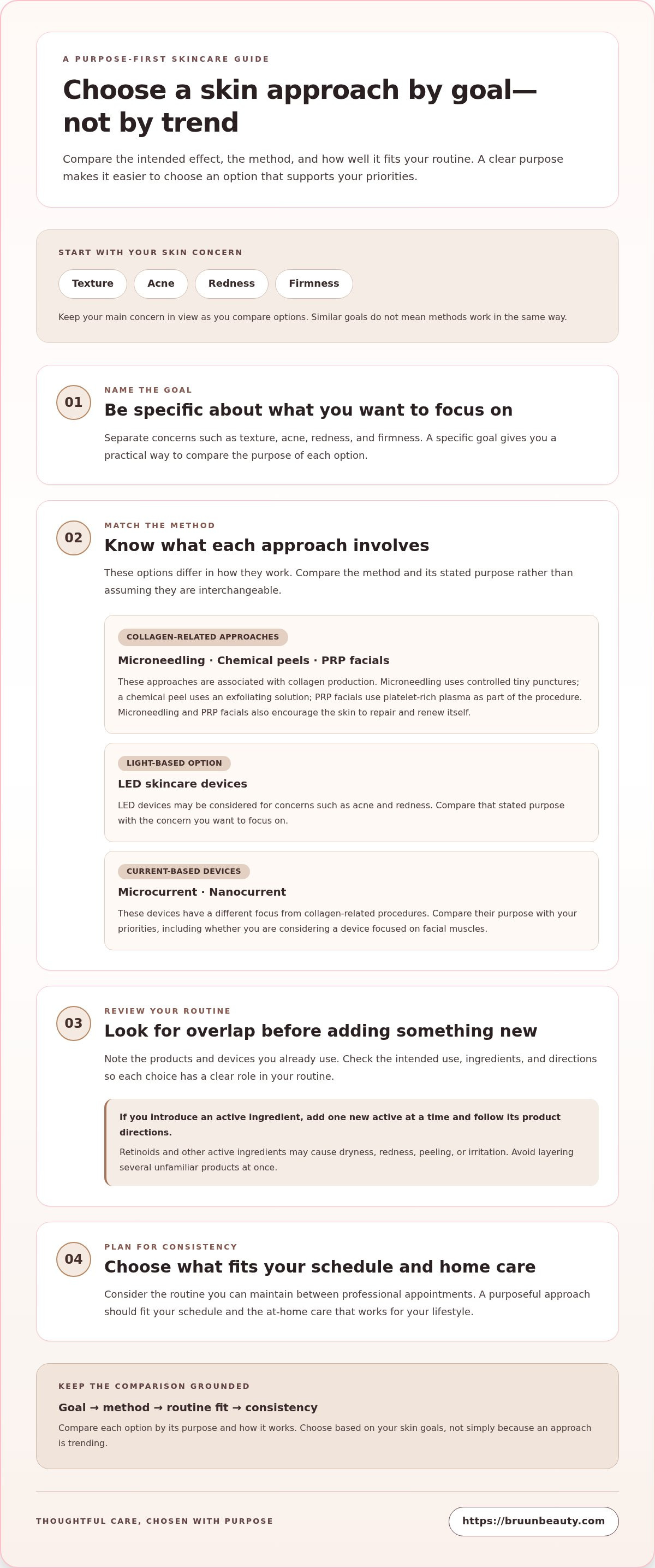
Compare an option by its intended effect, evidence, and place in your routine. Microneedling, platelet-rich plasma (PRP) facials, and chemical peels are approaches associated with collagen production. PRP facials and microneedling also encourage the skin to repair and renew itself. These options differ, so choose based on your skin goals rather than a trend.
Microneedling uses controlled tiny punctures in the skin, while a chemical peel uses an exfoliating solution. Both aim to prompt a skin response associated with collagen production, but they work differently. PRP facials use platelet-rich plasma as part of the procedure. Understanding each method helps you compare options without assuming similar goals mean identical processes.
LED skincare devices offer another approach. They may be considered for concerns such as acne and redness, so assess whether those concerns match your goal. Microcurrent and nanocurrent devices are another option to consider. These devices have a different focus from collagen-related procedures. Ask what a device is designed to do, then compare that purpose with your priorities.
What are the risks of retinoids and other anti-aging skincare ingredients? Retinoids and other active ingredients may cause dryness, redness, peeling, or irritation. Introduce one new active at a time, follow its product directions, and avoid layering several unfamiliar products at once.
Use a simple decision process before committing to an option:
- Name the goal. Separate concerns such as texture, acne, redness, and firmness.
- Match the method. Compare microneedling, peels, PRP, LED, and microcurrent by the skin feature each targets.
- Review your routine. Note the products and devices you already use, so you can spot overlap.
- Plan for consistency. Choose an approach that fits your schedule and the home care you can maintain.
What you do outside your routine matters, too. Sleep, a varied diet, and avoiding smoking may influence your skin’s appearance over time. These habits complement skincare, but they don’t replace daily SPF or consistent moisturizing.
If redness is your main concern, compare an LED device’s stated purpose with your current routine before adding another active. If texture is your priority, consider how collagen-related approaches differ from devices targeting facial muscles. That comparison makes your next step more purposeful.
If microneedling is relevant to your goals, browse microneedling options as one way to explore the category alongside other approaches.
3. Choosing quality products over quantity
A crowded shelf can make it harder to tell which products earn their place. Choose fewer, higher-quality skincare products that each serve a clear purpose. For example, if you already own two moisturizers, a third may add less value than replacing a product that doesn’t suit your routine. Quality means fit, function, and consistent use, not simply an impressive label.
Start by mapping your routine to basic steps: cleansing, moisturizing, and sun protection. Then identify a specific gap before shopping. If your skin feels dry after cleansing, review your cleanser and moisturizer before adding a serum. A product should solve a defined routine need, not duplicate what another item already does.
Read the ingredient list and directions before you buy. Look for ingredients related to the product’s stated purpose, then consider whether its directions fit your habits. For example, a leave-on product that requires a step you regularly skip may sit unused. A simpler option you’ll apply as directed can be a more useful purchase.
Use this product audit to separate essentials from extras:
- Name the job. Write one purpose beside each product, such as cleansing or moisturizing.
- Spot overlap. Compare products that appear to serve the same step, then decide which one fits your skin and routine better.
- Check use. Keep products whose directions you can follow consistently.
- Pause before adding. Identify the gap a new purchase would fill before placing it in your routine.
Consider how long a product is likely to remain useful in your routine. Higher-quality skincare can be a worthwhile purchase when you keep using it. That value depends on choosing products that match your needs, rather than buying a premium item that doesn’t. A practical test is whether you can explain its purpose and where it fits.
If your routine already includes a moisturizer you enjoy using, don’t add another simply because it is trending. Check whether the products you own work together in a manageable sequence. If a product repeatedly goes unused, note why before buying a similar one. The pattern may point to an inconvenient texture, confusing directions, or a step you don’t need.
Keep a short list of products you finish and repurchase. That record helps you notice which formulas fit your routine over time. If you’re investing in your skin for the future, prioritize products with a clear role and repeatable use. Fewer well-chosen products can make your skincare routine easier to maintain.
4. Professional treatments and visible signs of aging
Visible changes such as rough texture or pore buildup can help you identify what you want a professional service to address. Describe one concern in plain terms, then compare services by their purpose. This keeps your choice focused on your skin goals instead of a long menu of procedures.
Professional-grade microdermabrasion and extractions can produce results for months. They serve different purposes: microdermabrasion exfoliates the skin’s surface, while extractions remove pore buildup. If uneven texture is your focus, compare that goal with microdermabrasion. If visible congestion is the concern, consider whether extractions are more relevant.
Before choosing a service, write down details that can make the decision clearer:
- Your visible concern: Describe what you notice, such as rough texture or clogged-looking pores.
- Your preferred focus: Decide whether you’re prioritizing surface exfoliation or pore buildup.
- Your current routine: List the products and steps you already use at home.
- Your desired role: Identify what you want the professional service to add to your regular care.
This preparation helps you compare a service with your existing habits. If you’re considering extractions for visible pore buildup, note your cleansing routine and where you notice congestion. If surface texture is the priority, consider whether microdermabrasion better matches that goal. A clear description is more useful than asking for a service by name without explaining your concern.
Professional care can help you consider how a service fits alongside home skincare. Make a note of the products you use and the steps you can maintain. That context makes it easier to understand the role of a professional service without assuming it replaces your everyday routine.
Keep your choice tied to the concern you identified. If you’re comparing microdermabrasion with extractions, consider the difference between surface exfoliation and pore buildup. If neither matches your main concern, don’t add a service just because it appears on a menu. A focused decision can help direct your skincare budget toward the support you want.
After choosing a service, pay attention to how it fits your overall plan. Note the concern you wanted to address and whether the service complemented your existing routine. This gives you a practical reference for future decisions, without relying on a trend or an unrelated product recommendation.
5. Which skincare ingredients have the strongest evidence for long-term skin health?
Ingredient strength depends on your goal, the product formula, and how you use it. Daily SPF is a useful protection step, but there is no universal ranking of other ingredients for every routine. Start by defining your goal, then assess each product by its stated purpose and directions.
Read the full ingredient list rather than relying on a prominent ingredient name on the front label. A product may feature one ingredient, while other components affect its texture and how it fits your routine. Check the directions, too. An ingredient is practical for your routine only if you can use the product as directed.
Use a simple evaluation checklist before adding a formula:
- Set a goal. Decide what you want the product to contribute, such as moisture or a specific routine step.
- Review the label. Read the complete ingredient list and directions, not just a highlighted claim.
- Compare your current products. Look for a distinct role rather than buying another formula that seems to do the same job.
- Consider routine fit. Choose a product whose texture and application steps work with your habits.
If you’re comparing two serums, note each one’s stated purpose and application directions. Then consider whether either adds a distinct step to your routine. If both appear to serve the same role, choose based on which instructions and texture suit your habits. That makes the decision more concrete than choosing by a trending ingredient name alone.
Keep a brief product note with its name, purpose, and directions. This is useful when you revisit a formula or compare it with another option. It also helps you remember why you added a product, keeping your choices connected to actual goals rather than shifting claims or packaging.
Daily SPF remains a practical part of long-term skin care. For other ingredients, assess the specific claim and the product’s intended use instead of assuming every popular active has equal relevance. If microneedling is part of the routine you’re researching, compare the products in the microneedling collection with your routine goals and the directions provided for each product.
Ingredient choices are part of a broader routine: tailor skincare to your skin type and lifestyle. That keeps product decisions connected to the circumstances in which the routine has to work. Regular moisturizing is also important, so consider how the products you choose fit around it. These points help you assess a routine by its suitability and consistency, rather than treating a highlighted ingredient as the whole plan.
LED skincare devices are used for concerns such as acne and redness. Keep that consideration separate from the question of which ingredients have evidence for long-term skin health, and assess devices against your routine’s goals. Skin type, lifestyle, and regular moisturizing offer a practical basis for shaping care, while LED devices are a separate consideration from choosing a skincare formula.
Bruun Beauty: Advanced Microneedling Serum SD - Control Salmon DNA Ampoule Serum
Advanced Microneedling Serum SD - Control Salmon DNA Ampoule Serum is an option to consider when you’re exploring products for a microneedling-focused skincare routine. Its name identifies the Salmon DNA ampoule format, while its intended use and directions should guide how it fits into your regimen.
Keep product selection connected to your goals: review the directions, consider your existing routine, and avoid adding an item without a clear purpose. Bruun Beauty also sells jelly mask kits and BB Glow treatment supplies. Choose products according to the role you want them to play, rather than adding steps simply to expand your shelf.
For more details about the serum, contact Bruun Beauty and continue building a considered skincare routine at your own pace.
Make Your Next Skincare Choice Count
Your next skincare decision can be small and still move your routine forward. Choose one goal to focus on, then make your next purchase or appointment serve that goal. The phrase “investing in my skin for the future” becomes more useful when it leads to a choice you can sustain, rather than another step you may not use.
Before changing your routine, write down what you want to improve and what you already use. That simple note can help you spot overlap, make a more intentional choice, and keep your skincare spending connected to your priorities. Build gradually, paying attention to how each step fits your daily habits.
Explore Bruun Beauty’s microneedling serums and devices if they align with your skincare goals.
Let your routine grow at a pace that feels right for you. Thoughtful, consistent choices can help you care for your skin with confidence.
Frequently Asked Questions
What does investing in skin health for the future mean?
It means making skincare choices that support your goals over time, rather than buying products based on short-lived trends. Consider what you want your routine to accomplish, how much time you can give it, and which steps you enjoy using. An at-home skincare enthusiast might prioritize a simple routine, while an esthetician may focus on products that fit their professional workflow.
What daily skincare routine helps prevent premature aging?
A practical routine includes cleansing, moisturizing, and daily sun protection. In the morning, apply moisturizer and SPF according to each product’s directions. In the evening, cleanse to remove the day’s buildup and moisturize. Keep the steps manageable and follow product instructions. A routine you can repeat consistently is more useful than a complicated sequence you often skip.
How can I tell whether a skincare product suits my routine?
Notice how a product fits your daily routine, not just how appealing it looks on the shelf. Keep a simple note of when you use it, how it feels to apply, and whether its directions are practical for your schedule. This record can help you distinguish a product you genuinely use from one that adds clutter without serving your routine.
When should I reconsider my skincare routine?
Review your routine when your skin’s needs, schedule, or preferences change. A product that once fit your evening routine may become inconvenient if your schedule shifts. Revisit its directions and purpose, then decide whether your routine still works for you. You don’t need to change everything at once; adjust with intention.
How can skincare professionals apply these budgeting ideas?
Professionals can evaluate products by their intended role, how they fit the services they provide, and whether they complement the rest of their inventory. A simple purchasing note can record each product’s purpose and the clients or routines it suits. That makes future ordering more deliberate and keeps stock choices connected to actual professional needs.
Post-microneedling skincare routine for masks, makeup, and recovery
Post-microneedling skincare routine for masks, makeup, and recovery
Related Posts

Consistent Microneedling and the Long-Term Changes to Expect

Aftercare choices to lower infection risk at home after microneedling

How to Create a Relaxing At-Home Spa Day With Simple Rituals

Sunscreen Recommendations After Microneedling: How to Protect Healing Skin

Post-microneedling skincare routine for masks, makeup, and recovery

Skin Peeling After Microneedling: What to Avoid and When to Resume Makeup
