

What Is Microneedling? Benefits, Safety, and Results
Fine needles create controlled channels in the skin, prompting its natural response to produce collagen and elastin. Microneedling also makes product choice important: a serum suited to your routine may not be suitable for freshly needled skin.
This guide explains what to expect after a session, how professionals approach microneedling for acne scars, and why at-home use and product combinations require care. You’ll also learn how the procedure works and what to consider when choosing skincare products.
Use these details to understand the process, prepare questions, and make informed decisions about your skin.
Key Takeaways
- Allow for a short recovery period and keep your routine gentle afterward.
- Acne-scar plans are usually considered as a series, with skin response helping shape the schedule.
- FDA clearance applies to specific device uses and age groups, not every tool or product.
- Active breakouts, open wounds, and some skin conditions can make home use unsuitable.
- Choose product pairings carefully, since everyday skincare may not suit freshly needled skin.
What can I expect after having had a microneedling treatment?
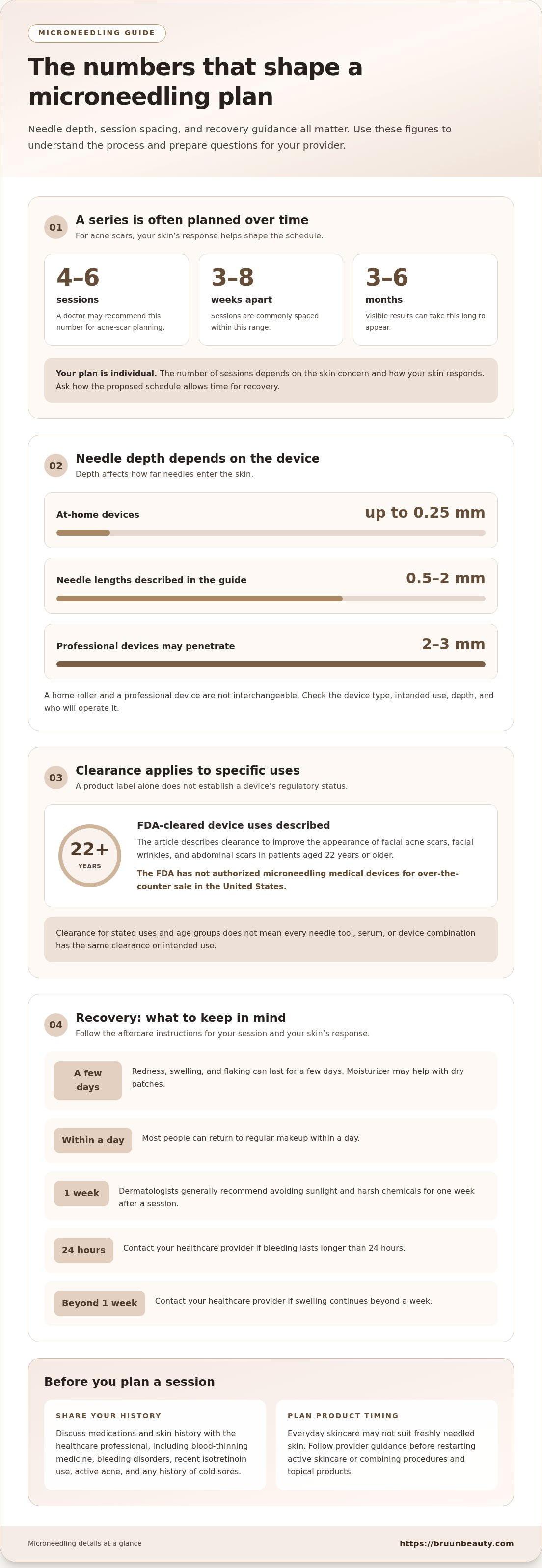
After the procedure, your skin may look red or feel swollen, tight, or warm. Redness, swelling, and flaking can last for a few days, while moisturizer may help with dry patches. Most people can return to regular makeup within a day. Follow the aftercare instructions for your microneedling session, since your skin’s response helps guide what to use next.
Before scheduling, share your medication list and skin history with the healthcare professional performing the procedure. Mention blood-thinning medicine, bleeding disorders, recent isotretinoin use, active acne, and any history of cold sores. These details can affect timing, preparation, and whether microneedling is suitable for you.
Some clinics may ask you to pause ibuprofen, acne products, or retinoids for a few weeks beforehand. Don’t stop prescribed medicine on your own. Depending on your skin and treatment plan, a healthcare provider may also recommend vitamin A or C cream about a month before your appointment.
After the session, protect your skin’s surface. Dermatologists generally recommend avoiding sunlight and harsh chemicals for one week after treatment. Use sunscreen regularly as directed, and follow your provider’s instructions about restarting active skincare. Contact your healthcare provider if bleeding lasts longer than 24 hours or swelling continues beyond a week.
Combining procedures or topical products requires planning. Some protocols pair needling with platelet-rich plasma (PRP), while others use topical agents such as hydroquinone or vitamin C for pigmentation. These combinations aren’t interchangeable. The skin concern, product, and timing all matter, so don’t apply an active formula to freshly needled skin unless your provider directs you.
For stretch marks, protocols may combine needling with PRP or topical retinoids. Radiofrequency adds energy to the procedure, making it a distinct approach rather than simply a serum pairing. Discuss the intended combination and aftercare before your appointment instead of adding products afterward.
Sessions are commonly spaced about 3 weeks to 8 weeks apart, and visible results can take 3 months to 6 months. The number of treatments depends on the concern and your skin’s response. Results may need maintenance over time, so ask how the proposed schedule allows for recovery between microneedling appointments.
Cost depends on the treatment area and approach. For planning, request a written estimate and ask your insurer whether benefits apply to the stated purpose. A clinic estimate describes the procedure; your insurance plan’s benefit rules determine any coverage. Keep those questions separate when comparing options.
Compared with laser resurfacing or chemical peels, microneedling uses fine needles to create controlled channels, rather than light energy or an exfoliating solution. The best fit depends on your skin concern, tolerance for downtime, and professional assessment.
To explore devices and related supplies, browse this microneedling collection as you consider questions for your appointment.
Are all microneedling products considered medical devices that are regulated by the FDA?
No. A topical serum and a needle device are different product types, even when both appear in the same skincare routine. The word “microneedling” on a label doesn’t mean every product has the same purpose or regulatory status. Focus on what the item is designed to do, how it’s used, and whether it physically punctures the skin.
Needle devices create controlled channels through the skin’s surface. The needles can range from 0.5 millimeters to 2 millimeters long. At-home devices may reach 0.25 mm, while professional devices can penetrate 2 to 3 mm. Depth changes how far needles enter the skin, so a home roller and a professional device shouldn’t be treated as interchangeable tools.
Controlled punctures prompt the body’s wound-response process. As the skin remodels, it can form collagen and elastin, structural proteins that support firmness and texture. This is why the method is also called collagen induction. The goal is to improve appearance, not to add collagen directly by applying a topical product.
The U.S. Food and Drug Administration has cleared microneedling devices to improve the appearance of facial acne scars, facial wrinkles, and abdominal scars in patients aged 22 years or older. That clearance applies to the stated device uses and population. It doesn’t mean every needle tool or cosmetic serum has the same clearance or intended use.
The FDA has not authorized microneedling medical devices for over-the-counter sale in the United States. This matters when a device is marketed for home use: a cosmetic claim, product name, or online description doesn’t establish FDA authorization. Before considering a procedure, understand the device type, intended use, needle depth, and who will operate it.
Radiofrequency microneedling adds energy to the needle procedure. It combines punctures with radiofrequency energy, so it differs from a simple cosmetic roller or topical skincare step. FDA-cleared devices with radiofrequency energy have specific uses, but that doesn’t make all devices or combinations equivalent. Ask what technology the procedure uses and which appearance concern it targets.
Side effects can include redness, tightness, itching, peeling, bruising, or bleeding. Reusing a needle cartridge can cause or spread infection, so single-use handling matters. Makeup also shouldn’t be used to judge immediate results: temporary redness can change how skin looks just after the procedure. Follow the device’s intended-use information and professional aftercare guidance.
If you’re comparing devices and related skincare, this microneedling product collection offers a starting point for exploring the categories discussed here.
How many sessions of microneedling do I need for acne scars?
There isn’t one session count that fits every acne-scar pattern. A doctor may recommend four to six sessions, weighing scar appearance, skin texture, and how the skin responds between visits. Dermatologists generally prefer to address acne scarring after active acne is under control, since ongoing breakouts can change the plan.
Published observations offer a sense of how progress may build. Mild improvement in post-acne scarring has been observed after two sessions. After six sessions, people saw moderate improvement in skin texture and good enhancement of scar appearance. These findings describe observed outcomes, not a promise of the same result for everyone.
Scar type and depth help guide expectations. A plan for shallow texture changes may differ from one for more noticeable indentations. The clinician also considers whether the main goal is a smoother-looking surface, improved texture, or less visible acne scarring. Those priorities help define meaningful progress.
Spacing supports a measured approach. One dermatologist recommends limiting dermaroller use to once a month and allowing full recovery between sessions. Recovery is a practical checkpoint, not a reason to rush into the next appointment. The interval gives the skin time to settle and lets the clinician review changes before continuing.
Keep a simple progress record to make those reviews more useful. Take photos in consistent lighting and from the same angles, then note each session date and the areas you want to compare. A side-by-side view can reveal gradual texture changes that are easy to miss when you inspect your skin every day.
Ask how the proposed number of sessions relates to your specific scar pattern. For example, describe whether unevenness is concentrated in one area or spread across the cheeks. Share which changes matter most to you, since your appearance goals influence how progress is assessed.
Side effects and recovery are part of deciding whether to continue. Rather than scheduling the next session automatically, use the follow-up to discuss how your skin responded and whether it has returned to its usual state. This keeps the treatment series responsive to your progress instead of treating a preset session count as a finish line.
More sessions don’t automatically mean better results. The useful question is whether each visit contributes to your goal while allowing adequate recovery. A thoughtful series balances observed changes, skin response, and your priorities, with acne under control before scar-focused procedures begin.
Conditions that may make at-home microneedling unsuitable
Some skin conditions can make home rolling a poor fit. Active acne, open wounds, eczema, rosacea, psoriasis, keloids, and perioral dermatitis can raise concerns about irritation or scarring. Diabetes and a weakened immune system also warrant extra caution before puncturing the skin.
Wait until active inflammatory acne or oral herpes lesions have cleared before considering needling. Rolling over active breakouts can spread bacteria across the skin, while irritated lesions can become more inflamed. A dermatologist can assess your skin’s condition and whether a different timing or approach makes more sense.
Medication and medical history matter, too. People with clotting or bleeding disorders, or those taking blood-thinning medicine, may not be suitable candidates. The research guidance also recommends waiting at least 6 months after stopping isotretinoin before starting a procedure. Share your medication list and relevant health history during screening.
Professional and home devices differ in penetration and control. At-home devices described by Yale Medicine reach 0.25 mm, while professional devices can penetrate 2 to 3 mm. A manual roller has fixed needles; an automated pen can adjust needle depth. Neither design makes a device appropriate for every skin concern.
To choose a qualified provider, select a healthcare professional specially trained in microneedling and discuss your candidacy, potential benefits, and risks before the procedure. The U.S. Food and Drug Administration recommends this conversation so you understand the device and plan, rather than choosing based on an aesthetic promise alone.
Use the consultation to give specific examples: mention a current breakout, a cold sore history, a keloid, or recent radiation. Those details help the provider assess your skin condition and relevant medical factors. Ask what device will be used, how its depth is selected, and what aftercare applies to your procedure.
At-home products require careful use, even when marketed for cosmetic routines. A roller can puncture the skin, and reused cartridges can cause or spread infection. Don’t roll over active lesions, open areas, or inflamed patches. Keep device hygiene and single-use components central to any safety decision.
Professional care isn’t automatically suitable for everyone, either. Active inflammatory acne and oral herpes lesions still need to clear first. A qualified provider should consider your skin’s current state, medical history, medications, and scar concerns before deciding whether needling is appropriate.
If you have rosacea, eczema, keloids, or a history of poor wound recovery, avoid experimenting with a home roller. The key distinction isn’t simply home versus clinic; it’s whether your skin and health history suit the device, depth, and procedure being considered.
Combining microneedling with other products
Pairing a procedure with another product can change how that product reaches the skin. Needling creates channels, and skincare ingredients may penetrate more effectively afterward. That doesn’t make every serum suitable for freshly needled skin. The key distinction is whether the combination is part of a planned protocol or simply added at home.
The FDA has not cleared microneedling devices for use with another product, including creams, ointments, other drugs or cosmetics, or platelet-rich plasma (PRP). This matters because a cosmetic serum and a procedure device have different roles. Don’t assume a product is suitable during or immediately after needling just because it’s marketed for skincare.
Professionals may use a glide agent during the procedure, most commonly hyaluronic acid gel. It serves a specific purpose: helping the device move across the skin. That differs from adding an active formula, such as vitamin C or retinol, which may irritate freshly needled skin. Follow the procedure’s protocol and aftercare instructions.
Some clinical approaches pair needling with topical depigmenting agents, including hydroquinone or vitamin C, for pigmentation concerns. For stretch marks, protocols may include PRP or topical retinoids. These are examples of combinations used in specific settings, not general instructions to layer products yourself. Ingredient choice and timing depend on the skin concern.
Other combinations address different goals. Silicone gels, scar creams, or laser procedures may be used alongside needling for surgical or burn scars. For hair restoration, approaches may pair needling with minoxidil, growth factors, or PRP. These examples aren’t interchangeable: acne scars, stretch marks, pigmentation, and hair concerns call for distinct plans.
Radiofrequency is another distinction. Radiofrequency microneedling combines needle punctures with energy; it isn’t the same as applying a topical product. The added technology changes the procedure itself, so don’t treat it as a skincare ingredient pairing or assume every device has the same purpose.
For home routines, keep the takeaway simple: don’t combine a device with an active product unless the product and procedure instructions specifically support that use. Avoid experimenting with chemical exfoliants or potent serums on freshly needled skin. A clinician can weigh the target concern, ingredients, device, and timing before recommending a combination.
Choose combinations based on the specific goal, not a longer product list. For example, a plan for acne scars differs from one for pigmentation or stretch marks. The right sequence matters as much as the ingredient, because channels can affect topical penetration. Clear instructions help prevent an unsuitable product pairing from disrupting recovery.
Bruun Beauty: Advanced Microneedling Serum SD - Control Salmon DNA Ampoule Serum
Advanced Microneedling Serum SD - Control Salmon DNA Ampoule Serum is an ampoule serum option for your skincare routine. Its name identifies Salmon DNA as a featured ingredient, making it relevant if you’re exploring products alongside professional skincare practices.
Timing matters: don’t assume a serum is suitable for freshly needled skin. Follow the product directions, and use it around a procedure only when your healthcare provider’s guidance supports that timing. This helps distinguish a routine skincare choice from a product intended for immediate post-procedure application.
If you’re comparing options for your routine, explore the serum details and choose based on your skincare needs and the instructions provided. For questions about Bruun Beauty’s offerings, you’re welcome to contact Bruun Beauty.
Make your next skincare step a thoughtful one
Before choosing a microneedling approach, write down the skin concern you want to address and what matters most to you: a professional setting, a home routine, or product compatibility. That distinction can help you focus your questions and avoid treating every device or serum as interchangeable.
Keep your skincare choices aligned with the instructions for any procedure you’re considering. If you’re building a routine, introduce products with care and keep post-procedure guidance separate from everyday application advice. Clear expectations and thoughtful timing can help you make choices that feel manageable for your skin.
Bruun Beauty offers skincare products for professionals and at-home enthusiasts, including microneedling serums and devices. Explore the collection to find options for your routine or business.
Make informed choices and enjoy skincare that feels considered, comfortable, and entirely your own.
Frequently Asked Questions
What is microneedling?
It’s a cosmetic procedure that uses fine needles to create controlled punctures in the skin. Those channels prompt a remodeling response that can include collagen and elastin formation. Unlike a serum applied to the surface, a needle device physically enters the skin. For example, a clinician may consider it for acne-scar appearance or uneven texture, while a topical product supports your regular skincare routine.
Are at-home microneedling devices effective?
At-home devices can create shallow punctures, but they aren’t equivalent to professional devices. Yale Medicine describes at-home devices reaching 0.25 mm, compared with 2 to 3 mm for professional devices. Their suitability depends on your goal and the device’s intended use. An at-home tool shouldn’t be assumed to produce the same effects as a professionally performed procedure.
Are derma roller results permanent?
No, results aren’t necessarily permanent. Changes in skin appearance can be temporary, and some people may need additional procedures over time to maintain them. Results from a roller also depend on the concern, your skin’s response, and safe spacing between sessions. Avoid judging progress by an immediate post-session glow, since temporary pinkness can affect how your skin looks.
Are there any risks or side effects?
Yes. Redness, tightness, itching, peeling, bruising, or bleeding can occur after a session. Less common effects include scarring or an allergic response to topical products applied during or immediately after the procedure. Note when symptoms begin and how they change. Contact your healthcare provider if bleeding continues beyond 24 hours or swelling lasts longer than a week.
How will you know it's working?
Look for gradual changes in the skin concern being addressed, such as texture or the appearance of acne scars, rather than judging your skin immediately after a session. Results can take 3 months to 6 months to appear. Take progress photos in similar lighting and note session dates; this makes subtle changes easier to compare over time.
What are the risks associated with microneedling devices?
Device-related risks include skin damage, bleeding, bruising, redness, tightness, itching, and peeling. Reusing needle cartridges can cause or spread infection, so don’t reuse them. Radiofrequency devices add energy to the procedure; the U.S. Food and Drug Administration issued a safety communication about potential risks with certain uses on Oct. 15, 2025.
What happens during the treatment?
A healthcare provider may apply numbing cream or ointment before the procedure. The treated area is then worked with a needle device, with timing depending on the size of the area and the plan. A procedure can take from 15 minutes to a few hours. Before starting, share your skin history and the medications you take.
What is microneedling and how does it work?
It uses fine needles to create controlled channels in the skin, prompting the body’s remodeling response. That response can form new structures, including collagen and elastin. Needle length and device type affect how deeply the needles penetrate. This physical process differs from applying a cosmetic serum, which doesn’t create channels on its own.
Microneedling for Sagging Jowls: How to Firm and Define Your Jawline
Microneedling for Sagging Jowls: How to Firm and Define Your Jawline
Related Posts

Consistent Microneedling and the Long-Term Changes to Expect

Aftercare choices to lower infection risk at home after microneedling

How to Create a Relaxing At-Home Spa Day With Simple Rituals

Sunscreen Recommendations After Microneedling: How to Protect Healing Skin

Investing in my skin for the future: what deserves my budget

Post-microneedling skincare routine for masks, makeup, and recovery

Skin Peeling After Microneedling: What to Avoid and When to Resume Makeup
