

PDRN Microneedling: Benefits of Salmon DNA for Skin
PDRN microneedling combines microneedling with topical PDRN, a salmon-derived ingredient. It may support improvements in skin texture, uneven tone, and the appearance of acne scars. It’s generally not recommended during active acne breakouts or skin infections, pregnancy, certain bleeding disorders, or with a salmon allergy.
This guide explains how the combination works, which concerns it may address, and what to consider before deciding whether it suits your skin.
Key Takeaways
- Understand what salmon-derived PDRN is and why it’s paired with microneedling.
- Learn which skin concerns the combination may support and why visible changes can take time.
- See how microneedling’s controlled micro-injuries work alongside topical PDRN.
- Recognize situations when the procedure should be avoided or postponed, including active breakouts, skin infections, pregnancy, certain bleeding disorders, or salmon allergy.
- Explore how a PDRN serum can fit into a skincare routine, including Bruun Beauty’s Advanced Microneedling Serum SD - Control Salmon DNA Ampoule Serum.
What skin concerns can PDRN microneedling address?
This combination may support skin rejuvenation when texture, dullness, or uneven tone is a concern. Whether it’s appropriate depends on your skin’s current condition and the goal you want to prioritize.
Potential Skin-Rejuvenation Benefits
PDRN paired with microneedling may support smoother-looking, more hydrated skin. It may interest people focused on fine lines, the appearance of acne scars, or a dull complexion. Consider it as one possible approach when you want to address more than surface dryness, but don’t expect a guaranteed change in skin texture.
Start by identifying your main concern. Someone bothered by uneven texture, for example, may have a different priority from someone focused on hydration. A consultation can help clarify which concern matters most and whether a series of sessions suits your plans.
Tone, Pigmentation, and Discoloration
Uneven pigmentation means some areas look darker or less uniform than nearby skin. Before considering a procedure, note where the discoloration appears and whether it changes over time. This can help distinguish a tone concern from texture, redness, or irritation.
For dark marks, consider how visible they are and how they affect your skincare goals. Don’t expect one procedure to address every kind of discoloration. A focused assessment can connect the concern you see with your skin’s current condition and help set a realistic priority.
Is PDRN microneedling FDA-approved in the United States? As of October 2026, the FDA has not officially classified PDRN as a cosmetic ingredient. This refers to PDRN’s classification as an ingredient, not approval of a specific product or procedure.
What does PDRN microneedling cost in the United States? The total depends on the treatment area, number of sessions, and what each appointment includes. Compare the full proposed plan rather than judging by the cost of one appointment alone.
Suitability involves more than age or a single skin concern. An assessment should account for your skin’s condition, sensitivity, history of reactions, and the area you want to address. Share which products you use and whether your skin is currently irritated so these details can inform the discussion.
People with visible signs of aging may consider this approach, but age alone doesn’t determine whether it’s suitable. Your goals and skin condition matter. If your main concern is active irritation rather than a stable texture or tone issue, timing and suitability need closer consideration.
Use the assessment to compare your goals with the procedure’s demands. Ask how the plan addresses your concern and what recovery would mean for your routine. You can browse the microneedling collection for products related to the procedure.
Aura Portland says skin may appear more hydrated, radiant, and smooth within the first week after microneedling plus PDRN. Patients may notice results from PDRN microneedling after one to three appointments.
How Does Microneedling Enhance PDRN’s Effects on Collagen Production?
Microneedling creates controlled micro-injuries that stimulate collagen production as skin responds to the procedure. In this approach, PDRN is applied topically after needling. The device creates microchannels, while the serum supplies PDRN to the skin’s surface.
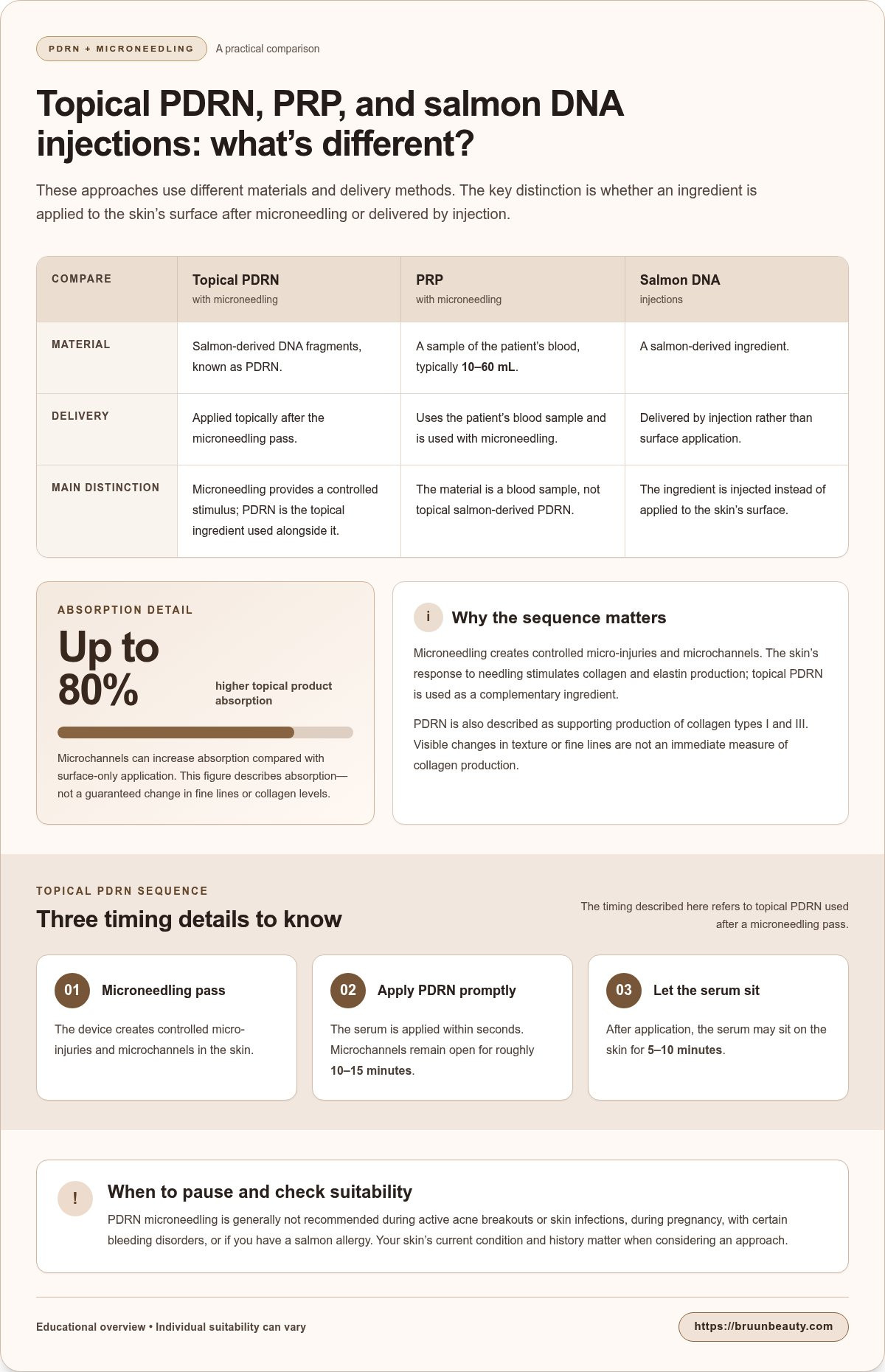
That sequence matters. Microchannels can increase topical product absorption by up to 80% compared with surface-only application. This figure describes absorption, not a guaranteed change in fine lines or collagen levels. Microneedling encourages collagen and elastin production through the skin’s natural response, while PDRN is used as a complementary topical ingredient.
PDRN is described as supporting the production of collagen types I and III. These types contribute to skin structure, helping explain interest in the ingredient for rejuvenation. If fine lines are your concern, the combination brings together microneedling’s controlled stimulus and a topical PDRN serum. The timing and method matter as much as the ingredient.
How does this approach compare with PRP microneedling and salmon DNA injections? PRP uses a sample of the patient’s blood, typically 10-60 mL, while topical PDRN uses salmon-derived DNA fragments applied after microneedling. Salmon DNA injections deliver the ingredient by injection instead of surface application.
PRP and PRF are different from PDRN, even when used with microneedling. Combining approaches involves distinct materials and protocol choices; they aren’t interchangeable. Exosomes are another separate addition used in some skin procedures. Each method has its own rationale, so combining ingredients isn’t automatically better.
For topical PDRN, application follows the device pass while microchannels remain open for roughly 10-15 minutes. This timing explains why the serum is applied within seconds of needling, rather than as an unrelated step in a daily routine. The serum may sit on the skin for 5-10 minutes after application.
Changes in fine lines or texture aren’t immediate markers of collagen production. The skin’s response develops over time, and the plan depends on the concern being addressed. If you’re exploring topical products for this approach, browse the microneedling collection to see options associated with the procedure.
The GaliDerm Aesthetics article describes microneedling as a minimally invasive treatment that stimulates the body’s natural healing response and production of collagen and elastin. In a topical PDRN approach, the procedure provides that stimulus, while the serum is applied after the device pass. Keeping their roles distinct clarifies why the combination is described as complementary: needling provides the controlled stimulus, and PDRN is the topical ingredient used alongside it.
PDRN’s proposed regenerative and anti-inflammatory properties
PDRN microneedling combines topical PDRN, DNA fragments derived from salmon sperm, with microneedling. It pairs a skin-rejuvenation ingredient with controlled micro-injuries that stimulate the skin’s natural response.
What PDRN Is
PDRN, short for polydeoxyribonucleotide, consists of DNA fragments derived from salmon sperm. Its reported molecular weight ranges from 50 to 1,500 kDa, a broad range that describes the fragments’ size. Knowing the ingredient’s origin and form helps you understand what a PDRN serum contains, rather than treating “salmon DNA” as a vague marketing phrase.
PDRN entered medical use in the 1980s for skin damaged by radiation, and the term was officially introduced in 1996. Those dates describe its history, not a guarantee of cosmetic results. In a microneedling context, PDRN is applied topically as an ingredient alongside the procedure.
Proposed Regenerative and Anti-Inflammatory Effects
PDRN is described as having proposed regenerative and anti-inflammatory properties. In skincare, these terms refer to its potential role in supporting skin structure and moderating inflammatory responses. They don’t mean every skin type will respond alike, or that a product replaces the controlled stimulus created by microneedling.
PDRN is also described as supporting the production of collagen types I and III. Collagen contributes to skin structure, which helps explain interest in the ingredient for texture and visible rejuvenation. Someone focused on rough-looking skin, for example, may consider the ingredient’s role alongside the procedure rather than expect topical PDRN alone to change texture.
Proposed Mechanisms and Benefits
The proposed mechanism connects PDRN with cellular activity involved in tissue maintenance and inflammatory signaling. This gives researchers a reason to study the ingredient’s regenerative potential. It doesn’t establish a specific cosmetic outcome for an individual, and “regenerative” shouldn’t be read as a promise that skin will be restored.
Application matters, too. In a microneedling protocol, PDRN is applied after the device creates microchannels, placing the serum within the same treatment sequence. That differs from using a serum on intact skin as part of a daily routine. The product’s formulation and intended use should match the application method.
Skin type and current condition shape how a routine is planned. Reactive skin and rough texture, for example, call for different considerations than a general radiance goal. PDRN’s proposed anti-inflammatory properties explain interest in the ingredient, but don’t make microneedling suitable during irritation or active infection. Assess the ingredient and the procedure separately.
Microneedling preparation and application protocol
A PDRN microneedling protocol combines skin assessment, controlled needling, and topical serum application. Preparation matters because skin condition, treatment area, and product sequence all shape the session.
Consultation and Preparation
A consultation reviews your skin, goals, sensitivities, and relevant health history before treatment. Share active skin concerns, medication use, bleeding disorders, pregnancy, and salmon allergy, since these can affect suitability. A qualified provider should be licensed, trained in microneedling, able to assess contraindications, and prepared to explain the planned approach.
Preparation includes pausing chemical exfoliants and other strong skincare products at least one week before the appointment. This gives the provider a clearer view of your skin’s baseline and helps with session planning.
Microneedling Application Protocol
Needle depth depends on the treatment area and concern. Facial rejuvenation commonly uses a range of 0.5-1.5 mm, while acne-scar tissue may call for 2.0-2.5 mm. These are treatment ranges, not settings to copy at home. Depth is selected according to the skin and goal.
A session may involve four to six passes in alternating directions, creating more even microchannel coverage. The controlled micro-injuries stimulate the skin’s collagen and elastin production. The provider then applies PDRN to the skin, often within seconds of finishing, while microchannels remain open for roughly 10-15 minutes. The serum may sit on the skin for 5-10 minutes.
PRP and PRF use a different preparation: they involve drawing 10-60 mL of the patient’s blood. PDRN is derived from salmon DNA and applied topically, rather than prepared from the patient’s blood. These approaches can involve different materials and steps, so they aren’t interchangeable names for the same protocol.
A PDRN microneedling session typically takes 30 minutes to an hour, depending on numbing time and treatment area. Afterward, mild redness and warmth may occur for one to two days. Avoid makeup, exfoliants, and active skin-care ingredients for about 48 hours, and use broad-spectrum SPF 30+ if heading outdoors.
The protocol aims to stimulate collagen and elastin production while applying a topical ingredient. It isn’t a do-it-yourself recipe: depth, passes, and product timing require coordinated judgment. For licensed professionals and experienced users comparing equipment, microneedling devices offer context about the tool used in this procedure.
PDRN microneedling contraindications
Active acne, skin infections, pregnancy, certain bleeding disorders, and salmon allergy are reasons to avoid or postpone this procedure. Consider both parts: microneedling creates controlled micro-injuries, while PDRN, or polydeoxyribonucleotide, is derived from salmon DNA.
When to Avoid or Postpone
This procedure is generally not recommended during active acne breakouts or skin infections. These conditions mean your skin isn’t in the same state as calm, intact skin being assessed for a cosmetic session. Tell the provider where you have breakouts or signs of infection instead of focusing only on the desired result.
Pregnancy is another listed reason to avoid the procedure. Certain bleeding disorders also matter because microneedling punctures the skin. A salmon allergy is relevant to the PDRN ingredient itself. These are separate suitability concerns, so disclose each one clearly rather than assuming one answer covers the others.
Separate the Ingredient and Procedure Questions
Before booking, consider two questions: Is microneedling suitable for your current skin, and can you use a salmon-derived ingredient? A salmon allergy, for example, raises a concern about PDRN even if your skin otherwise seems suitable for microneedling. Active acne raises a separate concern about the procedure, regardless of your interest in salmon DNA.
Redness after microneedling can be part of the expected response, but redness with an active infection is a different matter. Describe what you see and feel, including whether a concern is present now. Clear details can help distinguish a current skin issue from a cosmetic goal such as improving texture or visible signs of aging.
What to Share During a Skin Assessment
Before the procedure, share your relevant health history and any current skin concerns. Clearly mention a bleeding disorder, pregnancy, salmon allergy, active breakout, or infection. This gives the assessment specific factors to address instead of leaving the discussion at general questions about sensitivity or skin type.
Explain your goal, too, such as improving the appearance of acne scars or uneven tone. A qualified assessment weighs that goal against contraindications and your skin’s current condition. If a listed concern applies, postponing the procedure is more appropriate than proceeding just to keep to a planned schedule.
For skin professionals and experienced users reviewing equipment related to this topic, explore microneedling products.
Bruun Beauty: Advanced Microneedling Serum SD - Control Salmon DNA Ampoule Serum
Bruun Beauty Advanced Microneedling Serum SD - Control Salmon DNA Ampoule Serum is a topical salmon DNA serum to explore alongside this procedure. It may be relevant when comparing PDRN-focused skincare for professional use or selecting microneedling products. The serum’s name identifies its salmon DNA focus; follow the product directions and your professional protocol when deciding how to apply it.
Ingredient interest is only one part of the decision. Keep the distinction clear between using a topical serum and deciding whether microneedling suits your skin or client. For a closer look at the ampoule, view the salmon DNA ampoule serum.
Visit bruunbeauty.com to explore the serum and related skincare products.
Choose your next skincare step with intention
Begin your next skincare decision with one clear priority. You might want to focus on texture, visible discoloration, or a more refreshed appearance. Defining your goal helps you decide whether a procedure fits your routine, rather than choosing it simply because an ingredient is trending.
As you consider PDRN microneedling, weigh the procedure and topical ingredient separately. Think about your skin’s current condition, history of sensitivity, and whether any listed contraindications apply. Use those details to guide a thoughtful conversation about your options and the right timing for your skin.
A considered approach can make skincare feel more personal and less like guesswork. Explore relevant products at Bruun Beauty as you plan a routine around your goals.
Keep learning, pay attention to your skin, and choose the next step that feels right for you.
Frequently Asked Questions
What Is PDRN?
PDRN is short for polydeoxyribonucleotide, a material made of DNA fragments derived from salmon sperm. Its molecular weight is described as ranging from 50 to 1,500 kDa, reflecting differences in fragment size. In skincare, the name usually refers to a topical ingredient. That distinction helps you separate an ampoule used on skin from procedures that deliver ingredients in other ways.
How Many Sessions Are Needed?
A typical course includes 3-6 sessions, spaced 3-4 weeks apart. Acne-scar concerns may involve 4-6 sessions, depending on scar severity. A course is planned around the skin concern and its response over time, rather than assuming one appointment is enough. Improvements may begin to appear within 2-6 weeks as collagen production increases.
Are You Making These PDRN Application Mistakes?
Common missteps include assuming every PDRN serum is suitable for microneedling, applying it at the wrong point in a protocol, or overlooking allergy history. Product timing and intended use matter. Don’t assume a serum designed for ordinary topical use belongs in a procedure. Follow the product directions and consider salmon allergy before use.
What Are the Side Effects and Downtime of PDRN Procedures?
Temporary redness, warmth, dryness, flaky patches, and increased sensitivity can follow microneedling. Redness and a sunburn-like sensation commonly last 24-48 hours, while dryness or sensitivity may continue longer. Makeup, exfoliants, and active skincare ingredients are generally avoided for about 48 hours afterward. If going outdoors, broad-spectrum SPF 30+ sunscreen is recommended.
What Is PDRN, and Why Is Salmon DNA for Skin So Popular?
PDRN is a skincare ingredient made from salmon-derived DNA fragments. Interest in salmon DNA reflects its proposed role in supporting collagen production and skin rejuvenation, especially alongside microneedling. The name doesn’t mean the procedure applies salmon tissue directly to your skin. Check the product label to see whether you’re considering a topical serum or another formulation.
What Should I Expect During and After a PDRN Microneedling Procedure?
A session typically takes 45-60 minutes, including preparation and the treatment area. Afterward, your skin may look red or feel warm, similar to a mild sunburn. Some people notice a more hydrated, radiant appearance during the first week, while texture changes take longer. Keep post-procedure care simple and avoid makeup and strong active products for about 48 hours.
Who Sees the Best Results With PDRN After Microneedling?
People seeking support for visible signs of aging, uneven texture, or acne-scar appearance may consider this approach. Adults over 35 with signs of aging are one group identified as potential candidates, but age alone doesn’t determine suitability. Active breakouts, skin infections, pregnancy, certain bleeding disorders, and salmon allergy are reasons to avoid or postpone the procedure.
What Are the Benefits of PDRN Microneedling for Skin?
Potential benefits include smoother-looking texture, improved hydration, and support for collagen-related rejuvenation. Clinical studies have reported 50-70% improvement in acne-scar appearance over a treatment series, though results vary by concern and skin condition. PDRN is also described as supporting collagen types I and III. Fading scars or severe hyperpigmentation can take several months to become visible.
The Ultimate Guide to Using a Jelly Mask After Microneedling for Glowing Skin
Your Ultimate Dr. Pen Needle Depth Chart: A Safe Guide to Professional Results
Related Posts

Consistent Microneedling and the Long-Term Changes to Expect

Aftercare choices to lower infection risk at home after microneedling

How to Create a Relaxing At-Home Spa Day With Simple Rituals

Sunscreen Recommendations After Microneedling: How to Protect Healing Skin

Investing in my skin for the future: what deserves my budget

Post-microneedling skincare routine for masks, makeup, and recovery

Skin Peeling After Microneedling: What to Avoid and When to Resume Makeup
