

How to match machine features to services and client needs
The machine with the most features isn’t automatically the best fit. To choose a professional beauty machine, start with the services you plan to offer, then match its functions to your clients’ needs, your team’s skills, and your treatment-room setup. A practical choice also accounts for maintenance, ongoing costs, and how often you expect to use it.
It’s natural to compare features first, but a machine makes sense for your business only when its functions support treatments you can deliver consistently. The right match can help you build a clear service menu without adding equipment your clients don’t need or your team can’t manage easily.
This guide explains how to match machine functions to planned services, evaluate client fit, compare single-function and multifunction systems, and estimate potential return on investment. It also covers maintenance, accessories, and training to consider before choosing equipment for your spa or clinic.
Key Takeaways
- Start with the services you plan to offer, then choose machine functions that support those treatments and fit your clients’ expectations.
- Compare single-function and multifunction systems by considering your service menu, available space, team capacity, and budget.
- Estimate potential return by weighing treatment demand, session costs, ongoing expenses, and how consistently you can use the equipment.
- Account for accessories, maintenance, replacement parts, and staff training when assessing the full value of a machine.
- Build your equipment choice around a clear service plan, rather than paying for features that don’t support your day-to-day work.
1. Expected ROI for commercial facial machines
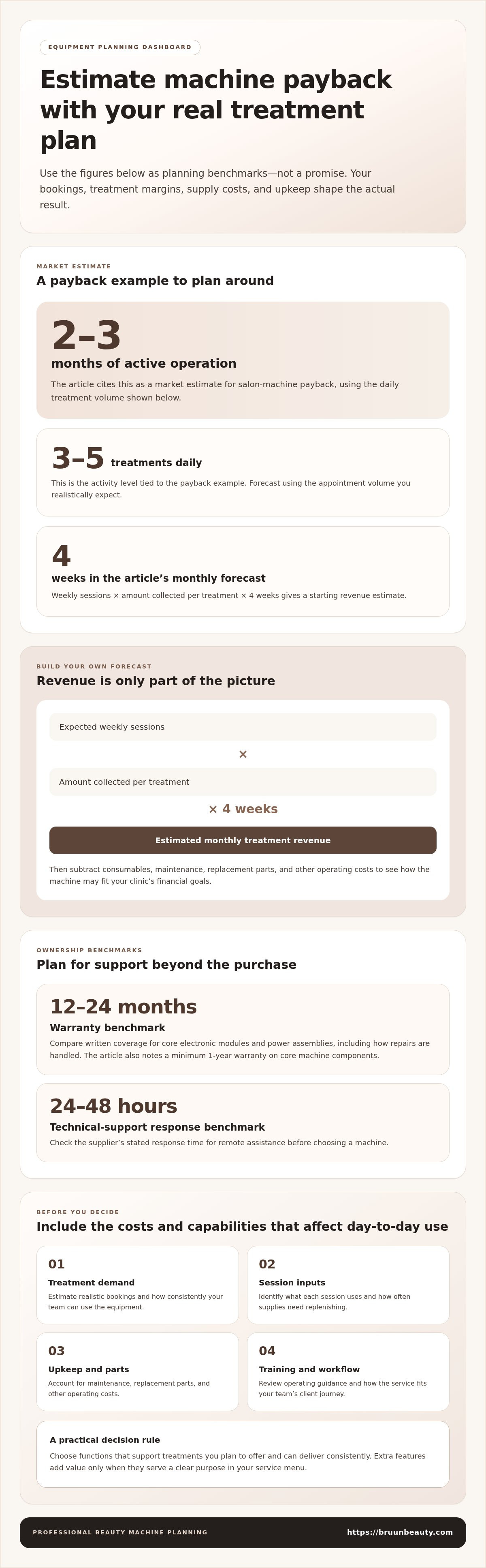
Estimate return by combining expected appointments, treatment margins, consumables, and ongoing upkeep. A market estimate places payback for a salon machine at two to three months of active operation, using 3 to 5 treatments daily. Use those figures as a planning example, then build a forecast around your own booking patterns and operating costs.
Start with realistic demand. Multiply expected weekly sessions by the amount collected per treatment, then by 4 weeks. Subtract consumables, maintenance, replacement parts, and other operating costs. This gives you a clearer view of whether the machine can support its purchase cost and fit your clinic’s financial goals.
Ask what training comes with the equipment and how your team can apply it. Useful training covers operating steps, explaining the treatment to clients, describing benefits accurately, and fitting the service into the customer journey. Also identify what each session uses, how often supplies need replenishing, and how those items fit your workflow.
Review the manufacturer’s quality checks and documentation for the machine’s intended use. For electrical equipment, examine applicable testing information, such as UL, ETL, or CE marks, alongside electromagnetic compatibility documentation. For clinical use in the United States market, FDA 510(k) / Registration is required, according to the U.S. Food and Drug Administration.
Compare written warranty coverage, including which components it covers and how repairs are handled. A 12-to-24-month warranty for core electronic modules and power assemblies is a useful benchmark; another recommendation sets a minimum 1-year warranty on core machine components. For remote assistance, 24–48 hours is considered a reasonable technical-support response time.
How do you compare new, refurbished, and used professional beauty machines? Compare documentation, warranty coverage, repair support, and remaining service life, then weigh these against the initial cost and expected use. A lower upfront cost may not mean better value if maintenance or downtime limits the machine’s ability to earn.
What FDA rules and state licensing requirements apply to professional beauty machines in the United States? For clinical use, FDA 510(k) / Registration is required, according to the U.S. Food and Drug Administration. State licensing requirements are separate, so match the machine’s intended use and planned therapy to the requirements and license scope that apply in your state.
Finally, review references and practical business support. Look for examples of similar clinics using the equipment, and assess whether the supplier provides useful training materials or marketing guidance for explaining the service. These resources can help your team use the machine consistently, communicate clearly with clients, and encourage repeat bookings.
2. What Truly Makes a Good Professional Beauty Machine?
A strong machine earns its place by supporting treatments your clients want and your team can deliver consistently. Compare its functions, workflow, and footprint with your actual service menu. A multifunction facial system may combine hydrodermabrasion, radiofrequency, microcurrent, ultrasonic or hot-and-cold therapy, and LED phototherapy, but extra functions matter only when they serve a clear purpose.
Which beauty machine brands and models are best for salons, spas, and medical aesthetics clinics? There’s no single best choice for every business. Compare functions, documentation, ease of use, available support, and intended treatments. Choose a system that suits your team and clients rather than selecting by brand name alone.
Should you buy, lease, or finance a professional beauty machine? Compare the payment structure with your cash flow, expected appointment frequency, and ability to use the equipment consistently. Buying may suit a business with available capital. Leasing or financing can spread payments, but the total commitment and terms should fit your business plan.
What types of professional beauty machines are available, and what treatments do they provide? Facial options include hydrodermabrasion, microdermabrasion, LED phototherapy, radiofrequency, microcurrent, and ultrasonic or hot-and-cold systems. Body equipment may use cavitation, EMS muscle stimulation, or radiofrequency, while HIFU uses focused ultrasound for non-invasive lifting applications.
A useful way to decide how to choose a professional beauty machine is to map each function to a treatment you plan to offer. Hydrodermabrasion can support a cleansing-focused facial, while LED phototherapy adds a distinct light-based step. A single-function machine may suit a focused menu. A multifunction platform can combine steps, but may add complexity if your team rarely uses its extra settings.
Hydrodermabrasion and microdermabrasion can both fit facial services, but they aren’t interchangeable. Hydrodermabrasion combines water-based delivery with exfoliation, while microdermabrasion focuses on mechanical exfoliation. Compare how each approach fits your cleansing sequence, client expectations, treatment time, and other services you already provide.
Choose facial and body equipment separately, matching each device to its intended service. For facial treatments, consider room space, noise, maneuverability, and how often clients request the treatment. For body services, compare technologies such as cavitation, EMS, and radiofrequency with your menu and your team’s ability to deliver each service consistently.
For a specific service plan, list each treatment, its required modality, the staff who will operate it, and expected use. This makes gaps and redundant features easier to spot. If microneedling also belongs in your menu, explore microneedling treatment supplies as a separate category from facial machine equipment.
3. Considering accessories, maintenance, training, and insurance
A machine’s day-to-day value depends on more than its main console. List the handpieces, cables, tubing, treatment tips, and other accessories needed for each planned service. Match every accessory to a treatment on your menu, then identify which parts need routine cleaning, replacement, or storage. This helps prevent unused attachments from taking up space while essential supplies run short.
How much do professional beauty machines cost, including maintenance and consumables? The total cost includes the purchase price, required accessories, consumables, maintenance, replacement parts, staff training, and insurance. Estimate each category against expected appointment frequency and revenue, then revisit the calculation as your treatments and client demand grow.
Before buying, make a maintenance schedule based on the manufacturer’s instructions. Record cleaning steps, routine inspections, and how to order spare parts. For example, assign a staff member to log equipment checks after use and report changes in performance. Clear ownership makes upkeep part of the workday rather than an unexpected interruption.
Warranty terms should explain which components are covered, how service requests work, and how repairs are arranged. Find out how replacement parts are sourced and what happens if a key handpiece or cable needs attention. Keep warranty documents, purchase records, and service notes together. These details help owners track equipment history and plan maintenance costs.
Training should cover hands-on operation, the treatment sequence, and client communication. Have each staff member practice setup, operating controls, accessory changes, and shutdown steps. Then rehearse a simple explanation of what a facial or body treatment involves, what sensations clients may notice, and how the service fits their goals.
Certification and training aren’t interchangeable. A course completion record can document staff instruction, while the machine’s operating guide supports consistent procedures. Keep training materials accessible and note who has practiced each treatment. For services involving tightening technology, such as radiofrequency, include clear explanations of the modality and the steps your team follows.
Ease of use affects how readily staff can deliver treatments during a busy schedule. Ask team members to walk through a sample service using the controls and accessories. Note confusing settings, extra setup steps, or awkward storage needs. A smooth workflow makes it easier to integrate the machine into existing appointments without disrupting other services.
Include insurance in your operating-cost plan alongside maintenance and consumables. Ask your insurance broker how the equipment and planned treatments fit your policy, then record the relevant premium in your forecast. This gives you a fuller picture of ongoing costs and helps you assess whether expected revenue supports the resources needed to operate the machine.
4. Matching machine functionality to client needs and services
Use real client interest to shape your equipment plan. Review booking requests, recurring questions, and feedback after appointments to see which services clients understand and want to revisit. These signals help distinguish a useful addition from a treatment that sounds appealing but has no clear place in your business.
How do you choose a beauty machine for your target treatments, clients, and business goals? Start with the client experience you want to support, then identify which planned service could improve it. Compare the machine’s function with your service plan and your team’s ability to deliver the appointment reliably.
Consider where a new service belongs in the client journey. A first appointment may introduce a focused experience, while a returning client may value a complementary option. Plan how staff will explain the difference between those appointments so clients can make an informed choice without feeling pushed toward extra services.
Look for gaps in your existing menu. If clients regularly ask for an option your current services don’t provide, identify the function needed to add it. If the new equipment would duplicate an existing appointment without offering a distinct client experience, its role may be less clear.
- Listen: Record service requests and questions clients raise during appointments.
- Define: Describe the experience each proposed service should provide.
- Connect: Match a machine function to a specific gap or client request.
- Assess: Decide how staff will introduce and deliver the service.
Consider a hypothetical clinic whose clients ask for a more customizable appointment. The owner could identify which treatment steps clients want to choose, then assess whether equipment supports that service design. The key is to turn a specific request into a clear service concept before investing.
Plan how you’ll learn from the first bookings. Gather staff observations and client feedback, then review whether people understood the service and found it relevant. This feedback can guide adjustments to the appointment description or service sequence without changing the machine’s intended use.
A practical way to decide how to choose a professional beauty machine is to connect client demand with a defined service and repeatable client experience. Keep the planned function tied to a real business need, and give clients clear information about what the service involves.
5. Choosing equipment based on planned services
Begin with a service menu, not a machine catalog. Write down each treatment you intend to offer, whom it serves, and the result or experience you want to deliver. Then match equipment functions to those services. This keeps your investment focused on useful capabilities instead of advanced features that never reach your treatment room.
Map each service into a simple sequence: client goal, treatment steps, required technology, and supporting products. For example, a cleansing-focused facial could include hydrodermabrasion, while a separate service might use LED phototherapy. Microdermabrasion suits a menu built around mechanical exfoliation. These distinctions help you choose equipment that supports the experience clients expect.
Next, group services by the needs they address. A facial menu might include cleansing, exfoliation, or light-based treatments. A body menu could focus on services using cavitation, EMS, or radiofrequency. Keep skin-tightening applications distinct from facial cleansing services, even if multifunction equipment can perform both. A clear menu helps clients understand what each appointment offers.
Plan a service pathway before purchasing. Decide which treatments stand alone and which can be combined into a longer appointment. For example, a basic facial could center on cleansing, while an advanced option adds another modality your staff can deliver confidently. This structure gives clients clear choices and helps your team explain the purpose of each step.
- Define: Name the service and the client need it addresses.
- Match: Identify the machine function and supporting supplies it requires.
- Deliver: Confirm the room, staff workflow, and appointment format fit.
- Review: Track bookings and client satisfaction before expanding the menu.
Use the same plan to separate essential equipment from future possibilities. If your immediate menu centers on facials, prioritize the functions those appointments require. Add body equipment only when body services are part of your actual plan. This avoids buying a machine based solely on a treatment you might offer someday.
Consider how each service fits your clinic’s identity. A quiet spa may favor a calming facial experience, while a results-focused studio may build its menu around clearly explained technologies. In either case, the equipment should support the atmosphere, appointment flow, and client expectations you want to maintain.
Before committing, test the service plan on paper: Can staff explain each treatment? Does every machine function support a named service? Do the planned appointments fit your room and workflow? Clear answers make the choice practical, help protect client satisfaction, and show when it makes sense to expand.
If microneedling is part of your planned service menu, explore professional microneedling supplies.
Bruun Beauty: Advanced Microneedling Serum SD - Control Salmon DNA Ampoule Serum
Advanced Microneedling Serum SD - Control Salmon DNA Ampoule Serum is a relevant option when microneedling is part of your planned service menu. Consider it alongside your equipment decision as a skincare product, not a substitute for selecting the right device, training, or treatment workflow.
Match your supplies to the services you intend to provide. If your treatment plan includes microneedling, explore the Advanced Microneedling Serum SD and consider how it fits your professional routine.
Visit bruunbeauty.com to explore the serum and other skincare offerings for your planned services.
Build a Service Menu You Can Grow Into
Your next equipment decision can shape how clients experience your business as it grows. Start with the service you want to make more accessible, then consider how the equipment will fit into your schedule, team workflow, and future plans. That gives you a practical way to revisit how to choose a professional beauty machine whenever your menu evolves.
Choose one clear next step: refine a treatment concept, review the supplies it requires, or map a new service into your client journey. A focused plan helps you build with intention instead of adding technology without a defined role. Keep the client experience at the center, and let each new service strengthen the way you care for your community.
Keep moving forward at a pace that feels right for your business. A thoughtful service plan is a strong foundation for what comes next.
Frequently Asked Questions
What Truly Makes a Good Professional Beauty Machine?
A good professional beauty machine performs the services you plan to offer and fits your team’s workflow. Look beyond its feature count: assess control layout, handpiece balance, operating instructions, room fit, and access to replacement parts. For example, a facial device that staff can set up and clean consistently may serve your daily menu better than a system with rarely used functions.
How quickly can a salon expect a return on investment on a commercial facial machine?
Payback depends on how often you book the machine, what each service earns, and the costs of delivering it. Estimate monthly appointments based on current client demand, then subtract consumables, maintenance, and other operating expenses. Compare the contribution with the equipment investment. Repeat the calculation using a lower booking estimate to see how slower demand affects your break-even point.
Single Function Machines or Multifunction Beauty Machines?
Choose a single-function machine for a focused service with a clear role in your menu. A multifunction system makes sense when its separate functions support treatments you intend to offer and your staff can manage them. For instance, don’t count three unused functions as value. Compare each one with a planned appointment and the supplies or workflow it requires.
What build quality factors are critical for high-volume commercial salon use?
For frequent use, inspect the components your team handles repeatedly: handpieces, tubing, cables, connectors, and controls. Look for a steady power supply and heat-dissipation design, since commercial facial equipment may operate for extended daily hours. Also consider whether the handpiece feels balanced and the machine moves easily through your workspace. These details affect routine handling and service flow.
Which technical specifications matter when comparing professional beauty machines?
Start with specifications tied to the treatment: available functions, operating controls, included handpieces, and adjustable settings. Then assess practical requirements, such as electrical compatibility, machine dimensions, noise, and room maneuverability. Compare the same details across options in a simple table. This makes it easier to spot features that change your workflow rather than merely adding another line to a product description.
What safety certifications, clinical evidence, and training should I verify before buying?
Review the machine’s intended use, operating documentation, and applicable electrical testing information. UL, ETL, and CE are examples of marks buyers may encounter; assess the documentation that applies to the device and its US distribution. For evidence, look for documented results and consistency over time. Training should cover operation, service explanations, and how the treatment fits your client journey.
How can I evaluate a beauty machine supplier's warranty, service, and replacement-parts support?
Read the warranty for covered components, exclusions, and repair procedures. Find out how replacement parts are identified and ordered, and keep those instructions with the machine’s records. Review supplier references, customer feedback, and the clarity of service information. A useful comparison includes both warranty length and the practical steps your staff would follow if a handpiece or control stopped working.
What are the risks, contraindications, and safety procedures for professional beauty machines?
Build safe, consistent use around the machine’s intended purpose and the manufacturer’s instructions. Train staff on setup, controls, cleaning, and shutdown, then document the process for each treatment type. Before an appointment, explain the service and confirm that the planned treatment matches the machine’s intended function and your team’s training. Keep operating materials accessible so staff can follow the same procedure each time.
Can Microneedling Cause Breakouts? Understanding Purging and Aftercare
Can Microneedling Cause Breakouts? Understanding Purging and Aftercare
Related Posts

PDRN Benefits for Skin: Regeneration, Results and Safety

How to Dispose of Used Microneedle Cartridges Safely

Self-care rituals for better skin through mindful daily habits

How to Explain Microneedling Benefits for Skin and Scars

How to use a Korean 10-step skincare routine for hydration

Microneedling for atrophic scars: clinic or at-home results

V-Line Lifting Masks and Their Claimed Face-Shaping Effects
