

Creating a Yearly Microneedling Schedule: A Practical 2026 Guide
What if a good microneedling schedule leaves room for recovery? Creating a yearly microneedling schedule can feel confusing when advice varies and professional sessions differ from at-home routines.
Use a flexible plan that accounts for your setting, guidance, skin response, and goals. This guide shows you how to organize sessions, recovery time, reviews, and between-session care without making your calendar rigid.
Key Takeaways
- Build your yearly microneedling schedule around session records, recovery observations, and review points rather than a rigid monthly pattern.
- Keep professional and at-home routines distinct, and follow the guidance and device instructions that apply to your setting.
- Use a flexible calendar to choose your setting, note relevant guidance, reserve recovery time, and reassess your plan.
- Choose devices and supplies as part of your routine, not as a reason to schedule sessions more often.
Why Creating a Yearly Microneedling Schedule Starts With Recovery
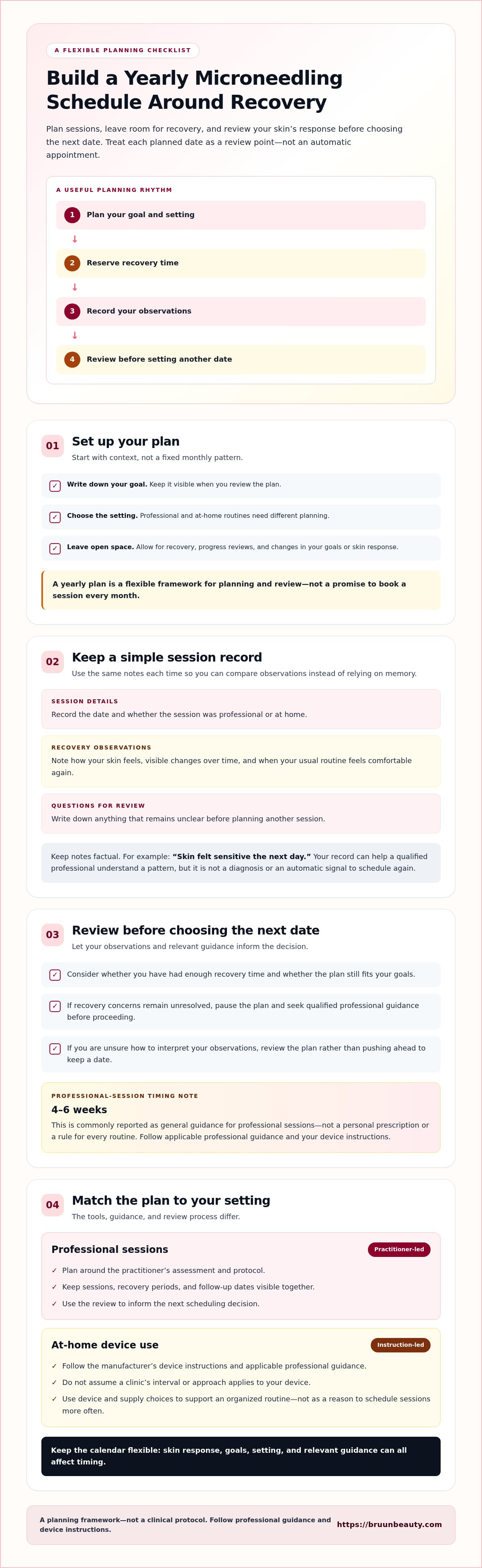
A yearly plan isn’t a promise to book a session every month. It’s a flexible framework for planning sessions, setting aside recovery time, reviewing your skin’s response, and deciding whether maintenance makes sense. That flexibility matters because your skin’s response, your goals, and the setting you choose can all affect timing.
Repeating sessions sooner doesn’t automatically mean better results. Your skin needs time between appointments, and scheduling by the calendar alone can ignore how it’s responding. Recovery time belongs in every annual plan because your next session should follow your skin’s response, not just the date you penciled in.
What belongs in a year-long microneedling plan?
Include more than appointment dates. Build in planning, sessions, recovery periods, progress reviews, and possible maintenance. Leave open space so you can adjust if your skin needs more time or your goals change. This is a planning framework, not a clinical protocol: it helps you organize questions and dates but doesn’t replace professional judgment or device instructions.
Why can’t every session follow the same calendar interval?
Timing can depend on your setting, goals, skin response, and the guidance that applies to your session. A four-to-six-week gap is commonly reported as general guidance for professional sessions, but it isn’t a personal prescription or a rule for every routine. Follow applicable professional guidance and your device instructions, especially if your skin’s response differs from what you expected.
Make each planned date a review point, not an automatic appointment. Before scheduling the next session, consider whether you’ve had enough recovery time and whether your routine still fits your goals. If you’re creating a yearly microneedling schedule for professional use, follow the guidance relevant to your practice and setting. At home, don’t assume that a clinic’s interval or approach applies to your device.
- Plan: Note your goal and the setting you’ll use.
- Make room: Reserve recovery time after each planned session.
- Review: Record your response before you set the next date.
This approach keeps your calendar useful without making it rigid. Device and supply choices can support an organized routine, but they don’t determine how often you should schedule a session. If you’re arranging relevant tools and supplies alongside your plan, explore Bruun Beauty’s microneedling collection as one part of a schedule built around recovery and appropriate guidance.
How Recovery and Skin Response Shape Microneedling Timing
Your skin’s response can vary from session to session, so a calendar can’t tell the whole story. Track what you notice over time, then use those observations to guide a review with a qualified professional when appropriate. A single day or one visible change doesn’t prove that your skin is ready for another session.
The next session should not be booked by calendar habit alone. Give recovery concerns space in your decision, and follow the guidance for your setting and device. The American Academy of Dermatology Association offers general information about microneedling and its goals, which can help you frame questions for a qualified professional.
What should you observe between microneedling sessions?
Keep a simple record after each session. Note the date, how your skin feels, visible changes, when your usual routine feels comfortable again, and any questions you want to raise. Use the same categories each time so you can compare observations instead of relying on memory.
- Session details: Record the date and whether the session was professional or at home.
- Recovery observations: Note comfort and visible changes over time, using neutral descriptions.
- Review questions: Write down anything that remains unclear before planning another session.
Keep the notes factual. For example, write “skin felt sensitive the next day” rather than guessing what caused the sensation. A consistent record can help a qualified professional understand the pattern, but it isn’t a diagnosis or a signal to schedule the next session automatically.
When should a planned session be reviewed or postponed?
If recovery concerns remain unresolved, pause the plan and seek qualified professional guidance before proceeding. Don’t use someone else’s schedule as your benchmark. Their setting, device, goals, and skin response may differ from yours, so their timing may not fit your circumstances.
Follow professional advice and the instructions for your device. If your observations change or you’re unsure how to interpret them, use that as a reason to review the plan rather than push ahead to keep a date. This practical record also gives you a clearer starting point when creating a yearly microneedling schedule.
Use your notes to shape a useful conversation, not to set a biological deadline. If you’re organizing the devices and supplies that fit your routine, Bruun Beauty’s microneedling products can be one part of your planning, alongside recovery time and appropriate guidance.
Professional and At-Home Microneedling Need Different Schedule Planning
A yearly plan needs to match the setting, not just the calendar. Professional sessions follow assessment, the practitioner’s protocol, and follow-up. At-home device use follows the manufacturer’s instructions and isn’t equivalent to a professional procedure. The tools, guidance, and review process differ.
| Setting | Planning lead | Guidance source |
|---|---|---|
| Professional | Practitioner | Assessment, practitioner protocol, and follow-up |
| At home | You, following device instructions | Manufacturer instructions and applicable professional guidance |
How should a professional schedule be planned?
For a professional routine, map the year around the practitioner’s assessment and protocol. Keep planned sessions, recovery periods, and follow-up dates visible together, so a review can inform the next scheduling decision instead of leaving appointments on autopilot. For a salon or clinic, documented notes and clear client communication also help keep the plan consistent when dates need to change.
Device choice is only one part of that process. If you’re comparing tools for professional use, explore available microneedling device collections alongside your established practice guidance. A device doesn’t set the right interval by itself, and product selection can’t replace assessment, appropriate scope, or recovery time.
What changes when planning at-home device use?
At home, make the manufacturer’s instructions the anchor for your plan. Don’t copy a clinic’s timing, technique, or session sequence and assume it applies to your device. Keep a record of when you use it and any observations that matter to your routine, then review those notes before planning another use.
Professional and at-home routines are not interchangeable. A professional schedule has practitioner-led assessment and follow-up; an at-home schedule depends on the specific device instructions and your own careful planning. If professional advice applies to your situation, include it rather than relying on general online intervals.
Supplies belong in the planning conversation, too, but they don’t dictate frequency. Needle cartridges are device supplies, so account for them as part of an organized routine and follow the relevant device instructions. As you’re creating a yearly microneedling schedule, keep three decisions distinct: who guides the plan, which instructions govern use, and when a review should happen.
How to Create a Flexible Yearly Microneedling Calendar
A useful calendar gives you structure without locking you into dates your skin or circumstances may not support. Think of it as a plan to review, not a fixed promise. Set quarterly checkpoints to reassess your schedule, but don’t treat a season or month as a reason to book a session.
Build your calendar in this order:
- Choose your setting. Decide whether your plan involves professional sessions or at-home device use. The guidance and scheduling process differ.
- Note the applicable guidance. For professional sessions, record the practitioner’s plan. For at-home use, review the manufacturer’s device instructions.
- Reserve recovery and follow-up time. Block space after a planned session before considering another date.
- Review before you commit. At each checkpoint, use your observations, schedule, and applicable guidance to keep, move, or remove a future date.
Some competitor sources report a four-to-six-week interval for professional sessions and an initial series of three to six sessions. These are competitor-reported general guidance, not recommendations or personal prescriptions. Don’t use those figures to fill your calendar automatically; your setting, professional guidance, and skin response should shape your plan.
What information should you put on the calendar first?
Once you’ve reviewed the guidance that applies to your setting, enter professional appointments or planned device use. Add recovery and follow-up time before considering another session date. Leave space to note routine changes, observations, and questions for your next review. This order helps you see the full commitment around a session, not just the appointment itself.
How can you adjust the plan across the year?
Use each quarterly checkpoint to decide whether a planned session still fits. Travel, a changed routine, or limited recovery time may mean moving or removing a date. A blank space isn’t a reason to add another session. Keep the calendar flexible, and follow professional advice or device instructions when you revise it.
For example, if a planned session conflicts with travel, don’t squeeze it into the days immediately before departure just to preserve the original date. Mark it for review instead. At the next checkpoint, consider the time available for recovery and any updated guidance before choosing what to do.
With this approach, creating a yearly microneedling schedule becomes a practical way to organize decisions, not a promise to follow a fixed frequency. Your calendar supports your plan; it doesn’t replace guidance or determine when your skin is ready.
Choose Microneedling Products That Fit Your Schedule
Your calendar and your supplies should support the same routine, but product choice doesn’t set session frequency. Keep device selection, replacement supplies, and skincare products as separate planning decisions. Your timing should follow the guidance for your setting, not the number of products you have on hand.
Which product categories belong in a microneedling plan?
Organize your supplies by role so you can see what your routine involves:
- Devices: Record the device you plan to use and keep its instructions easy to find.
- Needle cartridges: Track the supplies you need for your device and follow its guidance for their use.
- Serums: Note products you use in your broader skincare routine, but don’t assume a serum is suitable for freshly treated skin.
For any product used after a session, follow qualified guidance and the device instructions. Don’t add a serum or change your application routine based on a general online schedule. Bruun Beauty offers microneedling devices, needle cartridges, and serums, including a Salmon DNA ampoule serum. Keep product selection distinct from decisions about application after a session.
What makes a schedule easier to follow?
Store the practical details in one place. Keep appointment dates or planned device use alongside the relevant instructions, recovery notes, and questions for review. If you change a device or routine, record that change so you can make sense of your notes later.
A short checklist can make planning easier:
- Confirm the setting and the guidance that applies to it.
- Write down the device and supplies involved.
- Keep instructions and follow-up notes with the planned dates.
- Leave room to reassess before scheduling another session.
Choose a pace that fits your available recovery time and makes space for review. If travel, routine changes, or your skin’s response affect the plan, adjust the calendar rather than trying to preserve every original date. The point is to support a thoughtful routine, not to complete a set number of sessions or use every product on a shelf.
As you’re creating a yearly microneedling schedule, think of devices and supplies as tools within the plan, not reasons to schedule more often. Explore microneedling devices and supplies as you organize what fits your routine. Keep the year flexible, and let recovery and appropriate guidance shape each next step.
Give Your Microneedling Plan Room to Evolve
Make your next step small and useful: write down the date you created your plan and the conditions that would prompt you to revisit it, such as a change in routine or a shift in your priorities. That note gives future you a clear reason to reassess instead of following old dates by default.
Creating a yearly microneedling schedule works best as an ongoing decision, not a test of consistency. You can update it as your needs change, while keeping guidance and your skin’s response at the center. Choose tools and supplies to support the plan you’re following, rather than letting a product purchase set the pace.
Bruun Beauty serves individual customers and beauty professionals with DR. PEN devices, microneedling serums, and related supplies. Explore options that fit the routine you’ve planned.
You don’t need a perfect calendar to make a thoughtful plan. Start with what you know, leave room for updates, and let each review make your next choice clearer. Your routine can stay flexible while you move toward skin that feels nourished and cared for.
Frequently Asked Questions
How often should you schedule microneedling sessions?
Professional-session timing depends on your practitioner’s plan; a commonly reported interval isn’t an automatic booking rule. Ask which date marks the next review and whether it’s a tentative planning date or a confirmed appointment. Record that distinction so your calendar doesn’t turn an estimate into a commitment.
Can you microneedle every month?
Don’t make a monthly reminder an automatic prompt to use a device or book a session. Instead, use it to check the instructions that apply, your notes, and any advice you’ve received. If the next step isn’t clear, keep the date open while you seek qualified guidance.
How many microneedling sessions should you plan in a year?
There isn’t one yearly number that fits everyone. Separate planned sessions in an initial series from any later maintenance when you map your calendar. Ask which phase your plan is in, and count only the dates that fit the guidance for your setting, rather than aiming to reach a particular total.
Is at-home microneedling scheduled the same way as professional microneedling?
No. Keep home device use and professional appointments in separate calendar entries, with a clear label for each. For at-home planning, identify the exact device instructions you’re following; for professional appointments, record the practitioner’s plan. This simple distinction helps prevent one setting’s dates or directions from being mistaken for the other’s.
What should you do between microneedling sessions?
Keep a record of the products and instructions you followed after each session. If you’re unsure whether a product belongs in your post-session routine, rely on qualified guidance and the relevant device instructions instead of experimenting. A brief note about what you used can make later reviews more specific and useful.
When should you adjust a yearly microneedling schedule?
Review the plan if the guidance you’re following changes, your goals shift, or a planned appointment no longer fits your circumstances. For example, if you change devices, pause to read the instructions for the new one before adding use dates. Update the calendar only after checking what applies to that routine.
Related Posts

How to Choose Professional Esthetician Lighting: A Moon Lash Light Buying Guide

Is At-Home Microneedling Worth It? A Practical Comparison

What to Put on Your Scalp After Microneedling: A Safe Aftercare Guide

Derma Pen for Hair Regrowth: A Thoughtful Journey from Research to Routine

How Many Times Can You Use a Dr. Pen Cartridge? The Single-Use Answer

Best Dr. Pen Needle for Fine Lines: Cartridge Guide
