

Benefits of Nano Needling for Face and Aftercare
Nano needling may be a good fit if you want to focus on the look of uneven texture, fine lines, or dullness without the deeper action of microneedling. It reaches about 0.25 mm into the skin, creating tiny channels in its top layer, and the benefits of nano needling for face can include a fresher-looking, more hydrated appearance. It’s a gentler option to consider when your goals are focused on the skin’s surface.
It’s natural to wonder whether tiny channels can make a visible difference and whether nano needling is right for your skin. This guide explains how it works, the appearance concerns it may address, and how it compares with microneedling, so you know what to expect without confusing the two.
You’ll also find practical aftercare guidance, including which products to pause and what to use afterward. Keep your routine simple while your skin settles: gentle hydration and sun protection matter more than adding strong active ingredients right away.
Key Takeaways
- See how nano needling differs from microneedling, and why the method you choose should match your skin goals.
- Learn which visible concerns, including uneven texture and dullness, nano needling may help address.
- Find out how to keep your post-session routine simple and which strong skincare ingredients to pause.
- Understand why treatment spacing varies with the protocol and your skin’s needs.
- Explore how a hydrating serum, such as Advanced Microneedling Serum SD - Control Salmon DNA Ampoule Serum, can fit into a carefully chosen skincare routine.
Can you use your normal skincare after nano needling?
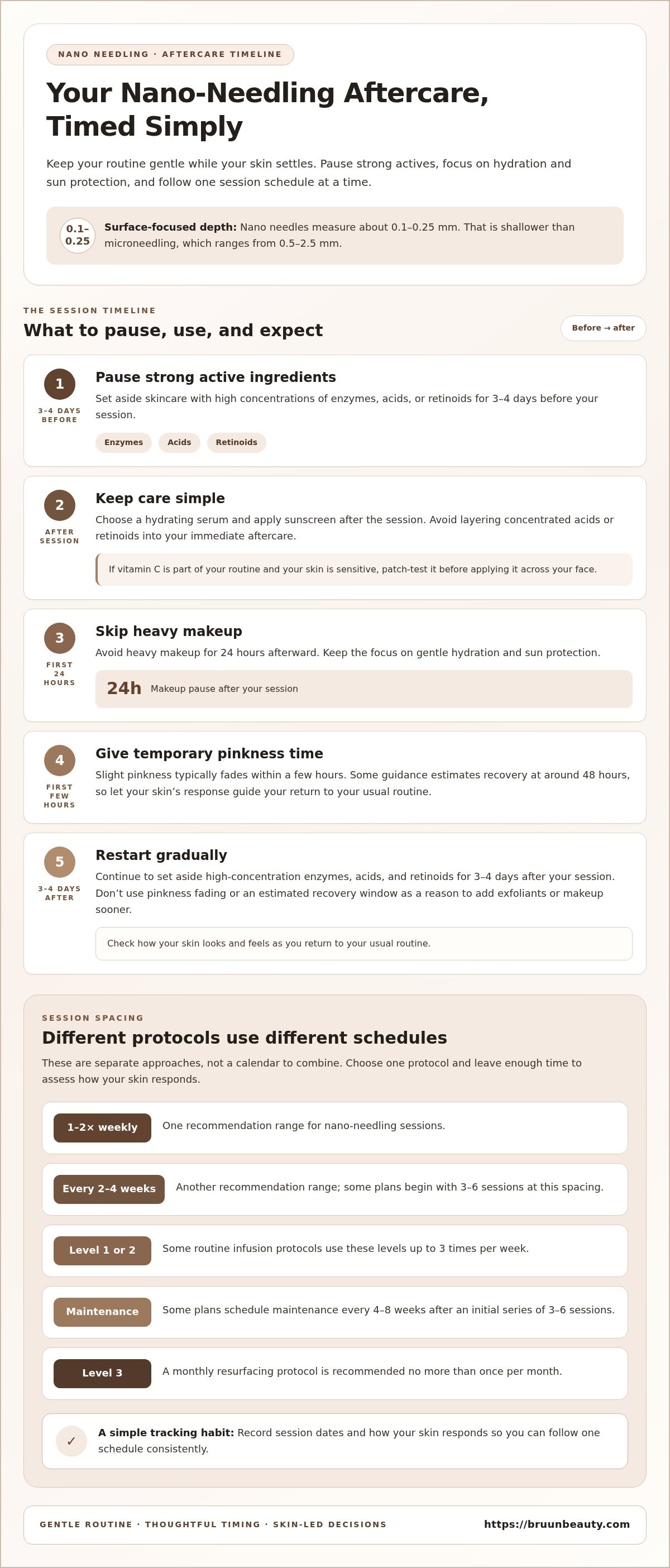
Don’t restart every product in your routine immediately after nano needling. Keep your aftercare simple: use a hydrating serum, avoid strong active ingredients, and apply sunscreen after your session. This prioritizes comfort and sun protection while your skin settles.
Use these practical timing points to plan your routine:
- Set aside skincare with high concentrations of enzymes, acids, or retinoids for 3-4 days before and after nano needling.
- Avoid heavy makeup for 24 hours afterward.
- Apply sunscreen after the session to protect your skin from UV damage.
Slight pinkness typically fades within a few hours, while some guidance estimates recovery at around 48 hours. Those timeframes describe different aspects of the skin’s response, so don’t use them as a reason to add exfoliants or makeup sooner. Pay attention to how your skin looks and feels as you return to your usual routine.
Frequency depends on the protocol and your skin’s response. Recommendations range from one to two sessions a week to every 2-4 weeks, while some routine infusion protocols use Level 1 or 2 up to three times per week. These schedules describe different approaches, not a single calendar to combine. Choose one protocol and leave enough time to assess your skin between sessions.
Some plans begin with 3 to 6 sessions spaced every 2 to 4 weeks, then schedule maintenance every 4 to 8 weeks. A Level 3 monthly resurfacing protocol is recommended no more than once per month. Keep a simple record of your session dates and how your skin responds; that makes it easier to follow one schedule consistently.
Your routine may also include the neck, jawline, or décolleté when addressing visible texture or dullness in those areas. Skin can feel different across these zones, so use controlled passes and avoid irritated or broken skin. Follow the chosen protocol for serum use and aftercare instead of automatically extending facial settings to other areas.
Choose a hydrating serum suited to the procedure. Peptides and Salmon DNA/PDRN are examples of ingredients found in microneedling serums, but the product’s intended use matters. Don’t layer concentrated acids or retinoids into your immediate aftercare. If vitamin C is part of your routine and your skin is sensitive, patch-test it before applying it across your face.
What skin concerns does nano-needling address?
Nano needling may improve the appearance of rough texture, dullness, and fine lines, while supporting a temporarily hydrated look. Changes may be noticeable within a few days to a week, but how long they last depends on your routine and maintenance schedule.
Skin Hydration
Nano needling may help a hydrating serum spread across the skin’s surface. Hydration matters because dry, tight-looking skin can make rough texture and fine lines more noticeable. Choose a simple serum with hydrating ingredients, then avoid layering strong actives immediately afterward. The goal is comfortable, supple-looking skin, not a promise of lasting moisture from one session.
Sensitive and Redness-Prone Skin
Sensitive skin can react to friction, strong ingredients, or changes in routine, so a gentler approach matters. Nano needling is associated with less downtime than microneedling, but that doesn’t make it suitable for every redness-prone complexion. Avoid working over a rash, infection, or irritated area. If you have a significant skin concern, consider discussing nano needling with a qualified skincare professional before proceeding.
Skin type and tone both matter when choosing a procedure, but they’re not the only considerations. Nano needling is described as suitable for all skin types, yet your current skin condition still affects whether it makes sense. If you have a history of sensitivity, keep your routine simple and pay attention to how your skin responds after each session.
When considering different skin tones, focus on the concern and the method rather than assuming one approach suits everyone. Uneven texture, dullness, and fine lines may be appropriate appearance goals to discuss. Hyperpigmentation is more complex: nano needling shouldn’t be presented as a reliable way to address every type of discoloration. The cause, depth, and pattern of pigment affect which approach is appropriate.
Set realistic expectations for visible changes. Skin may look brighter and more hydrated within a few days to a week, while texture and fine lines can change more gradually. One session can’t establish how long results will last; your skincare habits and the spacing of future sessions also influence the appearance.
Nano needling also has limits. It isn’t designed to address every concern, including deeper acne scars or pronounced skin changes that need a different approach. Collagen production has been studied with needles of 0.50 mm or larger, so don’t assume a superficial nano procedure has the same collagen-related effect. For product and device options that fit this topic, explore microneedling tools and serums.
What’s the difference between microneedling and nano needling?
Nano needling creates much smaller channels near the skin’s surface, while microneedling reaches deeper. Nano needles measure about 0.1 mm to 0.25 mm; microneedling depths range from 0.5 mm to 2.5 mm.
Both methods use a device that moves across the skin, but the difference in depth changes the experience and the concerns each may suit. That distinction matters when choosing between a surface-focused session and a deeper procedure.
Nano needling uses a tip with microscopic silicone pyramids to create thousands of tiny pathways across the outer skin layer. These channels are much smaller than those created by traditional microneedling. Nano needling doesn’t puncture the skin in the same way as deeper needles, so it’s often chosen for a surface-focused approach.
Microneedling uses fine needles that enter the skin more deeply. Common needle lengths are 1.5 mm to 2.0 mm, although professional devices can span a wider range. Deeper settings change how the skin responds and call for a different protocol than nano needling.
- Depth: Nano needling works near the surface; microneedling reaches deeper layers.
- Channels: Nano creates smaller pathways, while microneedling creates deeper channels.
- Downtime: Nano needling is associated with zero downtime, while microneedling can involve a few days of downtime.
- Frequency: Nano sessions can be spaced more frequently than microneedling sessions.
That difference helps guide your choice. Nano needling may suit goals such as a brighter appearance, smoother-looking texture, or temporary serum infusion. Microneedling is more often considered for concerns that call for deeper stimulation, such as deeper acne scars. Needle depth should match your goal, not simply your desire for a stronger sensation.
Skin tone alone doesn’t determine which method is appropriate. Your specific concern, skin condition, and the planned depth all matter. Because microneedling reaches deeper, its settings and approach differ from those of a surface-focused nano session. Don’t assume the methods produce identical results or have the same recovery needs.
For at-home use, the device and cartridge must match the intended technique. A nano cartridge isn’t interchangeable with a microneedling cartridge, and a device’s depth setting should follow its directions. Don’t increase needle depth to imitate a different procedure. That changes the method, the skin response, and the aftercare required.
In short, nano needling prioritizes smaller, shallower channels and more frequent sessions. Microneedling uses longer needles and reaches deeper, making it a distinct option for different concerns. Knowing that difference helps you choose a method based on your skin goals rather than treating the names as interchangeable.
Serum absorption
Nano needling is often discussed as a way to improve topical skincare absorption, but published estimates use different comparisons. Some describe absorption increasing by up to 97% when a product is applied during the procedure. Other estimates describe a 40-50% increase compared with traditional topical routines, where absorption is described as 2-10%. These figures aren’t interchangeable because their comparison methods differ.
That distinction matters when interpreting a serum’s performance. An absorption estimate doesn’t mean every ingredient reaches the same skin layer or produces a particular visible result. It describes product uptake, not a guaranteed change in firmness, pigmentation, or wrinkles. Keep your skincare goal separate from the mechanism.
A product’s formula also influences how it behaves on skin. Its texture, ingredient combination, and intended application all affect how it spreads and settles. Don’t automatically treat a product made for ordinary topical use as suitable during a device procedure. Read the directions and choose a formula intended for that context.
Choose ingredients based on the concern you want to focus on, not the assumption that stronger is better. A professional might select a serum for a specific goal, such as improving the appearance of uneven tone or supporting a smoother-looking surface. The formula should suit both the procedure and the person’s skin condition.
- Check intended use: Use a serum according to its label and directions.
- Keep the goal specific: Choose ingredients for one skin concern instead of layering several formulas.
- Assess the whole formula: Consider the product’s texture and ingredient combination, not just one highlighted ingredient.
The reported figure of up to 40% lost through failed absorption also needs context. It doesn’t mean that 40% of every serum disappears or that nano needling recovers that amount. It’s a broad estimate about absorption, not a measurement of an individual session or a specific product.
Think of nano needling as a method that can alter topical product uptake, not as a way to make every skincare product more effective. Concentration, formulation, and intended use still guide product choice. A considered serum pairing keeps the procedure focused and helps you evaluate results without confusing absorption estimates with promises about your skin.
How nano needling works
A nano-needling facial pairs a purpose-designed device tip with topical skincare. The provider moves the tip across selected facial areas in a controlled pattern, maintaining even contact rather than pressing harder to chase a stronger effect.
The tip’s microscopic silicone pyramids create many tiny pathways across the outer skin surface. This helps explain the term nano-infusion: the device and topical product are used together during the same session. It’s a surface-focused process, not a substitute for deeper procedures.
A well-organized session follows a clear sequence:
- Cleanse the face and remove makeup, oil, or other residue.
- Choose the area and serum based on the appearance goal, such as dullness or uneven texture.
- Move the device in controlled passes over the selected area, without adding unnecessary pressure.
- Discard the cartridge after the session, then follow the device’s cleaning and storage directions.
Planning the treatment area helps make each pass deliberate. For example, a provider may work across the forehead, cheeks, and chin, then address the jawline separately. Delicate areas need careful handling, and the device shouldn’t be dragged across irritated or broken skin.
Choose a serum for the intended procedure, not just a desired result such as less-visible pigmentation or wrinkles. The product’s ingredients and directions determine whether it belongs in that session. Apply it carefully, and don’t assume that using more product or making extra passes improves the outcome.
Device setup matters, too. Use a cartridge designed for the specific device, and follow the device’s instructions for installation and operation. Don’t reuse a cartridge between sessions. Careful handling helps keep the procedure consistent and prevents treating a disposable component as reusable.
Nano-needling terminology can vary, so focus on what the method does: a specialized tip creates superficial pathways as the operator works across the chosen area. The goal may be a fresher-looking face or smoother-looking skin. Deeper concerns, including pronounced scarring, call for a different approach, not more pressure or repeated passes.
Bruun Beauty: Advanced Microneedling Serum SD - Control Salmon DNA Ampoule Serum
Advanced Microneedling Serum SD - Control Salmon DNA Ampoule Serum is one option for routines intended for microneedling. Nano needling and microneedling differ in depth, so don’t assume that a serum designed for microneedling suits every nano-needling protocol. Match your product choice to the device directions and planned skincare routine.
For a simple post-session routine, focus on gentle hydration and avoid adding strong active ingredients too soon. The serum’s name identifies its Salmon DNA ampoule focus; review the product details when considering it for your routine. Bruun Beauty also offers Jelly Mask Kits and BB Glow Treatment Supplies for other skincare routines.
Explore Bruun Beauty’s skincare products to find options for your routine.
Choose a Routine That Fits Your Skin Goals
Consider the benefits of nano needling for the face alongside your specific skin goals and the routine you can maintain. Before your next session, decide what you want to focus on, then choose gentle aftercare that supports that goal without adding unnecessary active ingredients.
Bruun Beauty offers Advanced Microneedling Serum SD - Control Salmon DNA Ampoule Serum, professional microneedling devices, and Jelly Mask Kits for skincare routines. Match any serum or device to its intended use and directions, especially because nano needling and microneedling differ in depth.
Explore Bruun Beauty’s skincare options and choose products suited to your routine.
A considered approach helps keep your skincare routine focused as you work toward a fresh, nourished-looking complexion.
Frequently Asked Questions
Who Is the Ideal Candidate for Nano-Needling?
Nano needling may suit someone focused on the appearance of mild texture, dullness, or fine lines rather than deeper scarring. It isn’t recommended for people with scleroderma, undiagnosed lesions, rashes, skin infections, a recent herpes episode, severe acne or rosacea, diabetes or other autoimmune disorders, or those undergoing cancer treatment. Your skin’s current condition matters as much as your long-term cosmetic goal.
What is Nanoneedling?
Nanoneedling is a surface-focused procedure that uses a specialized tip to create tiny pathways across the outer skin layer. Unlike deeper microneedling, nano needling doesn’t puncture the skin in the same way. Think of it as pairing a gentle device pass with topical skincare, not as a substitute for procedures aimed at deeper concerns.
Can you wear makeup after nano needling?
Avoid heavy makeup for 24 hours after a nano-needling session. If you have an event coming up, plan the session far enough ahead to leave that makeup-free period clear. Remove makeup before your appointment or at-home session, too, so your face is clean before the device touches your skin. Follow the aftercare directions for your specific procedure.
Is nano needling good for acne scars?
Nano needling is not designed to address deeper acne scars because it works near the skin’s surface. Deeper acne scars usually require needle depths of 0.50 mm to 1.50 mm to get results, which is a different approach. Don’t increase a nano device’s depth to pursue scars; the selected method and depth need to match the concern.
What are the benefits of nano needling for facial skin?
The benefits of nano needling for the face may include a brighter-looking complexion, smoother-looking texture, and temporary support for serum application. These are appearance-focused goals, not a promise that one session will change every concern. For example, someone seeking a refreshed surface appearance has a different goal from someone looking to address deep scarring or pronounced discoloration.
What skin concerns can nano needling improve?
Nano needling may improve the appearance of rough or uneven texture, dullness, and fine lines. Skin may look brighter and more hydrated within a few days to a week. Hyperpigmentation has different causes and patterns, so don’t assume a surface-focused procedure addresses every type. Deep acne scarring and significant skin changes may call for a different approach.
How many nano needling sessions are recommended and how far apart?
Some protocols use an initial series of 3 to 6 sessions, spaced every 2 to 4 weeks, followed by maintenance every 4 to 8 weeks. Other schedules use more frequent sessions for routine infusion, so don’t combine protocols or assume one schedule applies to every device. The planned depth, goal, and skin response shape the spacing.
What happens during a nano needling facial, and how should you prepare?
A nano-needling facial typically takes 30-60 minutes, depending on the areas covered. The face is cleansed, a suitable serum is applied, and the device is moved over selected areas. Set aside concentrated enzymes, acids, and high-dose retinoids for 3-4 days before the session. Use a fresh cartridge for each session, then discard it afterward.
What Serum to Use With Dr. Pen: The Professional Guide to Flawless Results
What Serum to Use With Dr. Pen: The Professional Guide to Flawless Results
Related Posts

Consistent Microneedling and the Long-Term Changes to Expect

Aftercare choices to lower infection risk at home after microneedling

How to Create a Relaxing At-Home Spa Day With Simple Rituals

Sunscreen Recommendations After Microneedling: How to Protect Healing Skin

Investing in my skin for the future: what deserves my budget

Post-microneedling skincare routine for masks, makeup, and recovery

Skin Peeling After Microneedling: What to Avoid and When to Resume Makeup
